

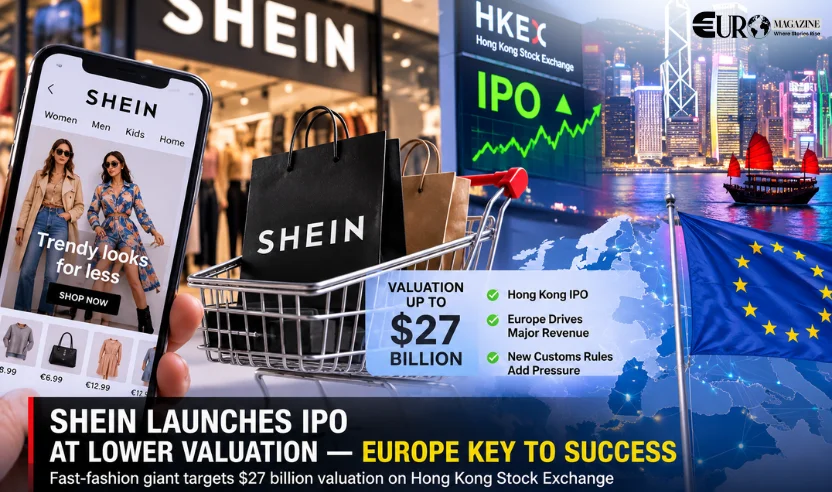
Shein is preparing for one of the most closely watched retail listings of the year, but the fast-fashion company will enter the public market carrying a valuation far below the level it commanded during the height of its global expansion.
The Singapore-headquartered retailer launched its Hong Kong initial public offering on August 24, seeking to raise as much as HK$13.86 billion, or about $1.77 billion. The company is offering around 280 million shares at HK$47.60 to HK$49.50 each, putting its valuation close to $27 billion at the upper end of the range. Trading is expected to begin on the Hong Kong Stock Exchange on September 1.
That figure represents a dramatic reset for a company once valued at almost $100 billion in 2022. Four years later, Shein faces a different commercial environment, marked by slower growth, tighter import rules, greater regulatory scrutiny and strong competition across global e-commerce.
A Much Lower Price Tag for Shein
Shein's rise was built on a model that combined low prices, rapid production cycles and data-driven decisions about what consumers were buying.
The company became particularly prominent during the pandemic, when online shopping accelerated and social media platforms helped turn inexpensive fashion products into viral purchases.
Its current IPO valuation shows how investor expectations have changed since then.
Shein had already seen its private valuation fall after 2022, but the Hong Kong offering places an even clearer public-market price on the business. Investors are now weighing the company's enormous international reach against pressure on margins and uncertainty over whether its earlier growth rates can be repeated.
The company plans to use IPO proceeds for technology, brand development and international expansion. A significant share of the money is expected to support marketing and its global presence, including building local sales and marketing teams in important overseas markets.
Europe Has Become Too Important to Ignore
Europe will play a major role in determining whether those investments pay off.
The European Union and United Kingdom generated about $14.8 billion in revenue for Shein in 2025, representing 35.4% of the company's worldwide revenue, according to figures disclosed in its filing.
That makes Europe one of Shein's most important commercial regions.
The company also averaged roughly 156 million monthly users in the European Union between August 2025 and January 2026, although that figure includes visitors who did not necessarily make purchases.
Scale, however, brings exposure.
European policymakers have become increasingly concerned about the rapid expansion of low-value e-commerce imports. Rules that once helped international online platforms ship inexpensive products directly to shoppers are being tightened, raising the cost of a business model heavily dependent on cross-border fulfilment.
New EU Customs Rules Challenge the Low-Price Model
One of the most significant changes took effect on July 1, 2026, when the European Union abolished its customs-duty exemption for e-commerce consignments worth up to €150.
A temporary €3 customs duty per item now applies to eligible low-value imports and is scheduled to remain in place until July 2028. The European Commission says the measure is intended to create fairer conditions for European businesses and strengthen oversight of the enormous number of low-value products entering the bloc.
For Shein, the issue goes directly to the economics of its business.
Much of its appeal has traditionally come from making fashionable clothing available at exceptionally low prices. Additional duties, handling expenses and compliance costs leave the company with several choices: absorb more of the expense, raise consumer prices or shift more inventory closer to customers.
Each carries consequences.
Taking the cost itself could pressure margins, while passing it on to customers risks weakening one of Shein's clearest competitive advantages.
Shein has indicated that its response could include selective price increases, greater use of European inventory, additional local fulfilment capacity and stronger trade-compliance systems.
The company already operates warehouses in Europe, but its wider supply network remains strongly tied to China.
Regulatory Pressure Extends Beyond Customs
Customs rules are only one part of Shein's European challenge.
In February, the European Commission opened formal proceedings against Shein under the Digital Services Act, examining areas including the sale of illegal products, potentially addictive platform features and transparency around its recommendation systems.
The investigation adds another layer of regulatory risk for a company whose technology and recommendation systems are central to the way shoppers interact with its platform.
France has also taken a particularly tough stance toward ultra-fast fashion.
Shein's growing visibility in the country was highlighted when it moved beyond temporary pop-up locations and opened a permanent retail presence at Paris department store BHV Marais in November 2025.
The expansion gave Shein greater physical visibility in one of Europe's major fashion capitals, but it also intensified debate among politicians, retailers and industry groups over the impact of ultra-low-cost fashion on domestic businesses and the environment.
Financial Performance Adds to Investor Questions
Shein remains a sizeable and profitable company on an annual basis, but recent results show why investors are approaching the flotation differently from the private-market enthusiasm seen several years ago.
The retailer generated approximately $41.85 billion in revenue in 2025, while annual net profit fell to around $2.06 billion.
More recently, it recorded a $99 million net loss in the first quarter of 2026, compared with a profit in the same period a year earlier. The deterioration came as the company faced weaker US performance, changes to low-value import treatment and a sizeable accounting charge.
These figures do not erase Shein's scale, but they make future profitability more important to the investment case.
The company is also competing in a crowded global online retail environment. Temu has emerged as a direct challenger in value-driven e-commerce, while traditional fashion groups and larger online marketplaces continue to strengthen their digital operations.
Speed Remains Shein's Biggest Strength
Despite the risks surrounding the IPO, Shein still possesses an advantage few traditional retailers have been able to match: speed.
Its supply system uses customer and sales data to identify demand, introduce products in relatively small quantities and increase production quickly when particular designs perform well.
This reduces the need to place enormous inventory bets months in advance.
Shein says popular products can be replenished within days, while its international customer base gives it a large pool of real-time purchasing data.
The company is also expanding its marketplace model, allowing third-party merchants and brands to sell through its platform. If successful, that strategy could help Shein move beyond its traditional fashion categories and generate growth without relying entirely on products sourced through its original supply structure.
Investors Face a Very Different Shein
The upcoming flotation presents investors with two sharply different views of the company.
One is a retailer whose valuation has fallen by roughly 70% from its private-market peak, whose margins face pressure and whose low-cost international shipping model is being challenged by governments in major markets.
The other is a global e-commerce platform with hundreds of millions of customers, a highly responsive supply chain and substantial room to develop its marketplace and local operations.
Its reduced IPO valuation may attract investors who believe much of the regulatory and financial risk is already reflected in the price.
But the company's ability to justify that valuation after listing will depend on more than selling inexpensive clothing at enormous scale.
Shein will have to show that it can adapt its supply chain, protect profitability, satisfy regulators and continue attracting consumers even as the true cost of delivering ultra-low-priced products rises.
Europe may be where that test becomes clearest.
With the region accounting for more than a third of Shein's disclosed global revenue, even modest changes in European demand or operating margins could have a meaningful impact on the company's overall results.
As Shein approaches its planned September 1 Hong Kong market debut, investors will therefore be watching not only the opening share price, but also whether one of the world's biggest fast-fashion businesses can successfully reshape the model that made it famous.
Read more news:-




























Comments
Be the first to share your thoughts.
Leave a comment
Join the conversation. Your email address will not be published.