

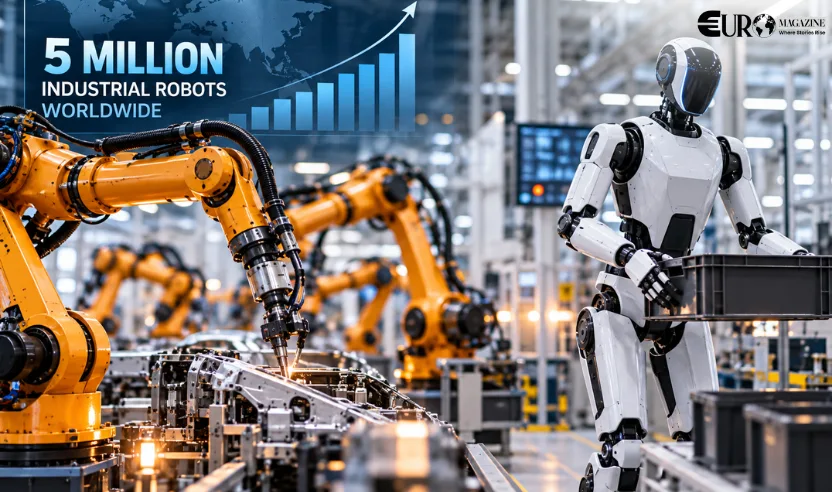
More than five million industrial robots are now operating in factories around the world, highlighting how automation has become a mainstream part of manufacturing even as the newer humanoid-robot industry works to prove its commercial potential.
The global operational stock of industrial robots reached about 5.08 million units in 2025, up 9% from the previous year, according to the International Federation of Robotics (IFR). Factories installed a record 603,000 new industrial robots, an 11% increase.
China Leads Global Robot Adoption
China continues to dominate industrial robot installations. Factories there installed around 354,000 robots in 2025, up 20% year-on-year and accounting for 59% of global installations.
The United States ranked second, with almost 38,500 installations, an increase of 12%. Europe is expanding more slowly, with the EU's operational stock reaching 712,000 robots in 2025, although new installations fell 11% to about 60,500.
The figures show that manufacturers are continuing to invest heavily in proven automation technologies, particularly machines designed for specific and repetitive industrial tasks.
Humanoids Remain a Much Smaller Market
The rapid growth of industrial robots contrasts with the relatively small scale of the humanoid-robot market.
The IFR estimates that only around 7,000 humanoid robots were sold globally for industrial and professional applications in 2025. Many were used for training and experimentation rather than large-scale production, while automakers testing humanoids generally operated only a small number of machines.
That leaves a significant gap between the millions of conventional industrial robots already working in factories and the much smaller number of humanoids moving from demonstrations into real production environments.
Companies Are Still Testing Humanoids
Major companies continue to invest in humanoid technology, particularly for manufacturing and logistics.
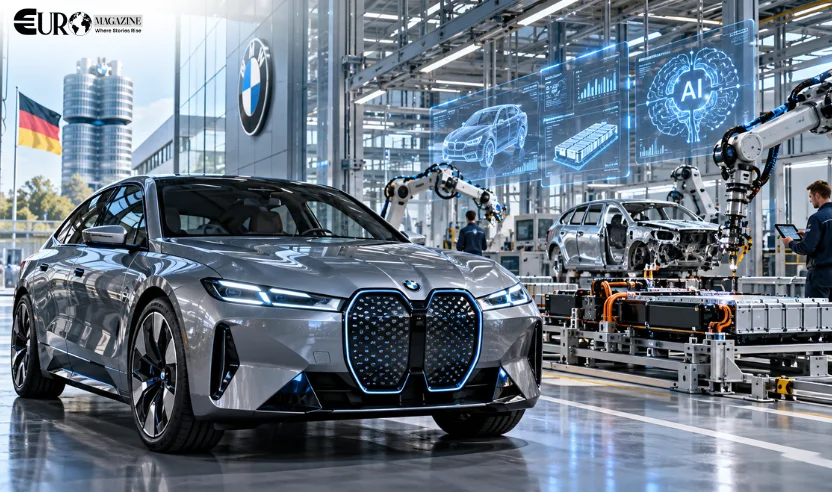
BMW is deploying a humanoid robot in vehicle and battery production, while Siemens has tested robots for logistics-related tasks at its Erlangen facility. At the same time, Boston Dynamics, owned by Hyundai Motor Group, has yet to deploy its Atlas humanoid at scale and remains unprofitable, making a planned 2027 stock-market listing unlikely, according to a Hyundai executive.
The developments suggest that companies remain interested in humanoids but are still evaluating where the machines can deliver reliable economic value.
Investors Are Becoming More Cautious
The commercial challenge is also appearing in financial markets.
In China, regulators have reportedly slowed the rush of humanoid-robot companies seeking stock-market listings after volatile trading in companies such as Unitree. Reuters reported that Chinese regulators have been scrutinising whether some companies' valuations and projected revenues are supported by genuine commercial demand.
The issue is not a lack of interest in robotics. Instead, investors and manufacturers are increasingly looking for evidence that humanoids can be produced at scale, operate reliably and generate returns beyond demonstrations and pilot projects.
Specialised Robots Still Have an Advantage
For many factories, traditional robotic arms, mobile robots and other specialised machines remain easier to deploy because they are designed for specific tasks and controlled environments.
An analysis cited by Euronews argues that specialised physical AI could capture more near-term value than humanoid robots because factories and warehouses offer structured environments where existing automation systems can be scaled more easily.
Humanoid robots could eventually be useful for jobs designed around human environments, but challenges remain around reliability, dexterity, autonomy, production costs and practical use cases.
The Robotics Race Is Moving Into Its Next Phase
The latest data show that industrial automation is already operating at enormous scale, with the global robot workforce now larger than ever.
Humanoids remain one of the most closely watched areas of robotics, but their next challenge is moving beyond high-profile demonstrations and limited pilot programmes into dependable, repeatable commercial deployments.
For now, the numbers suggest that the biggest robotics story is not the arrival of humanoids in large numbers, but the continued expansion of machines that manufacturers have already proven they can use at scale.
Read more news:-





























Comments
Be the first to share your thoughts.
Leave a comment
Join the conversation. Your email address will not be published.