

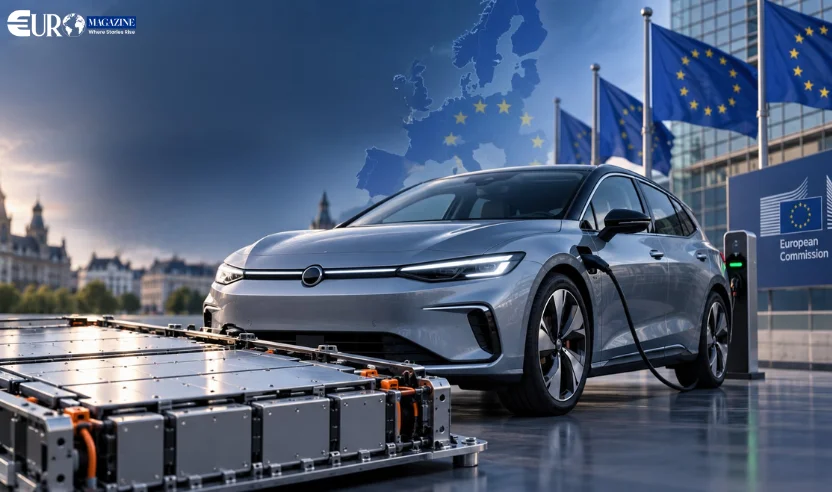
Proposed European Union rules requiring greater use of locally made components in electric vehicles could add around €2,100 to the price of a typical electric car, according to a new analysis from Brussels-based economic think tank Bruegel.
The report argues that the EU's push to strengthen domestic supply chains and reduce dependence on foreign producers, particularly China, could increase manufacturing costs for electric vehicles. It says consumers and taxpayers could ultimately bear part of the cost of policies designed to rebuild Europe's industrial base.
Battery Rules at the Centre of the Debate
The biggest potential increase comes from proposed requirements for European-made battery cells.
Bruegel estimates that forcing battery cells to be produced in the EU could increase their cost from around €50 to €85 per kilowatt-hour. For a typical electric vehicle, the think tank calculates that this would add approximately €2,100 to the vehicle's production cost.
The analysis is part of a broader debate over whether Europe should prioritise cheaper global supply chains or build more resilient domestic manufacturing capacity.
The European Commission has already launched measures to strengthen European battery production, including a €1.5 billion Battery Booster Facility offering interest-free loans to qualifying battery-cell manufacturing projects in the European Economic Area.
Other European Requirements Could Add to Costs
Battery cells are not the only area highlighted in the Bruegel analysis.
The report estimates that a proposed low-carbon steel requirement could add another €200 per electric vehicle. At the same time, a vehicle-approval simplification proposed by the European Commission could save manufacturers around €61 per car, according to the study.
The figures illustrate the trade-off facing European policymakers: measures designed to strengthen domestic production can increase costs, even when other reforms are intended to reduce them.
EU Wants Greater Industrial Independence
The proposed rules form part of the EU's Industrial Accelerator Act, introduced by the European Commission in March.
The legislation is intended to strengthen European industrial capacity, reduce strategic dependencies and encourage the use of European and low-carbon products in areas such as public procurement, public auctions and subsidy programmes. Strategic sectors covered by the proposal include electric vehicles, batteries, steel, aluminium, solar, wind, hydrogen and nuclear technologies.
For electric vehicles purchased through public procurement, the proposal would require vehicles to be assembled in the EU and have 70% of their components, excluding the battery, made in the EU once the relevant provisions take effect.
China Remains a Major Focus
Europe's effort to build domestic supply chains is closely connected to China's dominant position in several clean-technology industries.
Chinese manufacturers have become major suppliers of batteries, solar equipment and electric vehicles, while European automakers continue to rely on global supply chains for critical components.
Bruegel argues that Europe should give its manufacturers time to become more competitive rather than simply shielding them from foreign competition. The think tank says foreign investment should also be welcomed where it helps European companies develop manufacturing capacity and technological expertise.
Carmakers Warn of Supply Chain Pressure
European automakers have expressed concerns about policies that could disrupt their existing supply networks.
The industry's supply chains stretch across multiple countries, making it difficult to quickly replace components sourced from outside Europe. Earlier this month, European carmakers also raised concerns about proposed battery-origin rules affecting EU-UK electric vehicle trade, warning that the requirements could expose the industry to significant additional costs.
The debate comes as electric-vehicle demand in Europe is nevertheless growing. Battery-electric vehicles accounted for 30.5% of new-car sales across 16 key European markets in August, according to recent industry data, suggesting that affordability and supply-chain policy could become increasingly important as adoption expands.
Europe Faces a Cost Versus Resilience Debate
The central issue is becoming increasingly clear: European policymakers want stronger local production, but building those supply chains can be more expensive than relying on established international suppliers.
Bruegel describes this as a tension between the lower costs of global supply chains and the greater resilience of domestic production. It warns that putting too much emphasis on protection could make European electric cars more expensive, particularly for lower-income consumers.
At the same time, the European Commission argues that stronger domestic battery manufacturing is important for the region's industrial competitiveness and strategic independence.
Rules Are Still Being Negotiated
The €2,100 estimate is not a confirmed price increase for every electric vehicle. It is an estimate of the potential impact of a specific battery-cell requirement under the policy scenario examined by Bruegel.
The Industrial Accelerator Act remains a proposal and must still be agreed by EU governments and the European Parliament. Final provisions, implementation timelines and exemptions could therefore change before the legislation is adopted.
For Europe's automotive industry, the debate is likely to continue between the goals of reducing dependence on overseas suppliers and keeping electric vehicles affordable.
As Brussels works on its “Made in Europe” strategy, the price of batteries is becoming a key part of a much bigger question: how much should Europe pay to build a more self-reliant electric-car industry?
Read more news:-


























Comments
Be the first to share your thoughts.
Leave a comment
Join the conversation. Your email address will not be published.