

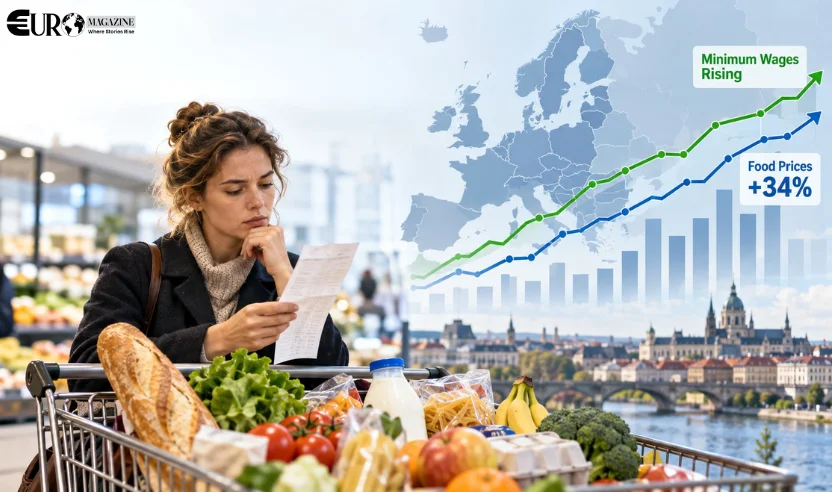
Food prices have climbed sharply across Europe over the past five years, but in most countries, minimum wages have risen fast enough to give low-paid workers greater purchasing power.
A new analysis by Euronews Business, based on Eurostat data, compared food prices and gross statutory minimum wages in 26 European countries between August 2021 and August 2026. The comparison found that workers on minimum wages could afford more food than five years ago in most of the countries studied.
Food Prices Rose 34% Across the EU
The cost of food and non-alcoholic beverages increased by 34% across the European Union between August 2021 and August 2026.
Hungary recorded the largest increase among EU countries, with food prices rising 57%, followed by Bulgaria at 54% and Romania at 53%. Cyprus saw the smallest increase, at 21%.
Among Europe's wider group of 35 countries, Switzerland recorded a much smaller 5% increase, while Turkey stood out with a 752% rise in food and non-alcoholic beverage prices.
Among Europe's largest economies, food prices rose by 25% in France, 30% in Italy, 34% in Germany and 35% in Spain over the same period.
Minimum Wages Rose Faster in Many Countries
Minimum wages also increased substantially, although the pace varied widely.
Within the EU, Hungary recorded the largest increase in its statutory minimum wage at 93% over five years. Germany's minimum wage rose 46%, while Spain recorded a 29% increase and France 20%.
Outside the EU, Turkey's minimum wage jumped 823%, while wages more than doubled in Serbia and Montenegro, rising 103% and 102%, respectively.
Eurostat's latest July 2026 data also shows the wide differences in statutory minimum wages across Europe, ranging from €620 a month in Bulgaria to €2,704 in Luxembourg. The figures are gross monthly wages and do not account for differences in taxes or living costs.
Malta, Spain and France Lost Food Purchasing Power
Higher wages did not translate into greater food-buying power everywhere.
In three of the 26 countries studied, minimum-wage workers could afford less food than they could in August 2021. Malta recorded the largest decline, with food purchasing power falling by about 6%.
Spain followed with a 5% decline, while France recorded a 4% fall. In other words, although minimum wages increased in these countries, food prices rose enough to erode the amount of groceries a minimum-wage salary could buy.
The comparison measures what a gross monthly minimum wage could purchase at the two points in time. It does not show how much workers actually have available for food after rent, taxes, utilities and other household costs.
Serbia and Montenegro See Large Gains
At the other end of the comparison, Serbia and Montenegro recorded the biggest increases in food purchasing power, with minimum-wage earnings able to buy about 37% more food than in 2021.
Croatia, Albania, Romania, Hungary, Bulgaria and Lithuania also recorded increases of more than 20%.
Food purchasing power increased by 10% in Ireland, 9% in Germany, 7% in Greece, 6% in Belgium and the Netherlands, and 3% in Portugal.
Turkey Shows Why Inflation Matters
Turkey presents a different picture because both food prices and wages increased at exceptionally high rates.
Between August 2021 and August 2026, the Turkish minimum wage increased 823%, compared with a 752% increase in food prices. Despite the enormous gap in nominal terms, the increase in actual food purchasing power was around 8%.
The comparison highlights why simply subtracting food-price inflation from wage growth can give a misleading impression when inflation is extremely high. Looking at how much food a salary can actually buy provides a clearer measure of purchasing power.
What the Numbers Mean for European Workers
The figures show that rising wages have offset some of the pressure from higher food costs for minimum-wage workers across much of Europe. But the experience differs significantly between countries.
For workers in Malta, Spain and France, food costs have risen faster relative to minimum wages since 2021. Elsewhere, particularly in parts of Central and Southeastern Europe, wage growth has outpaced food inflation by a wider margin.
The comparison also comes with an important limitation: food affordability is only one part of household purchasing power. Housing, energy, transport, taxes and other essential expenses can significantly change how far a minimum wage stretches in everyday life.
Read more news:-


























Comments
Be the first to share your thoughts.
Leave a comment
Join the conversation. Your email address will not be published.