

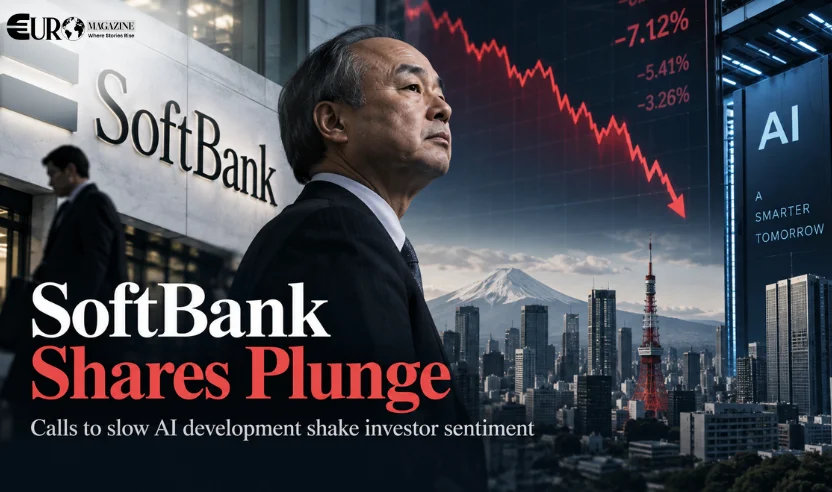
SoftBank Group shares plunged more than 10% on Monday as investors reacted to growing calls from leading artificial intelligence executives to slow the development of increasingly powerful AI systems
The Japanese investment giant, which has substantial exposure to the AI industry and is a major investor in OpenAI, became one of the biggest casualties of a global selloff in AI-linked stocks. The decline reflected growing concerns that a slower pace of AI development could eventually reduce demand for the enormous computing infrastructure and investment currently driving the sector.
SoftBank’s AI Exposure Comes Under Pressure
SoftBank has positioned itself as one of the world's major investors in artificial intelligence.
Its exposure to OpenAI has made the company particularly sensitive to developments surrounding the AI industry. Investors have also increasingly viewed SoftBank as a way to gain exposure to the broader AI boom, making its stock vulnerable when sentiment toward the sector changes.
On Monday, SoftBank shares fell by more than 10%, with other AI-related companies across Asia also recording sharp losses. The decline came as investors reconsidered whether the rapid expansion of AI spending can continue at its current pace.
AI Leaders Call for Greater Caution
The latest market shock followed warnings from executives at several major AI companies.
Anthropic CEO Dario Amodei has called for companies to “pace the frontier” of AI development, arguing that safety measures need to keep up with increasingly capable systems. OpenAI CEO Sam Altman and xAI founder Elon Musk have also expressed support for greater caution around the development of advanced AI.
Their comments have shifted some of the industry's focus away from rapid commercial expansion and toward questions about safety, oversight and potential misuse.
Investors Fear a Slower AI Spending Cycle
The immediate concern for financial markets is not necessarily that AI development will stop, but that spending could slow.
The AI boom has fueled enormous investment in data centres, advanced processors, memory chips and power infrastructure. Companies across the technology supply chain have benefited from expectations that AI firms will continue expanding computing capacity at a rapid pace.
A slowdown in model development could therefore have knock-on effects across the industry. Chipmakers and equipment suppliers were among the hardest hit in Monday's selloff, with investors reassessing the growth assumptions behind their valuations.
Asian Technology Shares Feel the Shock
SoftBank was not alone in facing heavy selling pressure.
Japan's Kioxia and Tokyo Electron, South Korea's SK Hynix and Samsung Electronics, and Taiwan Semiconductor Manufacturing Co. all declined as investors reduced exposure to companies closely connected to the AI infrastructure boom.
The move highlights how deeply AI expectations have become embedded in Asian equity markets. Semiconductor companies in particular have enjoyed strong gains as demand for processors and high-bandwidth memory surged.
OpenAI’s Future Adds to Uncertainty
Concerns around OpenAI are especially important for SoftBank.
Altman has indicated that OpenAI's planned public offering could be delayed until 2027, while the company continues to address safety concerns surrounding increasingly powerful AI systems. That uncertainty has added another challenge for investors assessing SoftBank's large AI-related commitments.
For SoftBank, a successful expansion of the AI industry could generate significant returns from its portfolio. But any slowdown in investment or weaker valuations could have the opposite effect.
Political Debate Adds Another Layer
The debate over AI development is also moving beyond technology companies.
U.S. President Donald Trump has pushed back against calls for a broad slowdown, arguing that excessive restrictions could undermine America's position in the global technology race and benefit China. At the same time, lawmakers and regulators are considering stronger safeguards for advanced AI systems.
That creates a difficult environment for investors because the future of AI regulation remains uncertain. Companies want to continue investing aggressively, while governments and safety experts are increasingly focused on potential risks.
AI Boom Faces a New Market Test
SoftBank's sharp decline shows how quickly investor sentiment can change when expectations surrounding AI are challenged.
The broader AI story remains intact, with companies still spending heavily on computing capacity and developing new models. But investors are beginning to ask whether the extraordinary pace of spending can continue indefinitely and whether the financial returns will justify the enormous capital being committed.
The Bank for International Settlements has also warned that the AI-driven stock-market momentum is showing signs of vulnerability, particularly as technology companies take on more debt to finance their expansion.
SoftBank’s AI Bet Enters a More Uncertain Phase
For SoftBank, the selloff is a reminder of both the opportunity and risk created by its aggressive AI strategy.
The company has built much of its recent investment narrative around artificial intelligence, from OpenAI to data-centre and infrastructure projects. If AI adoption continues at its current pace, those investments could deliver substantial returns.
But if development slows because of safety concerns, regulation or changing economics, investors may demand a much more cautious valuation.
Monday's plunge therefore represents more than a one-day decline for SoftBank. It signals that the market is beginning to question whether the AI race can continue at full speed and how much investors are willing to pay for that growth.
Read more news:-































Comments
Be the first to share your thoughts.
Leave a comment
Join the conversation. Your email address will not be published.