

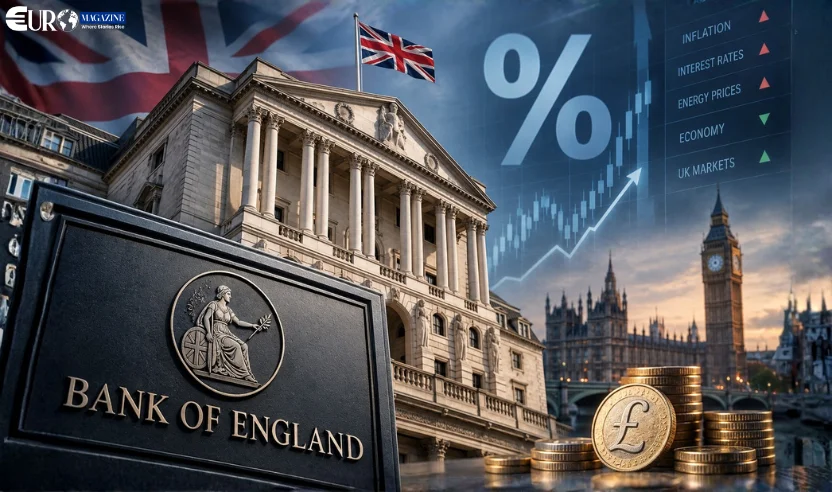
The Bank of England has kept its benchmark interest rate at 3.75%, but a divided vote and rising inflation risks have signalled that the central bank may face renewed pressure to tighten monetary policy in the months ahead.
The Monetary Policy Committee voted 6-3 to leave rates unchanged at its September meeting. Three policymakers, including Chief Economist Huw Pill, voted for a quarter-point increase to 4%. The decision came after UK inflation accelerated to a five-month high of 3.1% in August, up from 2.9% in July.
Inflation Moves Further Above the Target
The latest inflation figures have complicated the Bank's efforts to bring price growth back to its 2% target.
According to the Office for National Statistics, consumer prices rose 0.5% in August compared with July, with transport costs, particularly petrol and diesel, making the biggest contribution to the increase. Core CPI inflation, which excludes energy, food, alcohol and tobacco, remained at 2.6%, while services inflation held at 3.4%.
The increase in headline inflation has largely been connected to higher energy costs, rather than a broad acceleration across the entire economy.
Middle East Conflict Adds to Energy Pressure
The Bank of England said the prolonged conflict in the Middle East has pushed crude oil and refined energy prices significantly higher since its previous meeting.
The Bank noted that Brent crude had risen 36% from the period used in its July assessment, while UK wholesale gas prices had climbed 78%. At the close of trading on September 14, Brent was around $106 a barrel.
Higher energy prices could feed into transportation, food production and other business costs. The Bank said the risk of so-called second-round effects, where higher costs become embedded in wages and prices, increases the longer the energy shock continues.
Policymakers Are Divided
The 6-3 vote reveals a noticeable split within the Monetary Policy Committee.
Governor Andrew Bailey backed keeping rates at 3.75% but warned that prolonged Middle East tensions and the emergence of second-round inflation effects could require tighter policy.
Deputy Governor Clare Lombardelli said the case for raising rates was building the longer the conflict continued, while Sarah Breeden also highlighted the risk of inflation becoming more persistent.
On the other side, external member Swati Dhingra argued that financial conditions had already tightened considerably and that domestic demand remained subdued. She supported waiting for clearer evidence about the scale and duration of the energy shock.
The three members who voted for a hike argued that acting earlier could help prevent inflation from becoming more deeply embedded in the economy.
Inflation Could Rise Above 4%
The Bank's latest outlook suggests that the inflation problem may become more difficult before it improves.
Reuters reported that the Bank expects inflation to exceed 4% in early 2027, significantly higher than its previous peak forecast of 3.2%. The central bank nevertheless expects inflation to eventually return toward its 2% target as the energy shock fades and tighter financial conditions weigh on demand.
That creates a difficult environment for policymakers. Raising interest rates could help contain persistent price pressures, but doing so also risks weakening economic activity at a time when household and business finances are already under pressure.
Government Bonds Get a Boost
Alongside the rate decision, the Bank of England announced a major change to its plan for reducing its holdings of UK government bonds.
The central bank said it would pause active gilt sales until April and stop selling longer-dated government bonds entirely. Its longer-term plan is to reduce the stock of bonds held for monetary-policy purposes to zero by 2034, combining annual sales with maturing securities.
The announcement triggered a strong rally in UK government bonds. Britain's 30-year gilt yield fell to around 5.74%, after touching 5.96% earlier in the week, its highest level since 1998.
Markets Still Expect Higher Rates
Although the Bank left rates unchanged, financial markets continue to price in the possibility of further increases.
Reuters reported that traders were assigning around a 75% probability to a November rate hike, with markets also pricing in several additional quarter-point increases through 2027.
That expectation reflects concerns that energy prices could remain elevated and eventually produce wider inflationary pressure.
The pound, meanwhile, was little changed following the decision, while investors continued to assess how the Bank's cautious stance would interact with the government's economic plans.
UK Economy Shows Mixed Signals
The Bank's decision also reflects a mixed picture for the wider UK economy.
Economic activity has been somewhat stronger than previously expected, but the labour market remains soft and higher borrowing costs are already weighing on households and businesses. The Bank said these tighter financial conditions should eventually help bring inflation down.
At the same time, officials remain cautious about assuming that the latest inflation increase will automatically lead to a prolonged domestic price spiral.
Much will depend on how long energy prices stay high and whether companies begin passing increased costs through more aggressively.
What Comes Next for the Bank of England?
The September decision leaves the Bank in a difficult position heading into the final months of 2026.
Rates remain at 3.75%, but the three votes for an immediate hike show that support for tighter policy is growing within the committee. At the same time, six members believe it is still appropriate to wait for clearer evidence about the persistence of inflation.
The Bank's next scheduled rate decision is due on November 5, 2026.
Until then, markets will be watching energy prices, wage growth, services inflation and evidence of how businesses are responding to the latest cost pressures.
For the UK economy, the message from Threadneedle Street is increasingly clear: inflation may have more room to rise before it starts coming down, and the path for interest rates could become more uncertain if the energy shock continues.
Read more news:-























Comments
Be the first to share your thoughts.
Leave a comment
Join the conversation. Your email address will not be published.