

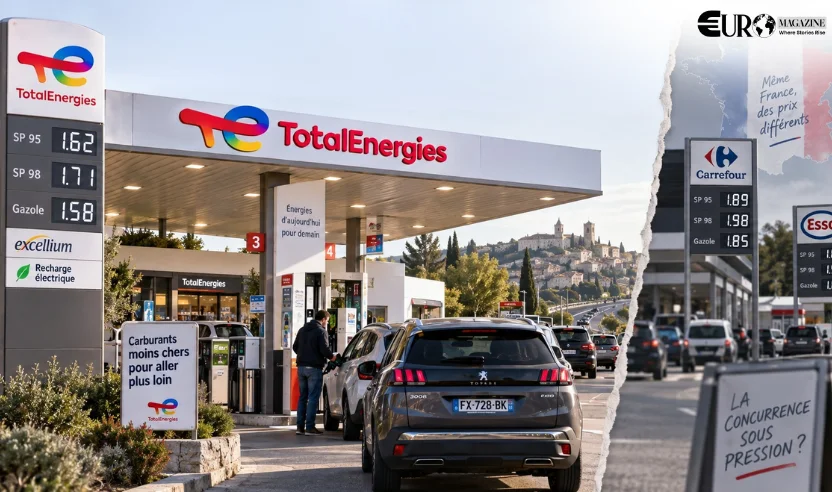
TotalEnergies’ decision to keep fuel prices below the French national average has sparked a growing dispute with supermarkets and independent petrol stations, which accuse the energy company of putting pressure on competitors with prices they say they cannot match.
The controversy comes as fuel prices have surged following the conflict involving the United States and Iran. TotalEnergies has maintained a price cap of €1.99 per litre for E10 petrol and €2.25 for diesel, significantly below the national average in many parts of France.
TotalEnergies Stations Draw Large Crowds
French motorists have increasingly been heading to TotalEnergies stations in search of cheaper fuel, particularly as diesel prices have moved above €2 per litre in much of the country.
The company’s nationwide network has become an important source of relatively inexpensive fuel during the current energy-price shock. In some areas, the difference between TotalEnergies prices and those charged by competing stations has reached several dozen cents per litre.
The lower prices have also strengthened TotalEnergies’ appeal at a time when households and businesses are facing higher transportation costs.
Independent Stations Claim Unfair Competition
Independent petrol station operators have become increasingly vocal about the pricing strategy.
The FF3C, which represents around 1,000 independent service stations, filed a complaint with France’s competition regulator in July. The group argues that TotalEnergies benefits from its position as an integrated oil producer and refiner, allowing it to offer retail prices that smaller operators cannot afford to match.
Jacques Goisque, head of the FF3C, said independent retailers cannot sell fuel at a loss to compete with the prices offered by TotalEnergies.
The situation has become particularly difficult in Corsica, where around 15 independent stations temporarily closed during the September 12–13 weekend to protest what operators described as a lack of government regulation.
Supermarkets Also Push Back
France’s major supermarket chains are also unhappy with TotalEnergies’ pricing.
Supermarkets traditionally use petrol stations as a way to attract shoppers, often selling fuel at very low margins. But retailers argue that TotalEnergies’ current prices leave them with virtually no room to compete.
Michel-Édouard Leclerc, head of supermarket group E.Leclerc, said retailers cannot reduce their prices further without selling below cost.
The dispute highlights a reversal of sorts in France’s fuel market, where supermarkets have historically been among the most aggressive players on prices.
Government Encouraged the Price Cap
TotalEnergies introduced the price cap after French authorities called on energy companies to help shield consumers from the sharp rise in fuel costs.
Prime Minister Sébastien Lecornu urged TotalEnergies in May to introduce what he described as a generous price ceiling. The company subsequently maintained prices at levels significantly below the national average.
But the government's reliance on a private company to provide price relief has drawn criticism from smaller fuel retailers, who say the policy effectively shifts the burden onto competitors.
Government spokeswoman Maud Bregeon has said authorities are focused on keeping fuel supplies available and limiting further price increases. Around one in 10 French service stations was reported to be missing at least one type of fuel, with most of those stations belonging to TotalEnergies.
The Price Cap Is Expensive for TotalEnergies
Maintaining the lower prices has also come at a substantial cost to TotalEnergies.
The company estimates that the price cap has cost it between €250 million and €300 million over roughly five months. However, higher oil prices have simultaneously boosted the company's upstream earnings, helping it more than double first-half profit to €11.2 billion.
TotalEnergies CEO Patrick Pouyanné has also warned that the company could end the price cap if the French government introduces a special tax on energy companies’ profits.
That has added another dimension to the dispute, linking fuel prices with the wider debate over how much energy companies should contribute during periods of unusually high profits.
Concerns Grow Ahead of France’s Election
The fuel dispute comes at a politically sensitive time, with France facing growing concern over household purchasing power and rising living costs ahead of the 2027 presidential election.
Higher fuel prices have historically been politically sensitive in France. The nationwide yellow vest protests in 2018 began partly in response to increases in fuel taxes and eventually became a much broader protest over living costs and economic policy.
The latest increase in fuel prices has already prompted renewed calls for demonstrations, increasing pressure on the government to respond.
A Difficult Balance for France
The TotalEnergies controversy illustrates the challenge facing French policymakers: keeping fuel affordable for consumers while ensuring that smaller fuel retailers can remain financially viable.
For motorists, TotalEnergies’ price cap provides meaningful relief at a time when energy costs are rising. For independent stations and supermarkets, however, the same policy is creating a competitive environment they say is increasingly difficult to sustain.
For now, the French government is seeking to contain fuel-price increases while TotalEnergies continues its cap. But with energy costs remaining elevated and pressure mounting from businesses and consumers alike, the dispute over who should absorb the cost of cheaper fuel is likely to remain a major issue in France.
Read more news:-
























Comments
Be the first to share your thoughts.
Leave a comment
Join the conversation. Your email address will not be published.