


Robotics is attracting billions of dollars in investment as companies race to automate factories, warehouses and eventually homes. But for ordinary investors, getting direct exposure to the companies driving the boom remains surprisingly difficult.
The main reason is simple: many of the most promising robotics startups are still privately held. That leaves retail investors with a limited choice between buying shares of established companies that are developing robotics, investing in diversified industrial firms or paying a premium for newer investment vehicles designed to hold private robotics companies.
The Robotics Industry Is Already Huge
The excitement around humanoid robots can sometimes make the industry appear to be just getting started. In reality, industrial robotics is already a large and established market.
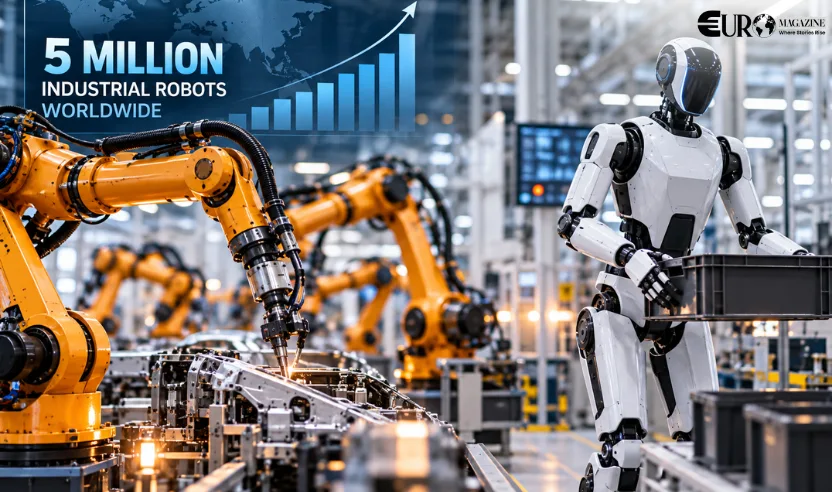
The International Federation of Robotics said the number of industrial robots operating in factories worldwide reached a record 5.079 million in 2025, while annual installations climbed 11% to 603,000 units. China accounted for 59% of global installations, making it by far the largest robotics market.
Humanoid robots, however, remain a much smaller part of that market. Around 7,000 humanoid robots were sold worldwide for industrial and professional applications in 2025, according to figures cited by Euronews.
That gap matters for investors because many of the companies receiving the most attention are developing technologies that have yet to reach large-scale commercial deployment.
Startups at the Centre of the Boom Are Mostly Private
Companies such as Figure AI, Apptronik and Dyna Robotics have become prominent names in the humanoid-robot race, but their shares are not available on public stock exchanges.
That means most retail investors cannot buy directly into these businesses before they go public. In the United States, access to private-company investments has traditionally been concentrated among investors who meet certain financial and sophistication requirements.
The trend is part of a wider change in capital markets. Technology companies are staying private longer, allowing them to raise large amounts of venture capital without immediately turning to public investors.
Tesla Offers One of the Most Visible Routes
For investors looking for a publicly traded company with a major humanoid robotics ambition, Tesla is one of the most obvious choices.
CEO Elon Musk has said humanoid robots could eventually become a major part of Tesla's value, while the company has begun producing its Optimus robot. But buying Tesla is still primarily a bet on a diversified automaker whose current business is dominated by vehicles and energy products rather than robot sales.
Tesla's valuation also reflects high expectations for its future businesses. Analysts cited by Euronews noted that Tesla trades at a far higher earnings multiple than traditional European automakers, meaning investors are already paying for significant anticipated growth.
Industrial Giants Provide Broader Exposure
Another option is to invest in established robotics and automation companies such as Fanuc, ABB or Siemens.
These businesses provide exposure to industrial automation without relying entirely on the success of humanoid robots. Fanuc generates a substantial share of its revenue from robotics, while ABB has a broader industrial technology portfolio. Siemens is more heavily involved in the software, controls and automation systems used by modern factories.
The trade-off is that robotics represents only part of these companies' overall businesses, so investors do not get a pure bet on the robotics sector.
ABB recently agreed to sell its robotics division to SoftBank for $5.4 billion, further illustrating how difficult it can be for investors seeking a direct listed robotics play.
New Funds Offer Access, but at a Cost
A newer option has emerged through publicly traded funds that invest in private robotics startups.
RoboStrategy, which began trading on Nasdaq under the ticker BOT, holds stakes in private companies including Figure AI, Dyna Robotics and Apptronik. The structure gives public-market investors a way to gain indirect exposure to startups that they otherwise could not buy directly.
But that access can come with a significant price.
RoboStrategy shares recently traded at around 2.4 times the value of the fund's underlying assets. The fund also charges a 2.5% annual management fee, while total annual expenses are close to 4%, according to the Euronews analysis.
Because its private holdings are valued using estimates rather than continuously traded market prices, the fund's share price can also move significantly away from the underlying value of its assets.
Robotics ETFs Offer a Different Approach
Traditional exchange-traded funds can provide broader exposure to robotics without the same premium structure.
Some robotics ETFs hold publicly traded companies involved in automation, industrial robotics, artificial intelligence and humanoid technology. Their advantage is diversification and, generally, trading closer to the value of their underlying holdings.
However, investors should remember that many of these funds are not focused exclusively on humanoid robots. Their performance can also depend on semiconductor companies, automakers and large industrial groups.
Investment Boom Comes With Higher Risks
Investor enthusiasm for robotics is clearly growing. Robotics startups had raised $18.8 billion globally by mid-June 2026, already exceeding the amount raised during the record-breaking year of 2025, according to Crunchbase data cited by Euronews.
But the rapid flow of capital also creates concerns about valuations. Recent developments in China's robotics market, including scrutiny of companies seeking public listings, show that enthusiasm does not always translate into reliable commercial results.
For everyday investors, the challenge is therefore not simply finding a way to buy into robotics. It is finding exposure at a price that reflects the industry's actual commercial progress rather than expectations alone.
The Public Market Is Still Catching Up
The robotics industry itself is already proving its value in factories, but the companies behind the newest generation of robots are still largely developing their businesses in private markets.
Until more major robotics startups go public, ordinary investors will continue to face a difficult choice: gain indirect exposure through companies such as Tesla and industrial groups, use robotics-focused ETFs or accept the higher risks and costs of funds that provide access to private startups.
The robotics boom may be real, but getting a clean investment stake in the companies driving it remains much harder than the headlines suggest.
Read more news:-





























Comments
Be the first to share your thoughts.
Leave a comment
Join the conversation. Your email address will not be published.