

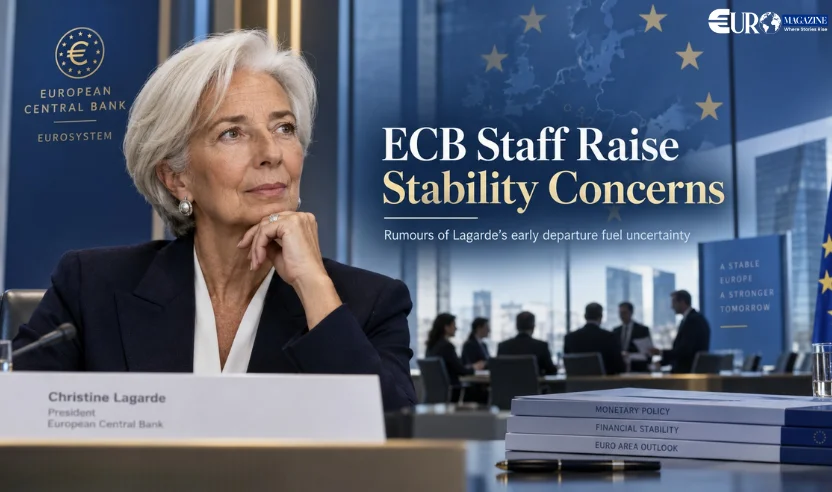
Staff representatives at the European Central Bank (ECB) have called for greater clarity over reports that President Christine Lagarde could leave before the end of her term, warning that prolonged uncertainty at the top of the institution could affect confidence and strategic planning
In a letter to the ECB’s Executive Board, the staff committee said uncertainty surrounding possible leadership changes could undermine trust in the central bank’s communications, create concern among employees and stakeholders, and complicate preparations for succession and internal reforms.
Lagarde’s Term Runs Until 2027
Lagarde’s current term as ECB president is scheduled to end in October 2027.
She has said publicly that she intends to remain in office, although she has stopped short of repeatedly giving an explicit commitment that she will complete the entire eight-year term. Questions over a possible earlier departure have intensified amid reports that she could be considered for a senior role elsewhere.
The speculation has included the possibility of Lagarde becoming the next chair of the World Economic Forum (WEF). The WEF and Lagarde have not confirmed such a move.
ECB Staff Want More Transparency
The staff committee's intervention is focused less on Lagarde's personal plans and more on the potential institutional consequences of uncertainty.
Representatives said they do not take a position on whether reports about possible departures are accurate. Instead, they argue that speculation involving senior ECB officials inevitably raises questions about how the institution would manage leadership transitions.
The committee has asked the Executive Board to provide appropriate clarity about any potential changes at the top of the bank.
Isabel Schnabel Also Draws Attention
The concerns extend beyond Lagarde.
ECB Executive Board member Isabel Schnabel has also been linked to speculation about an early departure. Reports have suggested that she is in discussions for a senior role at the International Monetary Fund, although no departure has been confirmed.
The possibility of multiple senior officials leaving before their scheduled terms could make succession planning more complicated, particularly if several appointments need to be coordinated at the same time.
The staff committee also pointed to the upcoming departure of ECB chief economist Philip Lane, whose term is due to end in May 2027, adding to the broader discussion about leadership continuity.
Leadership Changes Come at a Sensitive Time
The speculation comes as the eurozone faces a complicated economic environment.
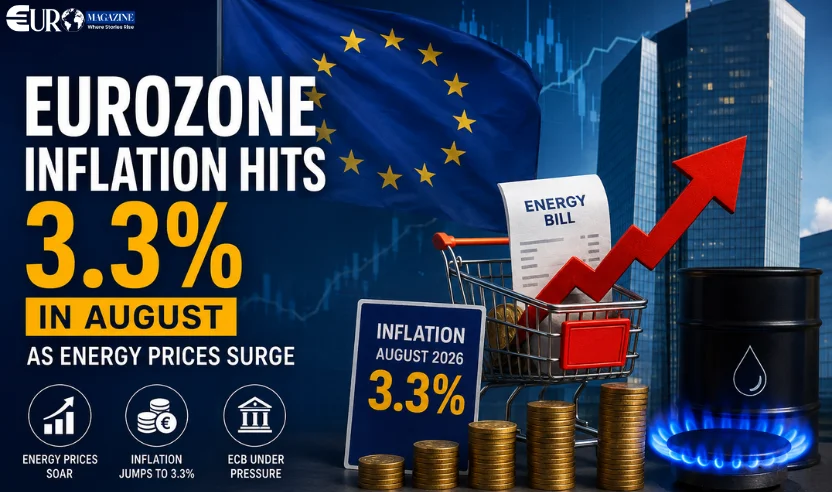
The ECB is dealing with inflation risks linked partly to higher energy prices and geopolitical instability, while policymakers must balance price stability against the effect of higher interest rates on households and businesses.
Any uncertainty surrounding senior leadership can therefore attract greater attention because markets closely monitor central-bank communication when assessing future monetary policy.
Recent market expectations have also shifted toward the possibility of further ECB tightening later in 2026 as energy-price pressures remain elevated.
Concerns Over Internal Reforms
The staff representatives also connected the leadership issue to ongoing internal reforms at the ECB.
According to the letter, prolonged uncertainty could delay or weaken efforts to address issues involving the institution's speak-up culture, career incentives and confidence in internal processes. The committee cited results from a 2025 staff survey in which only 40% of respondents said they felt able to express their views freely without fear of negative consequences.
The argument is that incoming senior officials would need time to understand these internal issues, making a clear and orderly succession process more important.
ECB Says Governance Arrangements Are in Place
The ECB has sought to reassure staff and outside observers that it has mechanisms for handling leadership changes.
A spokesperson said the central bank has long-established governance arrangements and significant institutional expertise to ensure that its operations continue smoothly during periods of transition.
There has been no official announcement that Lagarde will leave before her term expires.
Succession Discussions Are Already Emerging
The uncertainty has nevertheless triggered early discussions about who could eventually succeed Lagarde.
Among the names being discussed are former Dutch central bank governor Klaas Knot, Bank for International Settlements chief Pablo Hernández de Cos, Bundesbank President Joachim Nagel and European Investment Bank President Nadia Calviño. France has reportedly indicated support for Knot while seeking influence over the ECB's chief economist position, although the succession process remains unresolved.
Any eventual appointment would require political agreement among eurozone governments and EU institutions.
Markets Watch the Leadership Question
The ECB presidency is one of Europe's most influential economic positions, making any potential leadership transition important for financial markets as well as policymakers.
For now, the central bank continues to operate under Lagarde's leadership, and there is no confirmed date for an early departure.
However, the staff committee's warning shows that speculation itself is becoming an institutional issue. As Europe prepares for a potentially significant reshuffling of senior ECB positions, clarity over leadership may become increasingly important for maintaining confidence in the bank and ensuring that its policy and reform agenda continues without disruption.
Read more news:-




























Comments
Be the first to share your thoughts.
Leave a comment
Join the conversation. Your email address will not be published.