

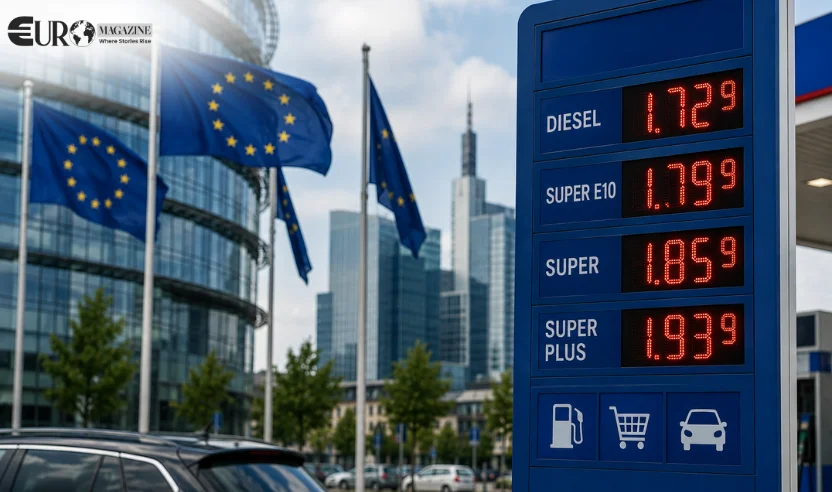
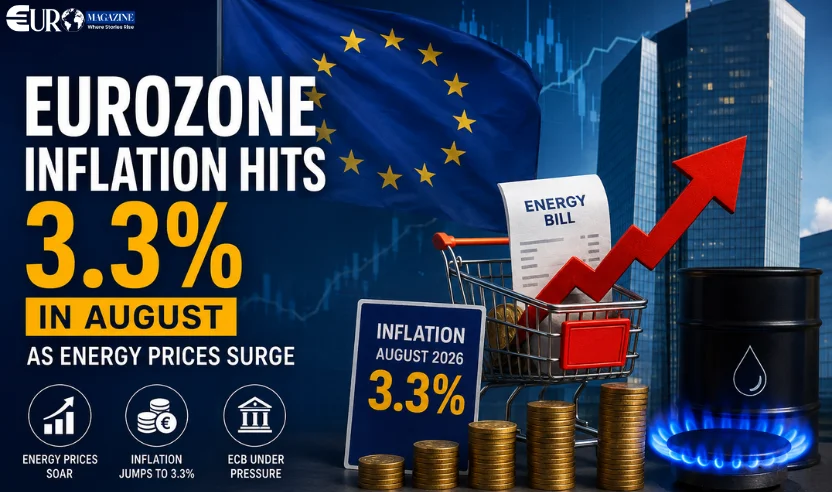
Inflation across the eurozone accelerated to 2.9% in July, ending June's brief slowdown as higher energy prices pushed consumer costs upward across the currency bloc, according to preliminary figures released by Eurostat.
Annual inflation increased from 2.8% in June to 2.9% in July, matching market expectations and highlighting the continued impact of higher fuel and energy costs on Europe's economy.
Core inflation, which excludes volatile food and energy prices, also edged higher to 2.5%, compared with 2.4% a month earlier, suggesting underlying price pressures remain persistent despite tighter monetary policy.
Energy prices recorded the sharpest annual increase, rising 10% year-on-year, while services inflation reached 3.3%, making them the largest contributors to overall consumer price growth.
The latest inflation figures were released a day after stronger-than-expected second-quarter economic growth, reinforcing confidence that the eurozone economy has remained resilient despite geopolitical uncertainty and elevated borrowing costs.
Inflation levels, however, varied considerably among member states.
Lithuania recorded the highest annual inflation rate at 5.6%, followed by Bulgaria (4.1%), Cyprus (4.0%), Spain (3.8%), and Croatia (3.6%).
At the opposite end of the scale, Estonia posted the lowest inflation rate at 2.0%, followed by Malta (2.1%), France (2.4%), Latvia (2.5%), Austria (2.6%), and Finland (2.6%).
Germany, the eurozone's largest economy, reported inflation of 2.8%, while Italy matched the bloc's overall average of 2.9%.
Monthly price movements also showed mixed trends across the region. Consumer prices rose most sharply in the Netherlands, increasing 1.5% compared with June. Germany, France, Croatia, Malta, Estonia and Bulgaria also recorded monthly increases.
Meanwhile, prices declined in several countries, with Greece posting the largest monthly fall at 1.4%, followed by Italy, Latvia, Belgium, Luxembourg, Austria, Portugal and Slovenia.
Economists said the renewed conflict in the Middle East continues to pose risks to inflation through higher oil and natural gas prices, particularly as Europe remains heavily dependent on imported energy.
Financial markets reacted positively to the latest data. The euro strengthened modestly against the U.S. dollar, while major European stock indices extended recent gains. Germany's DAX 40 reached a fresh record high, with the Euro Stoxx 50, France's CAC 40, and Italy's FTSE MIB also moving higher.
Technology stocks led the advance, supported by stronger corporate earnings and continued investor optimism surrounding artificial intelligence-related companies.
Despite the latest rise in inflation, analysts expect the European Central Bank (ECB) to continue closely monitoring energy prices and economic conditions before making further decisions on interest rates in the coming months.
Read more news:-

























Comments
Be the first to share your thoughts.
Leave a comment
Join the conversation. Your email address will not be published.