

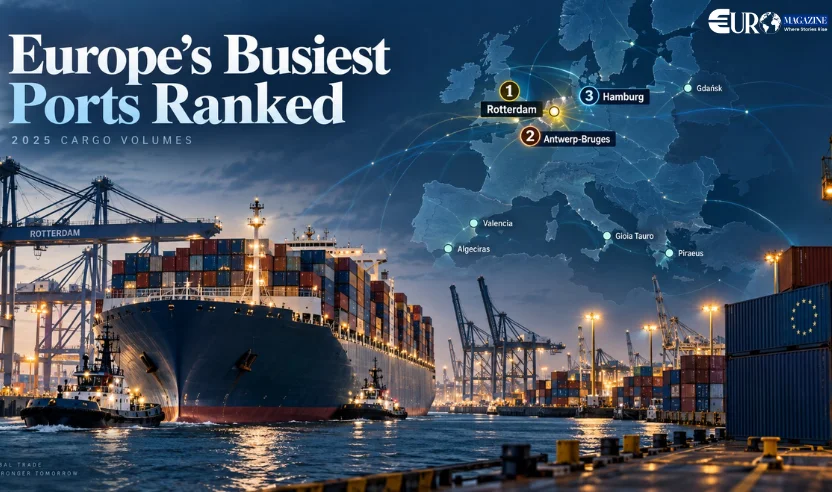
Europe’s ports remain at the centre of the continent’s trade network, moving hundreds of millions of tonnes of goods each year and connecting European industries with markets across Asia, Africa and the Americas.
Based on the latest full-year 2025 cargo-handling figures, Rotterdam remains Europe’s largest port by total cargo volume, followed by Antwerp-Bruges and Hamburg. The ranking also highlights the growing importance of Mediterranean and Baltic ports as trade routes continue to evolve.
Rotterdam Remains Europe’s Clear Leader
The Port of Rotterdam in the Netherlands continues to dominate European maritime trade. It handled around 428.4 million tonnes of cargo in 2025, despite recording a modest decline from the previous year.
Rotterdam's strength comes from its enormous industrial and logistics network. The port handles everything from containers and crude oil to chemicals, energy products and other bulk cargo, while its connections to inland waterways, rail and road networks allow goods to move deep into the European market.
Dutch statistics also show that the wider Rotterdam port area handled about 443.7 million tonnes in 2025 when its associated port areas are included.
Antwerp-Bruges Holds Second Place
Belgium’s Port of Antwerp-Bruges ranked second, handling approximately 266.4 million tonnes in 2025.
The port remains particularly important for chemicals, energy products, containers and general cargo. Although total throughput declined by around 4% during the year, Antwerp-Bruges retained its position as one of Europe’s most important industrial gateways.
Its location gives companies access to major manufacturing centres across Belgium, Germany, France and the Netherlands, making the port a crucial link between maritime trade and Europe’s industrial heartland.
Hamburg Completes the Top Three
Germany’s Hamburg took third place with about 114.6 million tonnes of cargo in 2025, marking an increase of more than 2% from the previous year.
Hamburg serves as one of the main gateways for Germany and central Europe. Its extensive rail connections are particularly important, helping move imported and exported goods beyond the port and into markets across the continent.
The gap between Hamburg and the two leading North Sea ports, however, remains substantial, underlining Rotterdam and Antwerp-Bruges’ enormous scale.
Mediterranean Ports Continue to Gain Importance
While northern European ports dominate total cargo volumes, Mediterranean gateways are playing an increasingly important role in European trade.
Algeciras and Valencia in Spain, along with Piraeus in Greece and Gioia Tauro in Italy, are major hubs for container shipping and connections between Europe, North Africa, the Middle East and Asia.
Eurostat data has shown particularly strong recent performance at Valencia and Algeciras, which recorded some of the largest increases among the EU’s biggest ports in 2024.
The Mediterranean’s strategic location makes these ports especially important for vessels travelling between the Suez Canal and European markets.
Container Rankings Tell a Slightly Different Story
The ranking changes somewhat when ports are measured by container throughput rather than total cargo tonnage.
Rotterdam handled about 14.25 million TEUs in 2025, keeping its position as Europe’s largest container port. Antwerp-Bruges followed with roughly 13.6 million TEUs, while Hamburg processed about 8.3 million TEUs.
This difference matters because a port can handle huge quantities of heavy commodities such as crude oil, coal or minerals without moving as many containers. Total tonnage therefore provides a broader measure of cargo activity, while TEUs are more useful for assessing containerised trade.
Baltic Ports Are Also Moving Up
Northern and Baltic ports are increasingly becoming important alternatives and additional gateways for European supply chains.
Gdańsk in Poland, for example, improved its position in the European cargo rankings in 2025 despite a challenging market environment. The port handled enough cargo to rank among Europe's leading facilities and continued investing in infrastructure to support future growth.
Its expansion reflects a broader shift in Europe's logistics landscape, with companies seeking more diversified supply routes and stronger connections to central and eastern European markets.
Ports Reflect Europe’s Changing Trade Map
Europe’s busiest ports are more than shipping terminals. They are major economic centres supporting manufacturing, energy, logistics and international commerce.
Rotterdam’s continued dominance shows the importance of large North Sea gateways, while Antwerp-Bruges and Hamburg demonstrate the strength of Europe’s industrial core. At the same time, Mediterranean and Baltic ports are gaining strategic importance as trade routes, energy flows and supply chains change.
For the cities and regions surrounding them, port performance can have a direct impact on investment, employment and industrial activity. As European trade continues to evolve, the competition between these major maritime hubs is likely to become even more significant.
Read more news:-



























Comments
Be the first to share your thoughts.
Leave a comment
Join the conversation. Your email address will not be published.