

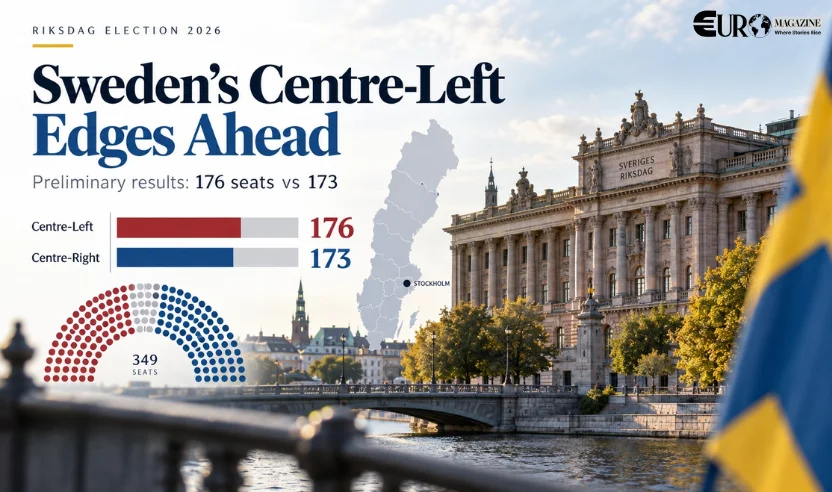
Sweden’s centre-left opposition bloc is narrowly ahead in the country’s parliamentary election, with preliminary results showing the alliance holding 176 seats compared with 173 for the right-wing bloc.
The result gives the opposition a three-seat advantage in the 349-member Riksdag, but the race remains too close to be considered settled. Vote counting is continuing, and overseas ballots and other final adjustments could still change the balance.
Magdalena Andersson’s Bloc Takes the Lead
The centre-left grouping is led by Social Democratic leader Magdalena Andersson, who is seeking a return as Sweden’s prime minister after serving from 2021 to 2022.
The Social Democrats remained the country's largest individual party, receiving around 28.1% of the vote in the preliminary count. Despite leading the election, that result would represent one of the party's weakest performances in more than a century.
Andersson's bloc includes the Social Democrats, Green Party, Left Party and Centre Party.
Right-Wing Coalition Loses Its Edge
Prime Minister Ulf Kristersson's governing bloc is currently behind with 173 seats.
Kristersson's government has relied on support from the Sweden Democrats, the country's largest right-wing party alongside the coalition partners. The Sweden Democrats have played a major role in Swedish politics since 2022 but now appear to be heading for a decline in their parliamentary support.
The party has pushed for tougher immigration policies and has sought a formal role in government if the right wins another term.
Election Remains Too Close to Call
Although the centre-left currently has the advantage, the margin is extremely small.
The Swedish Election Authority's preliminary figures have shifted as more districts report, with earlier projections putting the race at 175 seats to 174 before the latest count moved to 176–173. The final allocation is not expected until all votes, including ballots cast from abroad, have been processed.
Sweden's parliament requires 175 seats for a majority, meaning the centre-left's current three-seat advantage would technically give it control if the result remains unchanged.
Coalition Talks Could Still Be Complicated
Winning the most seats does not automatically mean Andersson will have an easy path to forming a government.
The four parties supporting the centre-left bloc have significant differences over issues such as taxation, migration and energy policy. In particular, the Centre Party and Left Party have disagreed over whether they are willing to serve in the same government.
That could force Andersson to build a minority government or negotiate agreements with parties outside a formal coalition.
Sweden’s Political Direction at Stake
The election has broader significance because it could determine whether Sweden continues the tougher political direction adopted under Kristersson's government.
Immigration, crime, welfare, taxes and the cost of living were among the major issues during the campaign. The possible entry of the Sweden Democrats into government also became a central question, after the party demanded cabinet positions rather than simply supporting a right-wing administration from outside.
A centre-left victory would potentially mark a shift away from that approach, although Andersson herself has supported some tougher positions on immigration compared with traditional Social Democratic policy.
Sweden Awaits the Final Count
For now, neither side can claim a definitive victory.
The Election Authority is continuing to count and verify votes, with the final result expected after the remaining ballots are processed. Sweden's parliament itself says the preliminary result is still being checked and that the final seat distribution will be confirmed once the count is complete.
The narrow preliminary lead gives Andersson's opposition bloc an advantage, but it also means that a small number of votes could still reshape the political picture.
Sweden now faces the possibility of weeks of negotiations over who will govern the country. Whether the centre-left's three-seat lead becomes a new government or disappears in the final count remains one of Europe's most closely watched political questions.
Read more news:-




















Comments
Be the first to share your thoughts.
Leave a comment
Join the conversation. Your email address will not be published.