

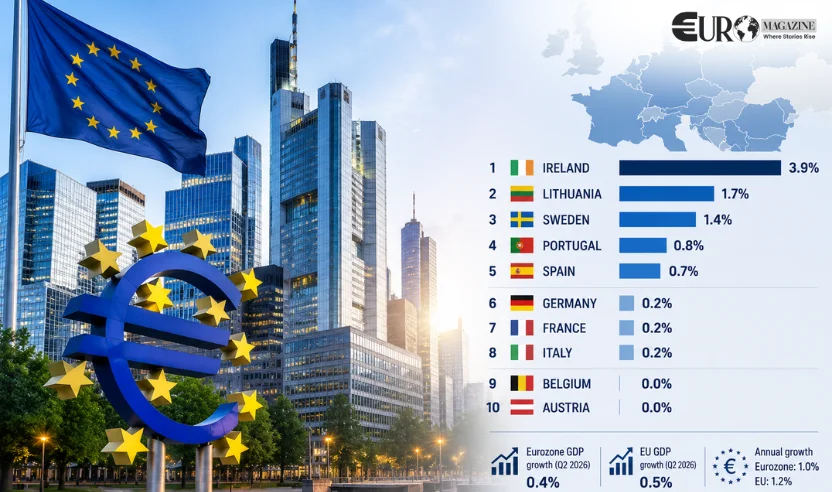
The eurozone economy expanded more strongly than expected during the second quarter of 2026, with Ireland emerging as Europe's fastest-growing economy as preliminary data pointed to greater resilience despite elevated energy prices and ongoing geopolitical uncertainty.
According to Eurostat's preliminary estimate, gross domestic product (GDP) across the euro area increased by 0.4% during the April-June quarter, improving from flat growth in the first quarter and exceeding economists' expectations of a 0.2% increase. Across the European Union, quarterly GDP accelerated to 0.5%, while annual growth reached 1.0% in the eurozone and 1.2% across the EU.
The latest figures suggest the bloc entered the second half of the year on firmer footing than anticipated, although economic momentum varied significantly among member states.
Ireland delivered the strongest quarterly performance, with GDP surging 3.9%, making it the fastest-growing economy in Europe during the quarter. Economists at Pantheon Macroeconomics estimated that Ireland's rebound alone contributed approximately 0.1 percentage points to overall eurozone growth.
Lithuania recorded the second-highest quarterly expansion at 1.7%, followed by Sweden with 1.4% growth.
Southern European economies also maintained positive momentum. Portugal's economy expanded 0.8%, while Spain once again outperformed the eurozone's major economies, posting quarterly GDP growth of 0.7%.
At the opposite end of the rankings, Belgium and Austria recorded no economic growth during the quarter, reflecting weaker domestic activity.
Among Europe's largest economies, growth remained positive but comparatively subdued.
Germany's economy expanded 0.2%, slowing from 0.4% in the first quarter but still exceeding market expectations. According to Pantheon Macroeconomics, exports remained the primary driver of German growth, while household consumption softened and business investment declined.
France returned to growth after contracting in the previous quarter, with GDP rising 0.2%. However, economists noted that weak investment continued to weigh on the country's economic recovery despite stronger consumer demand.
Italy also recorded 0.2% quarterly growth, slowing from the previous quarter but outperforming expectations. Analysts cautioned that Italy remains more vulnerable to higher energy costs than several of its European peers, particularly if prices remain elevated through the second half of the year.
Spain continued to distinguish itself among Europe's largest economies. Strong household spending, resilient exports, government support measures and expanding renewable energy capacity helped the country maintain one of the strongest growth rates in the eurozone despite rising energy prices.
Commenting on the latest figures, Claus Vistesen, Chief Eurozone Economist at Pantheon Macroeconomics, said the eurozone economy performed significantly better than anticipated despite the recent energy price shock.
"The Eurozone economy blew past the consensus in Q2 and was even stronger than our above-consensus forecast," Vistesen said, adding that the latest data reflected a resilient first half of the year.
Despite stronger economic growth, inflationary pressures have begun to re-emerge across several European economies.
Preliminary data showed Germany's headline inflation is estimated to have increased to around 2.7% in July from 2.3% a month earlier. Spain also reported higher inflation, with consumer prices rising 3.5% year-on-year, marking the highest reading since May 2024. Core inflation in Spain also edged higher to 3.0%.
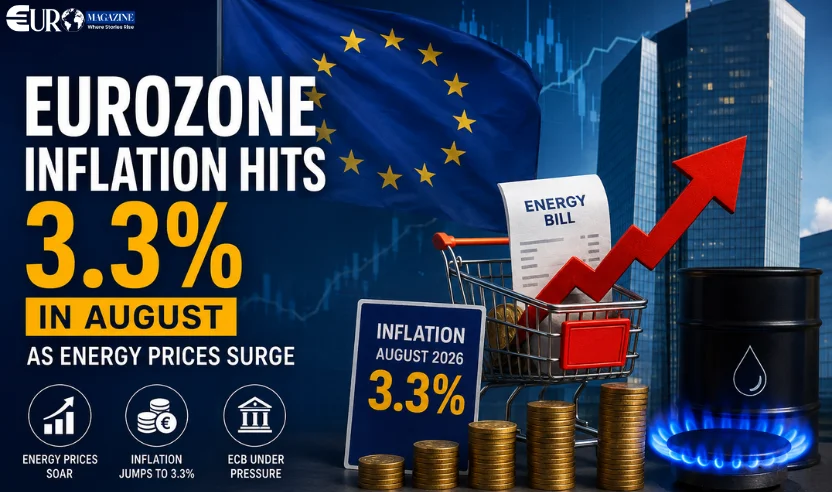
Economists are now awaiting the eurozone's latest inflation figures, expected later this week, with forecasts suggesting annual inflation could rise to 2.9% from 2.8% in June.
A stronger-than-expected economy combined with renewed inflationary pressures may influence the European Central Bank's monetary policy decisions in the coming months, with analysts indicating that policymakers could keep the option of another interest rate increase on the table if price growth remains elevated.
Europe's Fastest-Growing Economies in Q2 2026
| Rank | Country | Quarterly GDP Growth |
|---|---|---|
| 1 | Ireland | 3.9% |
| 2 | Lithuania | 1.7% |
| 3 | Sweden | 1.4% |
| 4 | Portugal | 0.8% |
| 5 | Spain | 0.7% |
| 6 | Germany | 0.2% |
| 7 | France | 0.2% |
| 8 | Italy | 0.2% |
| 9 | Belgium | 0.0% |
| 10 | Austria | 0.0% |
Read more news:-
























Comments
Be the first to share your thoughts.
Leave a comment
Join the conversation. Your email address will not be published.