

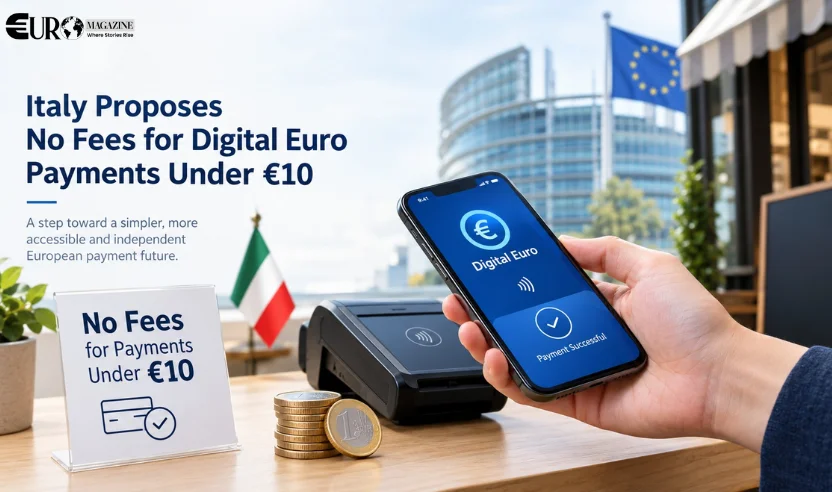
Italy has proposed exempting digital euro payments below €10 from merchant fees, in a move designed to make the European Union’s planned digital currency more attractive to small businesses.
The proposal comes as EU negotiators enter the final stages of discussions over how the digital euro’s payment-fee system should work. According to sources and internal documents reviewed by Euronews, the idea has received a favourable response from the central banking community, including the European Central Bank (ECB).
Focus on Small Businesses
One of the main goals behind the Italian proposal is to prevent small retailers and businesses from facing disproportionate costs when accepting digital euro payments.
Small merchants generally have less bargaining power with major payment networks and can pay significantly higher fees than larger companies. An ECB analysis cited in the negotiations found that smaller businesses can face fees three to four times higher than those paid by larger merchants.
Removing fees on transactions below €10 could therefore make the digital euro easier for cafes, shops and other small businesses to adopt.
Brussels Debates the Fee Structure
The distribution of payment fees, known as the “compensation model,” has become one of the most sensitive issues in negotiations over the digital euro.
An EU diplomat told Euronews that the current proposal would place a merchant service charge cap of up to €0.02 on low-value transactions, particularly for smaller merchants. However, negotiators are also considering a net-zero approach that would effectively eliminate the fee altogether.
The fee arrangement is expected to be temporary, giving the ECB time to collect additional data on the costs associated with digital euro payments before potentially proposing a longer-term framework.
Digital Euro Seen as a Strategic Tool
The digital euro is being developed as an electronic form of the European currency that would operate alongside cash rather than replace it.
The project has also taken on a broader strategic importance for the EU. European consumers and businesses rely heavily on payment networks operated by major U.S.-based companies such as Visa and Mastercard, and policymakers increasingly want to strengthen Europe's independence in payments.
The digital euro is therefore being positioned not only as a new payment option but also as part of Europe's effort to build a more independent digital financial infrastructure.
Merchants Would Generally Have to Accept It
Under the proposed framework, the digital euro would have legal tender status, meaning merchants would generally be required to accept it, subject to specific exceptions.
That makes the question of merchant costs particularly important. Businesses will need to understand how much accepting the new currency will cost and whether the system provides enough benefits to justify integrating it into their existing payment infrastructure.
For small businesses operating on tight margins, even relatively small transaction fees can have an impact, making Italy's proposed exemption particularly significant.
Launch Could Come in 2029
The ECB is currently aiming to be ready for a potential first issuance of the digital euro in 2029, provided the necessary legislation is adopted.
Before that can happen, EU institutions and member states still need to reach agreement on several major issues, including transaction fees and holding limits, which would determine how much digital euro users could keep in their wallets.
EU negotiators are scheduled to continue discussions in Brussels on September 10, when the proposed fee structure is expected to be among the issues under consideration.
Italy Pushes for a Simpler Payment Model
Italy's proposal could become an important part of the final design of the digital euro, particularly if other member states support a zero-fee approach for low-value transactions.
For consumers, the change could mean inexpensive everyday purchases can be made without additional payment costs for merchants. For small businesses, it could remove one of the potential barriers to adopting the new system.
The negotiations are still ongoing, however, and the final rules have not yet been agreed. As Brussels works toward a broader framework for the digital euro, the debate over fees shows just how important cost, accessibility and simplicity will be to its eventual success.
Read more news:-






























Comments
Be the first to share your thoughts.
Leave a comment
Join the conversation. Your email address will not be published.