

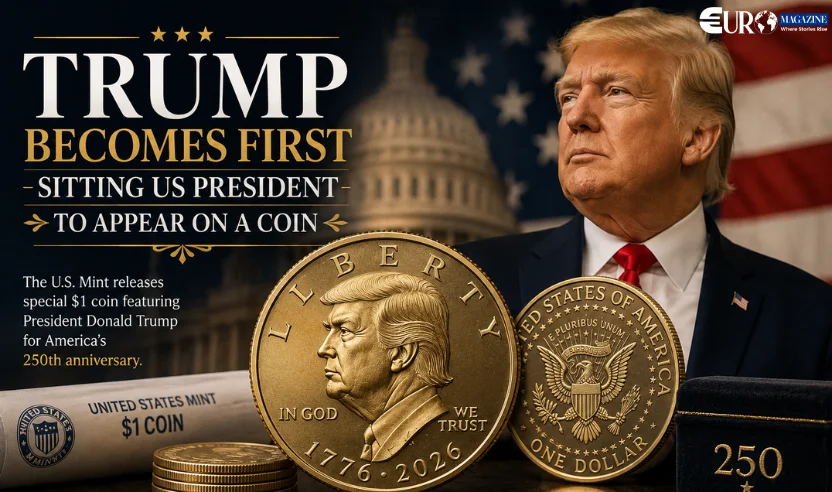
President Donald Trump has become the first sitting U.S. president in nearly a century to appear on American currency, after the U.S. Mint began selling a special $1 coin featuring his likeness.
The gold-colored coin was released Wednesday as part of the United States' preparations to celebrate its 250th anniversary. It carries Trump's portrait on the front, alongside the words “LIBERTY,” “IN GOD WE TRUST” and the dates “1776–2026.” The reverse features an adaptation of the presidential seal.
A Historic Change in US Currency
The release breaks with a long-standing American tradition of keeping living presidents off U.S. currency. The last sitting president to appear on a U.S. coin was Calvin Coolidge, whose image was featured on a commemorative half-dollar in 1926.
The Trump coin has therefore attracted considerable attention, not only because of its unusual design but also because of questions surrounding the rules governing presidential portraits on currency.
The Trump administration has pointed to legislation connected to the country's 250th-anniversary celebrations as the legal basis for the coin. Treasury Secretary Scott Bessent has also cited the Coolidge coin as a historical precedent.
The Coin Is Worth $1 But Costs More to Collect
Although the coin has a face value of $1 and is legal tender, the Mint is primarily marketing it as a collectible rather than ordinary pocket change.
A roll of 25 coins is being sold for $61, while a bag containing 100 coins costs $154.50. The coins do not actually contain gold; their gold-like appearance comes from a copper-based manganese-brass composition.
Some of the coins were struck on July 4, and those special pieces carry a “July 4th” mark. They were randomly distributed among the rolls and bags sold by the Mint.
Legal Debate Surrounds Trump's Image
The release has also reignited a political and legal debate over whether a living president should appear on U.S. currency.
Federal law has traditionally restricted the use of portraits of living people on American currency, while other legislation has created specific exceptions and commemorative provisions. Critics argue that Trump's coin pushes against a long-standing principle intended to prevent living political leaders from placing themselves on national money.
The administration, however, maintains that the semiquincentennial legislation provides sufficient authority for the design.
Strong Interest From Collectors
The unusual release has generated significant interest among collectors and the public. The Mint placed limits on purchases when the coins first went on sale, and reports indicate that some products quickly went out of stock.
For the Trump administration, the coin is another highly visible part of the country's 250th-anniversary celebrations. For collectors, it represents a rare moment in American numismatic history.
Whether people actually spend the $1 coin in everyday transactions or keep it as a collectible, Trump's appearance on U.S. currency has already made the 2026 anniversary one of the more unusual chapters in the country's monetary history.
Read more news:-































Comments
Be the first to share your thoughts.
Leave a comment
Join the conversation. Your email address will not be published.