
whatsapp

Trump Administration’s $1.22 Billion RWE Deal Pushes Offshore Wind Buybacks Near $4 Billion

/media/Trump_offshore_wind_buybacks.webp © Image Copyrights Title

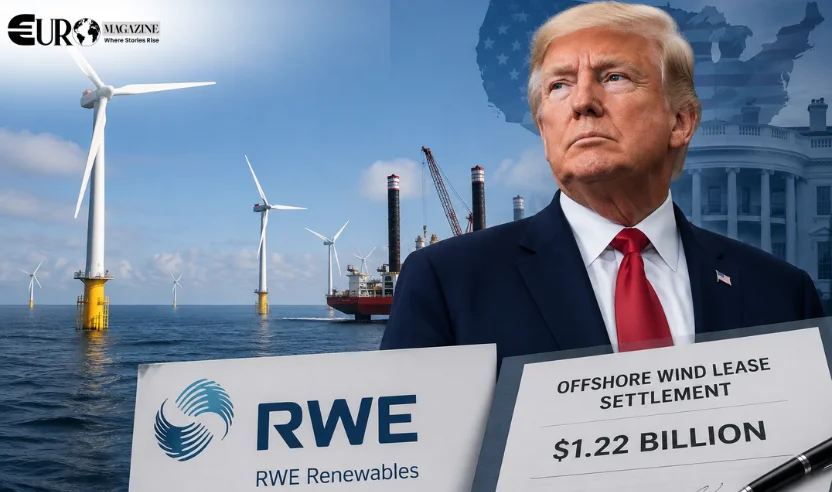
The Trump administration has reached a $1.22 billion agreement with German energy company RWE that will see the group give up three offshore wind leases in the United States, pushing the value of similar federal settlements this year to nearly $4 billion.

The agreement represents another major step in President Donald Trump’s effort to scale back the expansion of offshore wind power while encouraging greater investment in natural gas and other conventional energy projects.

RWE’s offshore wind interests covered areas linked to New York, California and Louisiana. The projects were still in development and had the potential to provide several gigawatts of electricity if eventually built.

RWE said it concluded that the projects no longer had a realistic path through the federal permitting process in the foreseeable future.

RWE to Receive $1.22 Billion for Offshore Wind Exit

Under the agreement, RWE will surrender its remaining US offshore wind lease interests in exchange for approximately $1.22 billion.

The leases represented years of investment, planning and engagement with US federal authorities.

Together, the proposed developments could have supported around seven gigawatts of generating capacity, enough electricity to serve millions of homes depending on actual output and consumption patterns.

Following the settlement, RWE will no longer hold offshore wind leases in the United States.

The development marks one of the largest individual offshore wind settlements reached by the Trump administration in 2026.

RWE Shifts Investment Toward Natural Gas

The agreement comes alongside significant new investment by RWE in US natural gas infrastructure.

The company plans to direct approximately $900 million toward a liquefied natural gas project in Louisiana and another $300 million toward natural gas turbine projects.

RWE is also developing multiple natural gas projects across the United States.

The shift reflects a broader change in the company’s US energy portfolio as federal policy becomes increasingly favourable toward conventional sources of electricity generation.

The Trump administration has repeatedly argued that natural gas and other dispatchable energy sources are better suited to meeting growing US electricity demand because they can provide power regardless of weather conditions.

Offshore Wind Settlement Costs Approach $4 Billion

RWE is not the first renewable energy developer to reach such an agreement with the federal government.

Earlier settlements have involved companies including TotalEnergies, Bluepoint Wind, Golden State Wind and Invenergy.

French energy group TotalEnergies agreed earlier this year to relinquish offshore wind leases under an arrangement tied to approximately $1 billion in US oil, gas and LNG investment.

Bluepoint Wind and Golden State Wind subsequently entered agreements involving hundreds of millions of dollars in reimbursements connected to investments in conventional energy projects.

Invenergy also agreed to terminate several offshore wind leases under a settlement valued at hundreds of millions of dollars.

With the latest RWE agreement included, the combined value of the administration’s offshore wind settlements is approaching $4 billion.

Trump Administration Defends Energy Strategy

The administration says its approach is intended to redirect investment toward energy sources it considers more dependable and affordable.

Interior Secretary Doug Burgum has argued that the United States needs an energy system capable of meeting rapidly increasing electricity demand while maintaining reliability and controlling costs.

Officials have also criticised offshore wind projects for depending on subsidies and facing high development costs.

Since returning to the White House, Trump has pursued a substantially different energy strategy from the previous administration, placing greater emphasis on oil, natural gas and other conventional energy resources while slowing federal support for offshore wind.

The Bureau of Ocean Energy Management has also been implementing federal policy that pauses new offshore wind leasing and certain approvals while the government reviews its wind development framework.

Critics Question Cost and Impact on Clean Energy

The policy has faced sharp opposition from Democratic lawmakers, state governments and renewable energy advocates.

Critics argue that reimbursing developers to surrender renewable energy leases wastes public money while reducing the future supply of low-carbon electricity.

They also warn that limiting offshore wind development could make it harder for some states to meet long-term climate and renewable energy targets.

Several states affected by changes to offshore wind projects have challenged the federal government’s actions through the courts.

California officials have also indicated opposition to federal efforts that affect projects planned off the state’s coast.

Supporters of offshore wind say the industry could provide substantial amounts of electricity while generating investment in ports, manufacturing, construction and specialised maritime services.

Louisiana Offshore Wind Plans Also Affected

The RWE settlement carries particular significance for Louisiana because it affects what had been the only federal offshore wind lease in Gulf waters.

The proposed development had been expected to generate as much as 2 gigawatts of renewable electricity if fully developed.

The Gulf Coast has historically been associated with the oil and gas sector, but companies based in Louisiana and Texas have increasingly supplied vessels, fabrication services and technical expertise to offshore wind developments elsewhere in the United States.

As a result, the changing federal policy could have implications beyond electricity generation, potentially affecting companies that had hoped to diversify into the offshore renewable energy supply chain.

US Energy Debate Intensifies

The settlement highlights the widening divide over the direction of US energy policy.

The Trump administration maintains that its strategy will strengthen energy security by prioritising reliable domestic energy production.

Renewable energy supporters argue that a diversified electricity system should include growing wind, solar and other low-carbon technologies alongside traditional energy sources.

With electricity consumption expected to increase because of data centres, manufacturing expansion, artificial intelligence infrastructure and wider electrification, the debate over how the United States adds new generating capacity is likely to remain a major political and economic issue.

The RWE agreement now adds another major development to that debate and leaves the future of large-scale offshore wind development in the United States increasingly uncertain.


Read more news:-

Commnets 0
Leave A Comment

Related Posts
© Infineon Posts Record Revenue as AI Data-Centre Demand Accelerates

Infineon Posts Record Revenue as AI Data-Centre Demand Accelerates

German semiconductor manufacturer Infineon Technologies reported record quarterly revenue as growing investment in artificial intelligence infrastructure strengthened demand for its power-management c...

© Apple Pay Launches in the Philippines With Support From Four Major Banks

Apple Pay Launches in the Philippines With Support From Four Major Banks

Apple Pay has officially launched in the Philippines, allowing eligible customers to make contactless payments using an iPhone, Apple Watch, iPad or Mac at participating stores, applications and websi...

© Visa to Acquire BioCatch for $2.4 Billion to Strengthen AI Fraud Protection

Visa to Acquire BioCatch for $2.4 Billion to Strengthen AI Fraud Protection

Global payments leader Visa has agreed to acquire Israeli cybersecurity company BioCatch for $2.4 billion in cash, strengthening its fraud prevention capabilities as financial institutions face a grow...

© Eurozone Inflation Rises to 2.9% as Energy Costs Drive Price Pressures

Eurozone Inflation Rises to 2.9% as Energy Costs Drive Price Pressures

Inflation across the eurozone accelerated to 2.9% in July, ending June's brief slowdown as higher energy prices pushed consumer costs upward across the currency bloc, according to preliminary figures ...

© Eurozone Inflation Rises to 2.9% in July as Energy Costs Accelerate

Eurozone Inflation Rises to 2.9% in July as Energy Costs Accelerate

Annual inflation across the eurozone accelerated to 2.9% in July, reversing June's slowdown as higher energy prices pushed consumer costs higher, according to preliminary data released by Eurostat on ...

© Eurozone Growth Surpasses Forecasts in Q2 2026 as Ireland Tops Europe’s Fastest-Growing Economies

Eurozone Growth Surpasses Forecasts in Q2 2026 as Ireland Tops Europe’s Fastest-Growing Economies

The eurozone economy expanded more strongly than expected during the second quarter of 2026, with Ireland emerging as Europe's fastest-growing economy as preliminary data pointed to greater resilience...

© BMW to Cut 8,000 Jobs in Global Cost-Saving Drive

BMW to Cut 8,000 Jobs in Global Cost-Saving Drive

BMW plans to reduce its global workforce by around 8,000 jobs as part of a major cost-cutting programme aimed at improving efficiency and strengthening long-term competitiveness, according to company ...

© Spain's Unemployment Rate Falls to Lowest Level Since 2008

Spain's Unemployment Rate Falls to Lowest Level Since 2008

Spain's unemployment rate dropped to its lowest level since 2008 during the second quarter of 2026, as strong seasonal hiring and continued labor market growth pushed employment to a new record, accor...

© JetBlue Unveils New Fare Structure Ahead of BlueFirst Domestic First-Class Launch

JetBlue Unveils New Fare Structure Ahead of BlueFirst Domestic First-Class Launch

JetBlue Airways has announced a major overhaul of its fare structure, introducing a simplified booking system and new ticket options as the airline prepares to launch its domestic first-class product,...

© Shein Reports $99 Million Quarterly Loss as Trump Tariffs Weigh on U.S. Sales

Shein Reports $99 Million Quarterly Loss as Trump Tariffs Weigh on U.S. Sales

Fast-fashion retailer Shein reported a $99 million net loss in the first quarter of 2026, reversing a $395 million profit recorded a year earlier, as higher U.S. import tariffs and slowing sales weigh...

© ECB Unveils Finalists for New Euro Banknote Designs

ECB Unveils Finalists for New Euro Banknote Designs

The European Central Bank (ECB) has unveiled the final shortlist of designs for the next generation of euro banknotes, giving European citizens the opportunity to help decide how the continent's commo...

© ECB Holds Interest Rates at 2.25% Amid Energy Price Uncertainty

ECB Holds Interest Rates at 2.25% Amid Energy Price Uncertainty

The European Central Bank (ECB) left its key interest rates unchanged on Thursday, maintaining the deposit facility rate at 2.25% as policymakers assessed the inflationary impact of renewed tensions i...

© Crypto Traders Value China’s CXMT Above ICBC Ahead of Record Shanghai IPO

Crypto Traders Value China’s CXMT Above ICBC Ahead of Record Shanghai IPO

China's largest memory chipmaker, ChangXin Memory Technologies (CXMT), is attracting extraordinary investor interest ahead of its Shanghai Stock Exchange debut, with crypto-based derivatives markets v...

© Trump Imposes 50% Tariffs on Canadian Goods

Trump Imposes 50% Tariffs on Canadian Goods

U.S. President Donald Trump has imposed 50% tariffs on most Canadian goods, significantly escalating trade tensions between the two neighboring countries over disputes involving automobiles, dairy pro...

© Eurozone Inflation Slows to 2.8% Ahead of ECB Policy Decision

Eurozone Inflation Slows to 2.8% Ahead of ECB Policy Decision

Inflation across the eurozone eased to 2.8% in June, marking the first annual decline of 2026 and reinforcing market expectations that the European Central Bank (ECB) could leave interest rates unchan...

© Germany Faces Growing Talent Drain as More High-Income Professionals Look Overseas

Germany Faces Growing Talent Drain as More High-Income Professionals Look Overseas

Germany may be facing a growing challenge in retaining its skilled workforce, with a new survey indicating that many of the country's highest earners are actively considering career opportunities abro...

© Trump Media to Launch Real-Time Truth Social Feed for Financial Institutions

Trump Media to Launch Real-Time Truth Social Feed for Financial Institutions

Trump Media & Technology Group (TMTG) has announced plans to introduce a premium data service that will provide financial institutions with near-instant access to selected Truth Social posts, targetin...

© TSMC Posts Record Quarterly Profit as AI Demand Drives Growth, Commits Another $100 Billion to US Expansion

TSMC Posts Record Quarterly Profit as AI Demand Drives Growth, Commits Another $100 Billion to US Expansion

Taiwan Semiconductor Manufacturing Company (TSMC) has reported its strongest quarterly financial performance on record, fueled by surging global demand for artificial intelligence chips. Alongside its...

© ASML Raises 2026 Forecast as AI Demand Drives Strong Earnings and Boosts Investor Confidence

ASML Raises 2026 Forecast as AI Demand Drives Strong Earnings and Boosts Investor Confidence

Dutch semiconductor equipment manufacturer ASML Holding NV has raised its full-year 2026 financial outlook after reporting stronger-than-expected second-quarter results, reinforcing investor confidenc...

© ECB Selects 36 Payment Providers for Digital Euro Pilot Beginning in 2027

ECB Selects 36 Payment Providers for Digital Euro Pilot Beginning in 2027

The European Central Bank (ECB) has selected 36 payment service providers to participate in a year-long pilot programme for the digital euro, marking another key milestone in the European Union's effo...