

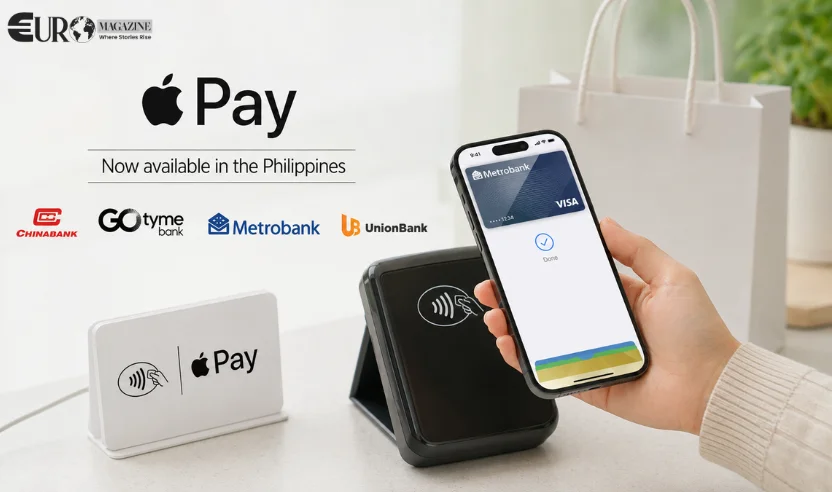
Apple Pay has officially launched in the Philippines, allowing eligible customers to make contactless payments using an iPhone, Apple Watch, iPad or Mac at participating stores, applications and websites.
The service is initially available to customers of Chinabank, GoTyme Bank, Metrobank and UnionBank. Users can add supported credit, debit or prepaid cards to Apple Wallet and make payments without presenting a physical card.
Apple said thousands of merchants across the Philippines now accept Apple Pay, marking the company’s entry into one of Southeast Asia’s fastest-growing digital-payment markets.
Four Philippine Banks Support Apple Pay at Launch
Eligible cardholders from Chinabank, GoTyme Bank, Metrobank and UnionBank can add their supported cards to Apple Wallet.
Card availability may vary depending on the issuing bank, payment network and type of account.
Customers will continue to receive the rewards, points and other benefits connected to their existing credit or debit cards when using Apple Pay.
Some participating banks may also allow customers to apply for virtual cards through their mobile applications or websites. These cards can be issued digitally and added to Apple Wallet for immediate use.
Additional financial institutions are expected to join the platform as Apple expands its partnerships in the Philippines.
Thousands of Retailers Accept the Payment Service
Apple Pay is available at thousands of stores equipped with compatible contactless payment terminals.
Participating retailers include Abenson, Anko, Ayala Malls, Ayala Malls Cinemas, Beyond the Box, Coach, Digimap, Foot Locker, Globe, HOKA, Hollister, Jollibee, Lush, Power Mac Center, Rustan’s, SaladStop!, Shake Shack, Smart and WalterMart Supermarket.
The service is also supported by selected applications and websites, including foodpanda, Jollibee, Rustan’s and Shopee.
Maya Business is expected to enable Apple Pay for more than 5,000 online merchants, further expanding the service’s availability across e-commerce platforms.
Businesses do not necessarily have to appear on Apple’s official launch list to accept the service. Apple Pay may also work at other stores that support contactless payments and the relevant card network.
How Apple Pay Works
Customers can make an in-store payment by double-clicking the side button on a compatible iPhone or Apple Watch.
The transaction must then be authenticated using Face ID, Touch ID or the device passcode. The customer holds the device close to a contactless payment terminal until the payment is confirmed.
Apple Pay can also be used for purchases within supported applications and websites on an iPhone, iPad or Mac.
The service can securely provide stored payment, billing and shipping information, reducing the need for customers to repeatedly enter card details when making online purchases.
Users need a compatible Apple device, an eligible card from a participating bank and an active Apple Account.
Apple Highlights Payment Security and Privacy
Apple said actual card numbers are not stored on users’ devices or on its servers.
When a card is added to Apple Pay, the system creates a unique Device Account Number. This encrypted number is stored in the device’s Secure Element, a dedicated chip designed to protect payment information.
During a purchase, the merchant receives the Device Account Number and a transaction-specific security code rather than the customer’s original card number.
Apple also said it does not retain transaction information in a form that can be directly linked to an individual user.
Every in-store transaction must be authorised through biometric verification or the device passcode.
When an Apple device is lost or stolen, the owner can use the Find My service to locate the device, mark it as lost, lock it or suspend Apple Pay remotely.
Launch Expands Competition in Digital Payments
The arrival of Apple Pay gives Philippine consumers another option for making mobile and contactless payments.
The service enters a competitive digital-payment market that already includes bank applications, local mobile wallets and other international payment platforms.
Unlike a conventional digital wallet that stores a separate balance, Apple Pay connects an eligible bank card to an Apple device. Funds continue to come directly from the customer’s card or bank account.
The issuing bank remains responsible for approving or declining each transaction.
Apple’s expansion comes as contactless payments, mobile banking and online shopping continue to grow across the Philippines.
Apple Pay Available in More Than 90 Markets
Apple Pay is now available in more than 90 countries and regions and works with thousands of banking partners worldwide.
The company has not yet announced when more Philippine banks will be added.
The wider adoption of the service is expected to depend on the number of participating financial institutions, the availability of contactless terminals and consumer demand for device-based payments.
For customers of the four launch banks, Apple Pay provides a new way to make in-store and online purchases without carrying or repeatedly entering physical card details.
Read more news:-






























Comments
Be the first to share your thoughts.
Leave a comment
Join the conversation. Your email address will not be published.