

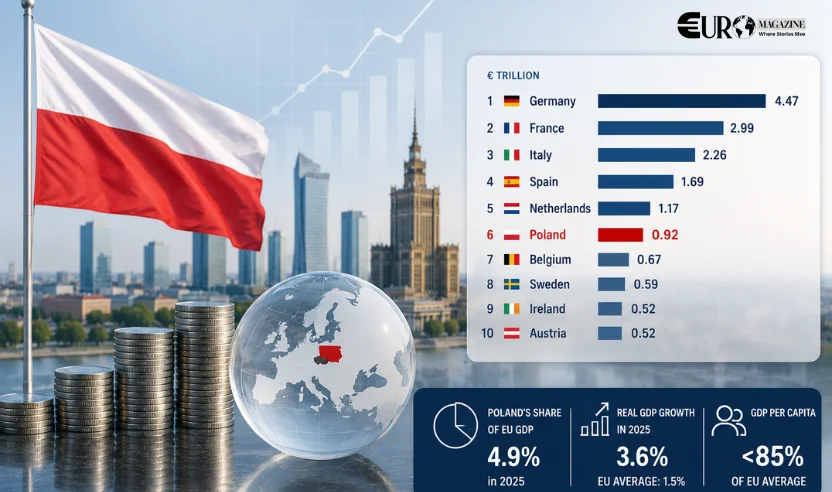
Poland has become the sixth-largest economy in the European Union, with its nominal gross domestic product reaching approximately €923 billion in 2025, placing it behind only Germany, France, Italy, Spain and the Netherlands.
The milestone underscores Poland’s growing economic weight within the bloc after years of steady expansion, rising household consumption, industrial development and investment.
Germany remained the EU’s largest economy in 2025 with GDP of around €4.47 trillion, followed by France, Italy, Spain and the Netherlands. Poland’s €923 billion economy moved it comfortably ahead of Belgium, Sweden, Ireland and Austria in nominal terms.
The combined economic output of the 27-member European Union reached about €18.81 trillion in 2025, meaning Poland accounted for close to 5% of the bloc’s total nominal GDP.
Poland strengthens its position in Central Europe
Poland is now by far the largest economy in Central and Eastern Europe.
Romania recorded nominal GDP of roughly €380 billion in 2025, while Czechia reached about €347 billion and Hungary approximately €219 billion, according to European statistical data compiled by Germany’s Federal Statistical Office.
Poland’s economic expansion has accelerated its convergence with larger Western European economies and strengthened its role in regional manufacturing, services, logistics and investment.
Real GDP grew by 3.6% in 2025, significantly faster than the 1.5% growth recorded across the European Union as a whole.
The European Commission said Poland’s growth momentum has been supported by resilient private consumption and investment, including projects financed through European Union funds.
The country’s relatively strong performance contrasts with slower expansion in several of the EU’s largest economies. Germany, for example, recorded growth of just 0.2% in 2025, while Italy expanded by 0.5%.
Poland’s economy approaches a new global standing
Poland’s rise is also increasingly visible beyond the European Union.
The country crossed the $1 trillion GDP threshold in 2025 in dollar terms and moved into the ranks of the world’s 20 largest economies, reflecting the scale of its transformation since the end of communist rule.
Its growing economic influence is supported by a large domestic market, a diversified manufacturing sector, foreign investment and deep integration into European supply chains.
Poland has also benefited substantially from EU membership, with infrastructure investment and access to the single market contributing to economic modernisation and productivity improvements over the past two decades.
Economic size does not tell the whole story
Despite Poland’s rapid rise in overall economic output, the country still trails richer Western European states when living standards are measured on a per-person basis.
Eurostat’s 2025 purchasing-power data showed Poland’s GDP per capita remained roughly 10% to 20% below the EU average, placing it in the group of member states still working to close the income gap with Western and Northern Europe.
That distinction is important because total GDP measures the overall size of an economy, while GDP per capita provides a clearer indication of economic output relative to population.
Poland therefore combines the scale of one of Europe’s largest economies with living standards that still have room to converge further with the bloc’s wealthiest members.
The European Commission expects growth to remain comparatively strong, forecasting Poland’s economy to expand by around 3.5% in 2026, supported by consumption and high levels of EU-funded investment.
If that momentum continues, Poland’s share of European economic activity could increase further, strengthening its influence in both regional business and wider EU economic policy.
Read more news:-



















Comments
Be the first to share your thoughts.
Leave a comment
Join the conversation. Your email address will not be published.