

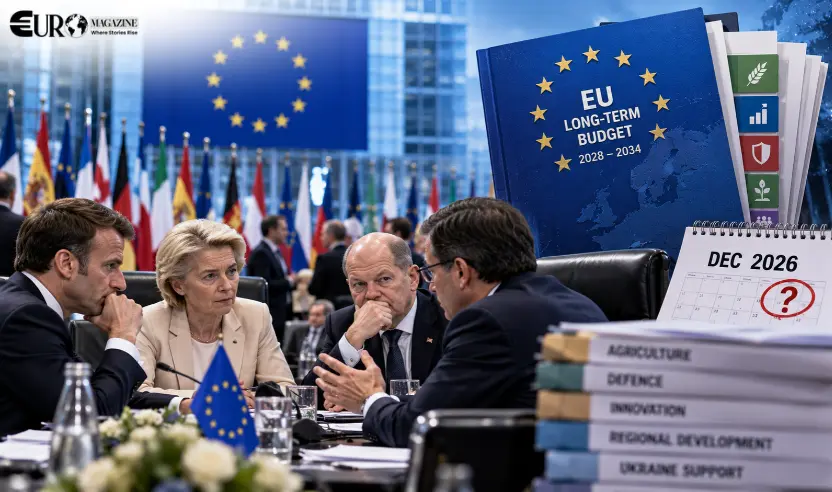
European Union leaders have failed to make significant progress on the bloc’s next long-term budget, raising doubts about whether an agreement can be reached by the end of 2026. Talks in Brussels on October 15 exposed deep divisions over spending priorities, national contributions and the funding needed to support Europe’s economic competitiveness and security.
The proposed budget covers the 2028–2034 period and will determine how the EU finances agriculture, regional development, research, defence-related priorities and support for Ukraine.
EU Leaders Remain Divided Over Budget Priorities
The European Commission initially proposed a long-term budget of around €1.76 trillion in 2025 prices. Ireland, which holds the EU’s rotating presidency, subsequently presented a revised proposal that reduced the total by approximately €141 billion.
However, the compromise failed to satisfy either of the main groups of member states. Countries that contribute more to the EU budget, including Germany and Sweden, want tighter spending controls, while the Friends of Cohesion group is seeking to protect funding for less-developed regions and traditional programmes.
Disagreements also remain over how the budget should be financed, including proposals for new EU-wide revenue sources.
Agriculture and Competitiveness at the Centre of the Dispute
The revised proposal has drawn criticism over its spending priorities. Although it seeks to reduce the overall budget, it protects agricultural support while proposing cuts to areas such as research, clean transport, climate initiatives and international assistance.
Some policymakers argue that the EU needs to direct more funding towards innovation, energy infrastructure and industrial competitiveness to respond to growing competition from the United States and China.
Others are concerned that reducing agricultural and regional development support could hurt rural communities and countries that depend heavily on EU funding.
The disagreement reflects a broader challenge for the bloc: balancing established spending commitments with new economic and geopolitical demands.
António Costa Takes Over Budget Negotiations
Following the inconclusive summit, European Council President António Costa is expected to lead efforts to find a new compromise. He plans to present another negotiating proposal in the coming weeks, ahead of a special EU summit scheduled for November 26.
The revised approach is expected to address concerns over national contributions, potential new revenue sources and the need to retain sufficient financial flexibility for unexpected crises.
EU leaders must ultimately agree unanimously on the seven-year budget, making compromise essential. However, several governments have questioned whether a deal by December is realistic, arguing that reaching an acceptable agreement matters more than meeting an arbitrary deadline.
Delays Could Complicate EU Funding From 2028
Although the new budget will begin in January 2028, an agreement before the end of 2026 would allow EU institutions to complete the necessary legislation during 2027.
A prolonged delay could complicate preparations and create uncertainty for governments, businesses, researchers and regions that depend on European funding. Negotiations may also become more difficult as several member states approach national elections in 2027.
The coming weeks will therefore be critical for determining whether Costa can bridge the divisions between member states. Without meaningful concessions, the EU’s next long-term budget could face a longer and more difficult negotiation process than originally planned.
Read more news:-



























Comments
Be the first to share your thoughts.
Leave a comment
Join the conversation. Your email address will not be published.