

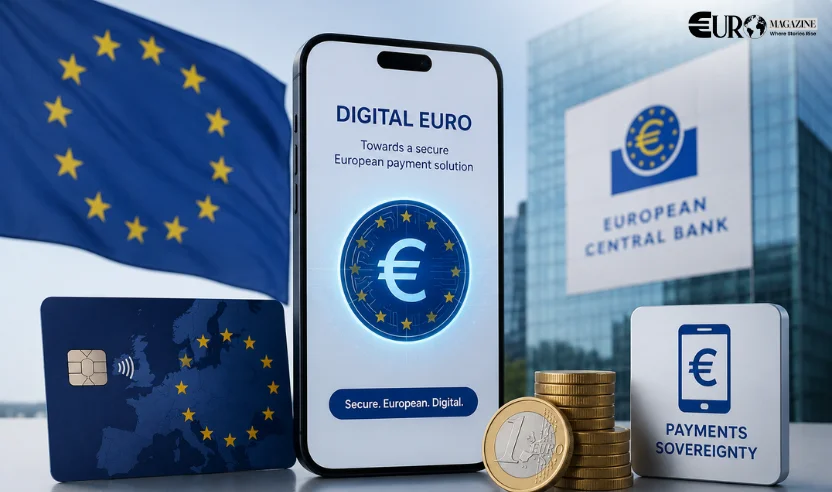
Europe is accelerating efforts to reduce its dependence on US-controlled payment networks as policymakers increasingly view financial infrastructure as a strategic issue rather than simply a question of convenience.
Visa and Mastercard currently account for around 61% of card payments in the euro area, while they dominate almost all cross-border card transactions. That dependence has raised concerns in Brussels over payment security, data control and Europe’s ability to maintain financial autonomy during periods of geopolitical tension.
Digital Euro Moves Closer to Reality
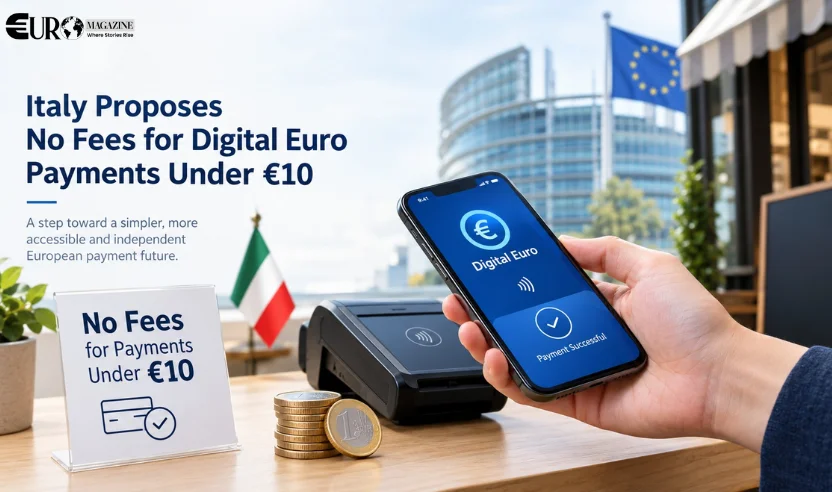
At the centre of Europe’s strategy is the digital euro, an electronic form of central bank money being developed by the European Central Bank.
Unlike cryptocurrencies, the digital euro would be issued and guaranteed by the ECB. It is designed to complement cash and existing banking services rather than replace them.
The proposed system would support both online and offline transactions, while commercial banks and payment providers would distribute digital euro services to customers.
Negotiations between the European Parliament and EU member states are expected to intensify later this year, with final approval currently targeted by the end of 2026.
A pilot programme is expected to begin in 2027 with 36 payment service providers, while broader retail availability is currently planned for 2029.
Europe Seeks Alternatives to Visa and Mastercard
European policymakers argue that reducing reliance on foreign payment systems could strengthen competition while giving the region greater control over its financial data and infrastructure.
ECB President Christine Lagarde has highlighted Europe's dependence on foreign networks and argued that the region needs a payment system it can control domestically.
The push goes beyond the digital euro.
Private European payment systems are also moving toward greater interoperability.
The European Payments Alliance and European Payments Initiative have agreed to connect their instant-payment networks, potentially creating a system capable of reaching around 380 million users across 15 European countries.
The network could eventually allow users of platforms such as Wero, Bizum, MB WAY, Bancomat and other regional services to send money across borders without changing applications.
UK Also Targets Card Network Dependence
Similar efforts are emerging outside the euro area.
The UK Payments Initiative, backed by major banks including Barclays, NatWest, Lloyds and HSBC, has been created to accelerate account-to-account payments and reduce dependence on traditional card networks.
Around 95% of UK card transactions are currently processed using Mastercard or Visa-owned systems, according to figures cited in the source report.
Brazil's PIX Shows Another Model
Europe is also watching the success of homegrown payment networks elsewhere.
Brazil’s PIX instant-payment platform has become one of the most widely used payment methods in the country, accounting for around 54% of transactions, according to Brazilian central bank data cited in the report.
Its rapid adoption demonstrates how domestic instant-payment infrastructure can compete with international card networks while reducing transaction friction.
Colombia is following a similar path with its Bre-B instant-payment system, which recorded 34.6 million customers and more than 638 million transactions during its first six months.
Could Payments Work Like Mobile Roaming?
Another emerging idea is to connect national payment systems internationally rather than forcing consumers to adopt a single global platform.
Brazilian fintech PagBrasil is developing RoamingPay, which aims to allow customers to use their existing banking apps or digital wallets abroad through interoperable QR-code payment systems.
The service is currently available in Brazil, Argentina and Paraguay, with plans for wider expansion.
The concept resembles mobile roaming: consumers would keep their domestic payment provider while being able to use it internationally through connected infrastructure.
Payment Infrastructure Becomes Strategic Priority
The broader debate reflects a major shift in how governments view payments.
What was once largely considered a matter of cost and efficiency is increasingly being treated as an issue of economic sovereignty, data security and geopolitical resilience.
For Europe, the digital euro, private payment interoperability and stronger domestic infrastructure could eventually reduce dependence on foreign networks.
The bigger challenge will be ensuring that European payment systems work not only within the region but also across international markets.
Read more news:-























Comments
Be the first to share your thoughts.
Leave a comment
Join the conversation. Your email address will not be published.