


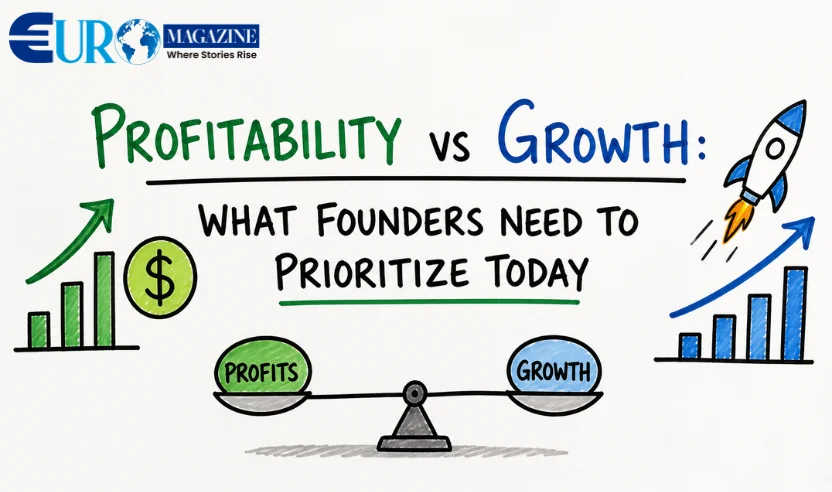
For decades, business success was often measured by a company's ability to grow faster than its competitors. Expanding into new markets, increasing revenues, hiring aggressively, and capturing market share were widely viewed as the primary indicators of corporate strength. Today, however, the conversation in boardrooms across Europe has evolved. While growth remains a critical objective, profitability has returned to the center of strategic decision-making.
As businesses navigate economic uncertainty, fluctuating consumer demand, inflationary pressures, geopolitical developments, and rapid technological change, many leaders are reassessing what sustainable success truly looks like. Rather than pursuing expansion at any cost, organizations are increasingly focused on achieving a balance between growth and profitability—a balance that allows them to remain competitive while building resilience for the future.
Across industries, from manufacturing and retail to technology and financial services, European companies are adopting more disciplined and strategic approaches to growth. They are investing selectively, improving operational efficiency, strengthening financial foundations, and prioritizing long-term value creation over short-term gains. In doing so, they are redefining the modern business playbook.
A Changing Economic Landscape
The European economy continues to face a complex set of challenges. Although inflation has eased in many markets compared to previous years, businesses are still dealing with higher operating costs, evolving regulatory requirements, supply chain disruptions, and ongoing geopolitical uncertainty.
Consumer behavior has also become more difficult to predict. Households remain cautious about spending, while businesses are taking a more measured approach to investment decisions. These conditions have created an environment where companies must be increasingly thoughtful about how they allocate resources and pursue growth opportunities.
In previous periods of economic expansion, organizations could often rely on rising demand to support ambitious growth strategies. Today, the reality is different. Growth opportunities still exist, but achieving them requires greater precision, stronger financial management, and a deeper understanding of market dynamics.
As a result, profitability is no longer viewed simply as an outcome of growth. Instead, it has become a strategic priority in its own right.
Why Profitability Has Regained Importance
The business environment of the past few years has reminded organizations of a fundamental truth: growth without profitability is difficult to sustain.
Investors, stakeholders, and leadership teams are increasingly focusing on financial health, operational efficiency, and long-term resilience rather than expansion alone. Companies are under growing pressure to demonstrate that growth initiatives can generate meaningful returns rather than simply increase revenue.
This shift is particularly evident in sectors that experienced rapid expansion during periods of low interest rates and abundant capital. As financing conditions have changed, businesses have become more selective about investments and more disciplined in evaluating performance.
Profitability provides organizations with flexibility. It enables companies to invest in innovation, weather economic downturns, attract investors, and pursue strategic opportunities without becoming overly dependent on external funding.
For many European businesses, maintaining healthy profit margins has become just as important as increasing market share.
Rethinking Growth Strategies
One of the most significant changes taking place across Europe is a shift away from aggressive expansion toward more sustainable growth models.
Rather than pursuing growth for its own sake, organizations are focusing on opportunities that align with their strengths, capabilities, and long-term objectives. This approach often involves making more deliberate decisions about where to invest and where to exercise restraint.
Businesses are increasingly prioritizing:
- High-value customers over volume-based growth
- Long-term profitability over short-term revenue gains
- Strategic market expansion rather than rapid diversification
- Operational efficiency alongside business development
- Sustainable investment strategies
This more disciplined approach is helping organizations achieve growth while preserving financial stability.
Improving Efficiency Without Sacrificing Innovation
Balancing growth and profitability often requires organizations to improve efficiency without compromising their ability to innovate.
European companies are increasingly leveraging technology to streamline operations, automate repetitive processes, and reduce unnecessary costs. These improvements allow businesses to operate more efficiently while freeing resources that can be redirected toward growth initiatives.
Digital transformation continues to play a critical role in this effort. Organizations are investing in cloud technologies, automation tools, advanced analytics, and artificial intelligence to improve productivity and decision-making.
Importantly, efficiency is no longer viewed solely as a cost-cutting exercise. Instead, it is becoming a means of creating capacity for innovation and future growth.
Businesses that successfully improve efficiency are often better positioned to invest in new products, services, and market opportunities.
The Role of Artificial Intelligence in Driving Smarter Growth
Artificial intelligence is becoming an increasingly valuable tool for companies seeking to balance expansion with profitability.
Organizations across Europe are using AI to analyze customer behavior, optimize pricing strategies, forecast demand, improve inventory management, and identify operational inefficiencies. These capabilities help businesses make more informed decisions while reducing waste and improving resource allocation.
AI is also enabling companies to automate routine tasks, allowing employees to focus on higher-value activities that contribute directly to growth and innovation.
Rather than replacing human expertise, artificial intelligence is helping organizations operate more intelligently and efficiently. Companies that effectively integrate AI into their operations are often able to achieve stronger financial performance while maintaining growth momentum.
Customer Retention Is Becoming as Important as Customer Acquisition
In uncertain economic conditions, acquiring new customers can become more expensive and more challenging. As a result, many European companies are placing greater emphasis on retaining existing customers and strengthening long-term relationships.
Customer loyalty provides a more predictable source of revenue and often generates higher lifetime value than continuous acquisition efforts. Businesses are investing in customer experience improvements, personalized services, and loyalty initiatives designed to increase retention rates.
Organizations are also using data analytics to better understand customer needs and identify opportunities for deeper engagement.
By focusing on customer satisfaction and retention, businesses can support growth while maintaining profitability.
How Leading Companies Are Protecting Margins
Protecting profitability in a challenging economy requires a combination of strategic discipline and operational excellence.
Many successful organizations are implementing measures such as:
- Optimizing supply chain operations
- Improving inventory management
- Investing in automation and productivity tools
- Reviewing pricing strategies regularly
- Strengthening vendor relationships
- Reducing operational inefficiencies
- Prioritizing high-margin products and services
- Enhancing workforce productivity
These initiatives help companies maintain financial performance without compromising their ability to pursue growth opportunities.
Workforce Investment Remains a Growth Priority
Despite economic pressures, leading businesses continue to invest in their people. Organizations increasingly recognize that long-term growth depends on attracting, developing, and retaining talented employees.
Workforce development has become particularly important as digital transformation creates demand for new skills and competencies. Companies are expanding training programs, leadership development initiatives, and employee engagement efforts to ensure they remain competitive in the labor market.
At the same time, businesses are adopting more flexible working models and investing in workplace culture to improve retention and productivity.
The most successful organizations understand that profitability and workforce investment are not competing priorities. In many cases, they are mutually reinforcing.
Sustainability and Long-Term Value Creation
Sustainability is playing an increasingly important role in how companies approach growth and profitability. Investors, customers, and regulators are paying closer attention to environmental, social, and governance performance, making sustainability a strategic consideration rather than a peripheral concern.
European businesses are incorporating sustainability into product development, supply chain management, energy usage, and corporate strategy. These efforts often create opportunities to reduce costs, improve efficiency, strengthen brand reputation, and attract investment.
Organizations that successfully align sustainability goals with business objectives are discovering that responsible growth can also be profitable growth.
Key Lessons From Europe's Most Resilient Businesses
While every organization faces unique circumstances, several common themes are emerging among companies successfully balancing growth and profitability:
- Focus on sustainable rather than aggressive expansion
- Invest in technology that improves efficiency and decision-making
- Prioritize customer retention and lifetime value
- Maintain financial discipline during periods of uncertainty
- Strengthen operational resilience
- Develop talent and leadership capabilities
- Embrace innovation while managing risk
- Align growth initiatives with long-term strategic objectives
These principles are helping businesses remain competitive while navigating increasingly complex market conditions.
Looking Ahead
The challenge facing European companies today is not whether to pursue growth or profitability. It is how to achieve both simultaneously.
In an uncertain economy, organizations can no longer afford to focus exclusively on expansion at the expense of financial performance. Nor can they rely solely on cost-cutting measures that limit future opportunities. Success requires a balanced approach that combines strategic growth initiatives with operational excellence, financial discipline, and long-term thinking.
Europe's most successful companies are demonstrating that sustainable growth and strong profitability are not mutually exclusive. By investing wisely, embracing innovation, strengthening resilience, and maintaining a clear strategic focus, they are building organizations capable of thriving in an increasingly complex business environment.
As economic conditions continue to evolve, the businesses that strike the right balance between ambition and discipline will be the ones best positioned for long-term success. Their experiences offer valuable lessons for leaders seeking to navigate uncertainty while creating lasting value for customers, employees, investors, and society as a whole.
You can also read:-





























Comments
Be the first to share your thoughts.
Leave a comment
Join the conversation. Your email address will not be published.