

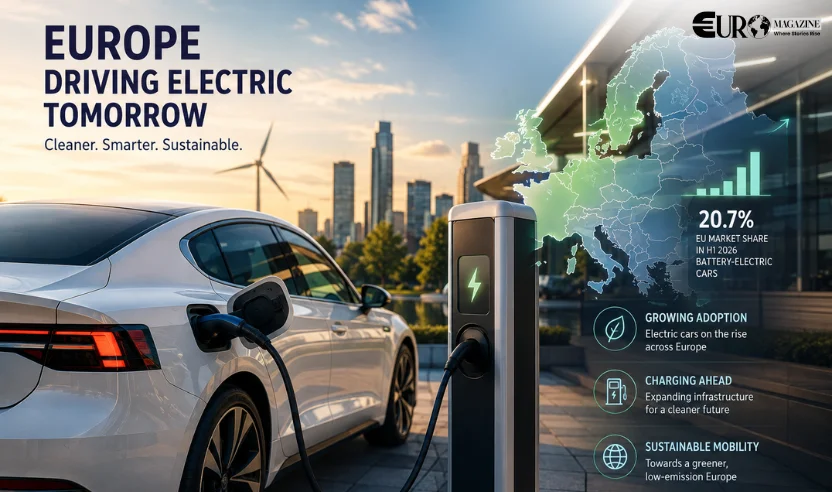
Europe’s shift towards battery-electric cars is gathering pace, but the transition remains sharply divided between countries, with Nordic markets leading adoption while several southern and eastern European nations continue to lag.
Around 1.88 million battery-electric cars were newly registered across the European Union in 2025, giving fully electric models roughly 17.4% of the EU new-car market, according to the European Automobile Manufacturers’ Association (ACEA). That represented a substantial increase from the previous year.
The momentum has continued into 2026. During the first six months of this year, more than 1.22 million battery-electric cars were registered in the EU, lifting their share of new registrations to 20.7%, compared with 15.6% during the same period in 2025.
The figures show that electric vehicles are becoming increasingly mainstream among new-car buyers, even though they still represent a relatively small proportion of the overall vehicle fleet in much of Europe.
Germany Leads Europe by Registration Volume
Germany recorded the largest number of newly registered battery-electric passenger cars in Europe in 2025, with roughly 545,000 vehicles.
The United Kingdom followed with approximately 473,000 registrations, while France recorded about 331,000.
Turkey also emerged as a significant electric-car market with around 187,000 registrations, ahead of several established Western European automotive markets.
Norway registered roughly 173,000 battery-electric passenger cars, followed by the Netherlands at around 156,000 and Belgium at approximately 144,000.
Denmark and Spain also crossed the 100,000 mark, while Italy recorded approximately 95,000 battery-electric registrations.
Registration volume alone, however, does not reveal how deeply electric cars have entered individual markets.
Norway Remains Far Ahead of the Rest of Europe
Measured as a proportion of all new passenger-car registrations, Norway remains in a category of its own.
More than 95% of new passenger cars registered in Norway during 2025 were battery electric, making the country Europe's most advanced market in the transition away from combustion-engine vehicles.
Denmark ranked second, with battery-electric cars accounting for 67.8% of new registrations, while Iceland reached 41.2%.
Malta, Finland, Sweden and Belgium also recorded battery-electric shares above one-third of new passenger-car registrations.
The figures highlight the particularly strong adoption of electric vehicles across northern Europe, where purchasing incentives, charging infrastructure and government policies have helped accelerate the shift.
UK Leads Europe's Largest Economies
Among Europe's major economies, the UK recorded the strongest battery-electric penetration in new-car registrations in 2025, with a share of 23.4%.
France followed at 19.6%, while Germany stood at 19.1%.
The difference was considerably larger further south.
Battery-electric cars represented only 8.7% of new registrations in Spain and 6.1% in Italy, putting both markets well below the EU average.
Turkey stood out among countries outside the EU, with battery-electric vehicles accounting for approximately 16.7% of its new registrations.
At the opposite end of the market, several Balkan and eastern European countries continued to record very low electric-car penetration, with shares below 2% in some markets.
Electric Cars Still Form a Small Part of Europe's Total Fleet
Despite strong growth in new registrations, replacing Europe's existing stock of petrol and diesel cars will take considerably longer.
Battery-electric cars represent only a small percentage of all passenger cars currently on European roads.
Norway again leads, with fully electric vehicles accounting for around 32% of the country's passenger-car fleet in 2025.
Denmark ranked second at approximately 17.9%, followed by Luxembourg at 8.7%, Sweden at 8.6% and the Netherlands at 7.2%.
Across the European Union, however, battery-electric cars account for only around 3% of the total passenger-car fleet, illustrating the scale of the long-term transition still ahead.
Germany's share stood at roughly 4.1%, while France was close behind at 3.9%.
Spain and Italy remained much lower, at around 1.1% and 0.9%, respectively.
In a large number of European countries, fully electric vehicles still represent less than 1% of all passenger cars on the road.
Electric Momentum Strengthens in 2026
More recent registration figures indicate that the transition is continuing to accelerate.
Between January and June 2026, battery-electric vehicles captured 20.7% of the EU new-car market, up from 15.6% a year earlier. France recorded a 62.9% increase in battery-electric registrations, Germany rose 48%, and Denmark grew 41.2%.
At the same time, conventional petrol and diesel vehicles continued to lose market share. Their combined share of EU registrations dropped to 29.7% during the first half of 2026, compared with 37.8% during the same period a year earlier.
The figures point to an increasingly electrified European car market, but they also show that progress remains uneven.
Countries such as Norway and Denmark are already approaching a market dominated by battery-electric vehicles, while other parts of Europe are still at an earlier stage of the transition. The gap means Europe's move towards electric mobility is likely to continue at markedly different speeds across national markets.
Read more news:-

























Comments
Be the first to share your thoughts.
Leave a comment
Join the conversation. Your email address will not be published.