

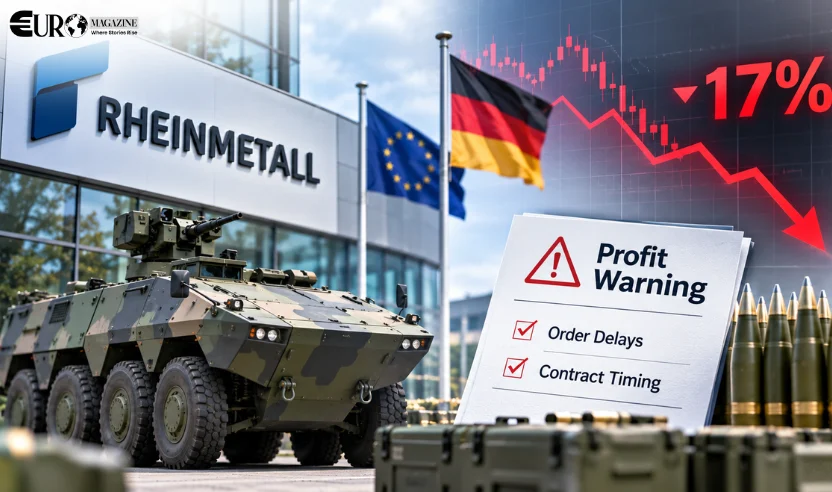
Shares of German defence manufacturer Rheinmetall fell more than 17% on Thursday, November 5, after the company lowered its 2026 revenue and operating margin forecasts, citing delays in major military contracts and ammunition deliveries.
The sharp decline followed the company's announcement that it no longer expects a major German military contract for Boxer armoured vehicles to be awarded before the end of 2026. Delays in ammunition approvals and weaker-than-expected contributions from newer business activities also contributed to the revised outlook.
The warning raised concerns among investors about the company's ability to convert Europe's growing defence spending into revenue and cash flow at the pace previously anticipated.
Rheinmetall Cuts 2026 Revenue Forecast
Rheinmetall now expects full-year 2026 revenue of approximately €13.2 billion, compared with its previous forecast of €13.7 billion to €14.2 billion.
The company also reduced its expected operating margin to around 18.5%, down from approximately 19%.
This marks the second time Rheinmetall has lowered its annual sales outlook in three months. The company had already revised its expectations in August following the cancellation of Germany's F126 frigate programme.
The latest forecast reduction came despite continued growth in its core defence operations.
Boxer Armoured Vehicle Contract Delayed
A major factor behind the revised guidance is Germany's Arminius project, which involves the planned procurement of Boxer wheeled armoured vehicles produced by Rheinmetall and defence partner KNDS.
Rheinmetall had expected the contract to be awarded during 2026, generating substantial advance payments and additional revenue.
However, the company now considers an award before the end of the year unlikely. Consequently, the associated payments and revenue are expected to move into 2027.
The company also reported delays in acceptance procedures for artillery ammunition batches, pushing some expected revenue into the next financial year.
Additionally, revenue opportunities from newer business activities, including its cooperation with Dutch defence technology company Destinus, are expected to contribute less than previously anticipated.
Strong Quarterly Results Fail to Reassure Investors
Despite the weaker annual outlook, Rheinmetall reported strong third-quarter financial performance.
Revenue increased 32% year over year to €3.15 billion, compared with €2.31 billion in the same period last year. Operating profit rose 62% to €553 million, while the operating margin improved to 17.5% from 14.8%.
For the first nine months of 2026, revenue increased 38% to approximately €8.4 billion, while operating profit climbed 69% to €1.34 billion.
However, third-quarter order intake reached €2.89 billion, below reported sales. Operating free cash flow was also negative at €82 million.
These figures added to investor concerns about the timing of contract awards, cash generation and the company's ability to meet its longer-term growth expectations.
European Defence Sector Faces Investor Pressure
Rheinmetall's share decline also placed pressure on other European defence stocks, including BAE Systems, Leonardo, Thales and Saab.
The sell-off reflects growing investor scrutiny of defence companies that have benefited from increased military spending across Europe but are now facing questions about execution, procurement timelines and financial performance.
European governments continue to prioritise military modernisation and defence production following Russia's invasion of Ukraine. However, Rheinmetall's latest warning demonstrates that strong demand does not necessarily translate into immediate revenue.
Investors Reassess Rheinmetall's Growth Outlook
Rheinmetall remains one of Europe's major defence suppliers, supported by a substantial order backlog and ongoing government investment in military capabilities.
Nevertheless, the latest forecast reduction has increased pressure on management to demonstrate that delayed contracts can move forward and that production expansion will deliver the expected financial returns.
For investors, the key question is no longer simply how much Europe plans to spend on defence, but how effectively Rheinmetall can turn those commitments into confirmed orders, deliveries and sustainable cash flow.
Read more news:-






















Comments
Be the first to share your thoughts.
Leave a comment
Join the conversation. Your email address will not be published.