

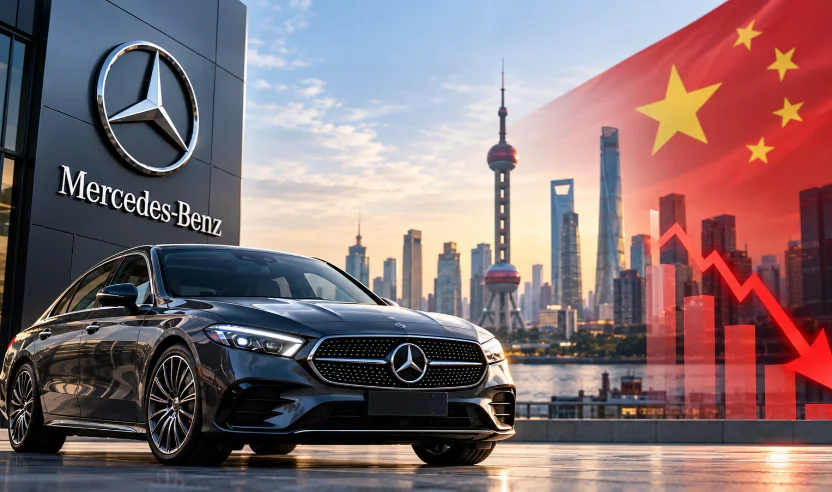
Mercedes-Benz has lowered its 2026 profit forecast, citing intensifying competition and difficult market conditions in China, alongside higher material costs expected in the final quarter of the year. The revised outlook highlights the growing challenges facing Germany’s premium automotive industry as domestic Chinese manufacturers gain ground in the world’s largest car market.
In an announcement on October 27, 2026, the German automaker said it now expects an adjusted return on sales of 2% to 3% for its core car business, down from its previous forecast of 3% to 5%. The company also revised its group operating profit outlook, moving from expectations of significant annual growth to earnings broadly in line with 2025.
The announcement came ahead of Mercedes-Benz’s full third-quarter financial results, scheduled for October 28.
China Competition Puts Pressure on Sales
China remains one of Mercedes-Benz’s most important markets, but demand for premium vehicles has weakened as local manufacturers expand their offerings and compete aggressively on price, technology and features.
Chinese electric vehicle and technology-driven automotive brands have strengthened their positions by introducing new models and offering advanced digital features at competitive prices. This has put pressure on established foreign manufacturers, which have traditionally relied on brand reputation and premium positioning.
Mercedes-Benz’s car sales in China fell 31% year over year in the third quarter, according to figures reported earlier this month. The decline reflects the challenges the company faces in maintaining its market position as consumer preferences shift and competition intensifies.
The pressure is not limited to Mercedes-Benz. German rivals, including BMW and Volkswagen, have also revised their financial expectations amid weaker demand and increasing competition in China.
Higher Costs Add to Financial Challenges
Alongside the difficult market environment, Mercedes-Benz expects higher costs in the fourth quarter, including increased material expenses. These additional pressures have contributed to the company’s decision to lower its full-year forecast.
The company now expects group earnings before interest and taxes (EBIT) to remain broadly at the previous year’s level, compared with its earlier expectation of a significant increase.
Mercedes-Benz also revised its industrial business free cash flow outlook. It now expects free cash flow to be significantly below the previous year’s level, compared with its earlier forecast of a smaller decline.
The updated projections indicate that weaker profitability and higher expenses are affecting not only earnings but also the cash generated by the company’s industrial operations.
Third-Quarter Results Offer a Mixed Picture
Mercedes-Benz’s preliminary third-quarter figures showed group EBIT of €1.77 billion, above the market consensus of €1.6 billion. The adjusted return on sales for its cars division was 2.5%, while the vans division recorded an adjusted return on sales of 9.4%.
Industrial business free cash flow, however, came in at €172 million, significantly below the market consensus of €422 million.
The figures suggest that while some areas of the business performed better than analysts anticipated, cash generation remains under pressure. Investors will be watching the full quarterly report for further details on pricing, costs, regional sales and the company’s financial position.
Following the announcement, Mercedes-Benz shares fell by as much as 5.5% in early trading, reflecting investor concerns about the revised outlook.
Automaker Accelerates Cost-Cutting Measures
Mercedes-Benz has been working to improve efficiency and reduce production costs as competition increases. Its measures include streamlining operations, increasing automation, lowering energy and logistics expenses, and shifting some production to lower-cost locations.
The company is also planning more than 40 new models over the coming years, aiming to refresh its product range and strengthen its position in key markets.
However, new vehicle launches and cost reductions may take time to offset the effects of weaker demand and pricing pressure. The company must also balance efficiency improvements with investment in electric vehicles, software and other technologies needed to remain competitive.
Outlook Remains Challenging for German Carmakers
Mercedes-Benz’s revised forecast underscores the structural difficulties facing German manufacturers in China. Slower demand, aggressive competition from local brands and changing consumer expectations are forcing established automakers to reconsider their pricing strategies, product development and cost structures.
The company’s performance in the coming quarters will depend on whether new models attract customers, cost-saving measures improve margins and demand stabilises in key markets.
For now, the lower profit forecast signals a more difficult year for Mercedes-Benz than previously expected. The company’s full third-quarter results and subsequent guidance will provide further indications of how it plans to navigate the changing global automotive market.
Read more news:-



























Comments
Be the first to share your thoughts.
Leave a comment
Join the conversation. Your email address will not be published.