

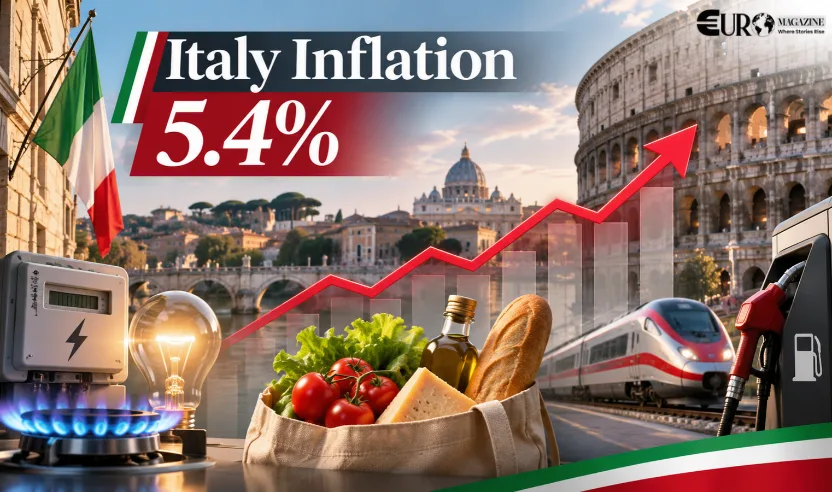
Italy's annual inflation rate accelerated to 5.4% in October 2026, rising sharply from 4.2% in September as soaring energy prices, higher food costs and expensive transport services increased pressure on households and businesses.
Preliminary figures released by Italy's national statistics agency, Istat, on October 30 showed that inflation reached its highest level since August 2023. The increase also exceeded economists' expectations of approximately 4.6%, highlighting the growing impact of geopolitical tensions on Europe's economy.
Energy Prices Drive Inflation Higher
Energy costs were the biggest contributor to the acceleration. According to Istat, annual energy price growth increased to 31.4% in October from 22.6% in September.
Regulated energy prices, including certain electricity and gas tariffs, surged by 59.5% year over year, compared with 25.8% in the previous month. Non-regulated energy prices also accelerated, rising 29.4% against 22.5% in September.
The increase has been linked to disruptions in international energy markets following the Iran war, which have contributed to higher oil and gas prices.
Food and transport costs added further pressure. Unprocessed food prices increased by 7.5%, up from 5.5% in September, while transport service inflation accelerated to 3.1% from 1.6%.
Overall, consumer prices increased by 0.9% compared with September.
Household Budgets Face Growing Pressure
The rapid increase in essential expenses is creating additional financial pressure for Italian households, particularly those already dealing with higher living costs.
Rising electricity, gas and fuel bills can also increase operating expenses for businesses, potentially leading to higher prices for goods and services.
Core inflation, which excludes energy and unprocessed food, increased to 2% from 1.6%, suggesting that price pressures are extending beyond energy-related categories.
The rising cost of living has also contributed to public demonstrations in Italy, with workers and other groups expressing concerns about wages, household expenses and economic conditions.
Italy's Economic Growth Stalls
The inflation surge comes as Italy's economy struggles to maintain growth. Separate preliminary Istat figures showed that gross domestic product remained broadly unchanged in the third quarter of 2026 compared with the previous three months.
The economy recorded annual growth of 0.8%, but the quarterly stagnation highlights the challenges facing the country's recovery.
The combination of rising prices and weak economic growth could complicate the outlook for households, businesses and policymakers.
Implications for the European Economy
Italy's inflation increase adds to wider concerns about energy-driven price pressures across Europe. Higher energy costs could influence monetary policy decisions as the European Central Bank works to maintain price stability.
Istat's October figures are preliminary, with final data scheduled for November 17, 2026. The coming months will be important in determining whether energy-related inflation continues to accelerate or begins to ease as global supply conditions change.
Read more news:-





























Comments
Be the first to share your thoughts.
Leave a comment
Join the conversation. Your email address will not be published.