

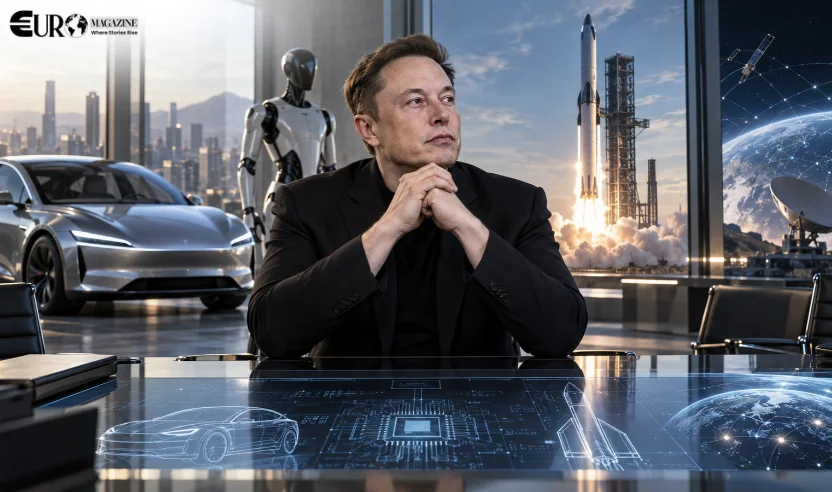
Elon Musk is pushing to explore a potential merger between Tesla and SpaceX, a deal that could create a technology giant valued at approximately $3.5 trillion. According to a Bloomberg report published on October 22, people familiar with the discussions say there is pressure to announce an agreement in the first half of 2027 and complete it before US President Donald Trump leaves office in January 2029. Both companies have confirmed that independent board committees are examining the proposal, although no final agreement has been reached.
AI and Robotics Drive the Merger Vision
Musk has argued that combining Tesla and SpaceX could strengthen their work in artificial intelligence, robotics, computing infrastructure and satellite communications. The companies are already collaborating on Terafab, a major AI chip manufacturing project in Texas.
Tesla is developing autonomous vehicles, robotaxis and its Optimus humanoid robots, while SpaceX operates the Starlink satellite network and is expanding its AI computing business. A combined company could potentially share technology, engineering resources and infrastructure across these operations.
Musk has described closer cooperation on advanced AI software as a major potential benefit. However, the extent of the financial and operational advantages would depend on the structure and terms of any eventual transaction.
Why the Trump Administration Matters
The reported timeline has raised questions about why Musk wants a potential deal completed while Trump remains president. Bloomberg, citing people familiar with the matter, reported that the aim is to secure an agreement while the current administration is still in office.
Musk previously worked with the Trump administration on government cost-cutting initiatives before the two had a public falling-out. Their relationship has since improved, and Musk has returned to public engagement with the president.
The political timing may reflect uncertainty about future government oversight, federal contracts and the regulatory environment. SpaceX works closely with US government agencies, while Tesla has substantial manufacturing operations in China. Changes in political priorities could therefore affect the companies in different ways.
However, neither company has publicly established that the proposed merger must be completed before Trump leaves office, and the reported deadline remains unconfirmed as a formal corporate requirement.
Financial Differences Add to the Merger Appeal
SpaceX has recently reported strong growth, supported by Starlink, rocket launches and its expanding AI business. Tesla, meanwhile, faces pressure from competition in the electric vehicle market and rising investment requirements for autonomous driving and robotics.
Tesla reported third-quarter net income of $787 million in 2026, down 43% from a year earlier, while revenue remained broadly flat at approximately $28 billion. SpaceX reported quarterly revenue of $14.6 billion and net income of $4.4 billion for the same period.
Combining the businesses could give the group access to a broader range of revenue streams and allow greater coordination of investment. But it would also bring together companies with different operating models, customers, risks and capital requirements.
Shareholder Approval and Regulatory Hurdles Remain
Despite Musk’s support, the merger is far from certain. Both companies must assess the proposal through their governance processes, and any transaction would face shareholder approval requirements and potential regulatory scrutiny.
Musk’s leadership roles and ownership interests in both businesses also raise questions about conflicts of interest, valuation and whether the terms would fairly treat shareholders of each company. The companies have established independent committees to examine the proposal.
Regulatory concerns could be particularly complex because SpaceX has defence and government contracts, while Tesla operates in international automotive markets, including China. Combining the businesses could trigger scrutiny related to national security, competition and cross-border operations.
For now, the proposal reflects Musk’s ambition to bring AI, robotics, electric vehicles and space technology closer together under one corporate structure. Whether the deal advances will depend on negotiations, financial terms, regulatory reviews and the willingness of shareholders to approve it.
Read more news:-



















Comments
Be the first to share your thoughts.
Leave a comment
Join the conversation. Your email address will not be published.