

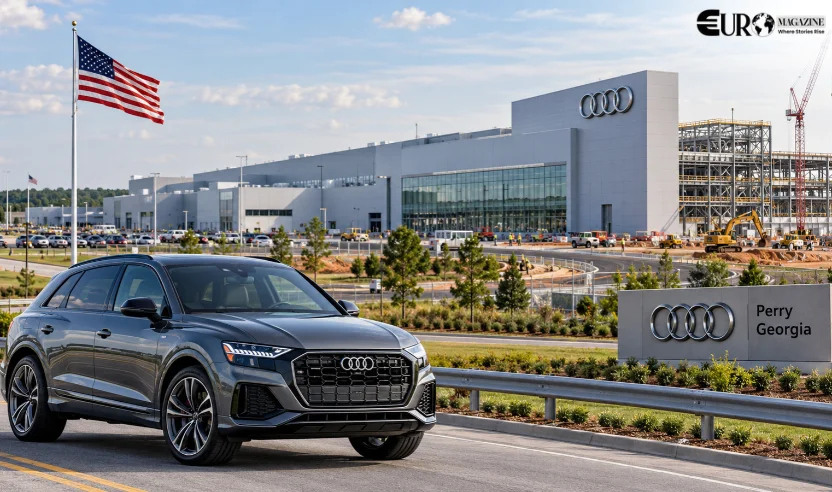
German luxury carmaker Audi plans to invest approximately $4.2 billion in its first dedicated vehicle production plant in the United States, marking a major expansion of its North American operations. The announcement was made on October 24, 2026, by US President Donald Trump alongside Audi CEO Gernot Döllner at an event in Perry, Georgia.
The factory is planned near Macon, Georgia, and is expected to produce up to 200,000 vehicles annually. Audi says the investment reflects its long-term commitment to the American market, where it aims to strengthen its position in the premium SUV segment.
New Georgia Plant to Create Around 4,500 Jobs
The proposed facility is expected to create approximately 4,500 jobs, with preparatory work scheduled to begin in 2027 and production targeted for the early 2030s. Georgia officials have identified 2031 as the target for full production.
The plant is expected to manufacture Audi’s larger, premium sport utility vehicles, including the Q7, Q8 and Q9. The project could also generate additional employment across regional suppliers, logistics providers and other supporting industries.
US Tariffs Influence Audi’s Expansion Strategy
Audi’s investment comes as the Trump administration maintains tariffs on imported vehicles and parts, increasing the cost of supplying the US market from overseas factories.
Reuters reported that tariffs cost Audi approximately €1.2 billion ($1.4 billion) last year. Establishing local production could help the company reduce its exposure to import duties while lowering transportation costs and strengthening its supply chain.
Trump has presented the investment as evidence that his trade policies are encouraging foreign manufacturers to build vehicles in the United States. However, Audi’s decision also reflects broader business considerations, including access to American customers, existing automotive suppliers and the potential for long-term growth.
Why Audi Chose Georgia
Georgia offers established automotive infrastructure, transport connections and access to a skilled workforce. The state already hosts major automotive manufacturing operations, making it an attractive location for a large-scale vehicle assembly facility.
The proposed site near Macon could help Audi serve US customers more directly while complementing the Volkswagen Group’s existing North American manufacturing network. Audi has also indicated that its German and European operations will remain central to its industrial strategy.
What the Investment Means for Audi
The planned factory represents a significant change in Audi’s US strategy, as the company has historically supplied American customers with vehicles manufactured in Europe and Mexico.
Local production could improve Audi’s ability to manage trade costs, respond to regional demand and compete with luxury automakers that already manufacture vehicles in the United States. Nevertheless, the project remains subject to the relevant Volkswagen Group approval processes, and production is not expected to begin until the early 2030s.
The investment also raises questions about the future distribution of manufacturing across the Volkswagen Group’s global operations. While the expansion is expected to create jobs in Georgia, its long-term impact on employment and production in Germany will depend on how the company develops its international manufacturing strategy.
Read more news:-






























Comments
Be the first to share your thoughts.
Leave a comment
Join the conversation. Your email address will not be published.