

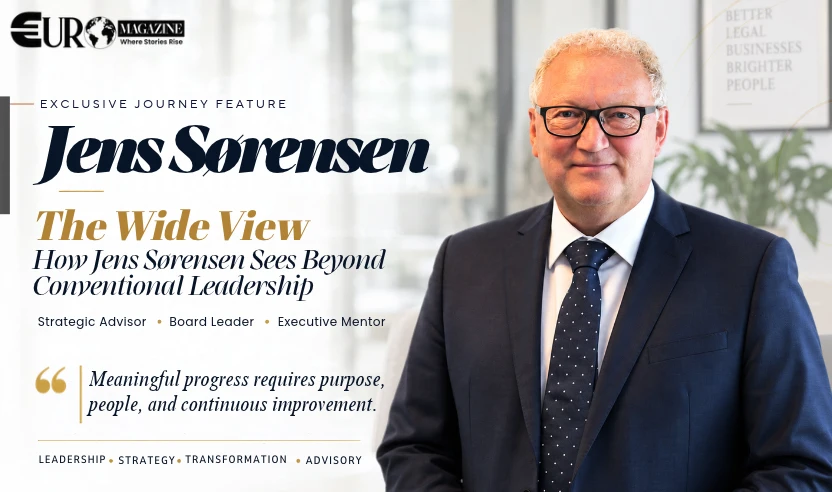
For Jens Sørensen, the difference between ordinary performance and extraordinary results begins long before a strategy is put into action. It begins with people, the structures that support them, and the willingness to challenge established ways of thinking. This conviction has shaped a career spanning nearly five decades, during which he has consistently placed organizational culture, independent thinking, and continuous improvement at the center of his leadership philosophy.
Born in Middelfart, Denmark, Sørensen began his professional journey in 1977 and went on to hold senior executive positions across Scandinavia and Germany. From overseeing finance and administration to leading major automotive wholesale operations, his career has been marked by significant business achievements, including tripling FTZ's turnover and developing the One House Philosophy during his work with Hella. Today, through The Wide View, he brings his experience to strategic advisory, board leadership, mentorship, and business transformation across industries.
Yet what makes Sørensen's journey particularly interesting is his approach to leadership itself. He believes structure must come before strategy, that boards should guide rather than control, and that successful organizations depend on the people behind their performance. His independently developed management tools, commitment to standing by his teams, and belief in finding opportunities even in difficult circumstances reflect a professional philosophy that extends beyond conventional management practices.
In this exclusive feature with The Euro Magazine, Jens Sørensen shares the experiences that have shaped his career, the principles behind his distinctive management approach, and the lessons he has drawn from decades of executive leadership. From his concept of Fingertip Management to his belief in being a move-around expert, his story offers an insightful perspective on leadership, adaptability, and the ongoing pursuit of excellence.
A Career Built on Leadership and Experience
Born on July 18, 1959, in Middelfart, Denmark, Jens Sørensen has built a professional career spanning several decades, with extensive experience in executive leadership, finance, administration, strategic advisory, and the automotive industry. With national and international education, including studies at Henley Business School, he has developed expertise that extends across multiple industries.
Today, he serves as a strategic advisor, professional board and advisory board member, chairman, generalist, and speaker. While his expertise is particularly strong within the automotive industry, his advisory work extends across industries, reflecting the philosophy behind his professional identity, The Wide View: Beyond the Possible.
His professional journey began in 1977 with Lydex, Walker, and Tenneco, where he worked until 1998 as a senior executive responsible for finance and administration across Scandinavia.
From 1999 to 2000, he served as CEO of ad-DATI, which was Denmark's largest automotive wholesale cooperation at the time.
Following this period, he was headhunted by Egon Zehnder, leading to further executive responsibilities within the automotive sector.
Between 2001 and 2014, Sørensen was associated with FTZ, Denmark's largest independent automotive wholesale company, initially as chairman and later as CEO. During his leadership, the company's turnover tripled over a few years. Alongside this achievement, he helped establish the Nordic Forum, a strategic initiative designed to reach approximately €640 million in turnover.
From 2003 to 2006, his responsibilities also extended into Germany, where he worked with Hella, headquartered in Lippstadt. During this period, he developed the One House Philosophy within Hella and its aftermarket operations. Hella was also the majority shareholder of FTZ at the time.
The philosophy focused on bringing people together, creating a positive organizational culture, and encouraging individuals to contribute their best. Sørensen describes it as a cultural transformation that brought greater happiness into the workplace and an additional 10% contribution from each individual.
The three-year period delivered extraordinary results, with successive records reflecting the effectiveness of this people-centered approach.
Since 2015, Sørensen has focused on developing The Wide View, providing high-level strategic advisory services across industries, alongside his expertise in mergers and acquisitions (M&A).
Throughout his career, one belief has remained central to his approach: To become successful, a leader must first care about the soul of a company. Otherwise, its inner mechanism will eventually die.
Putting Structure Before Strategy
One of the defining characteristics of Sørensen's leadership philosophy is his belief that organizational structure must come before strategy.
He explains that a strategy cannot be successfully developed or implemented without first establishing the right guiding principles, organizational framework, and people capable of carrying it forward.
For him, successful leadership begins with creating the conditions in which people can perform effectively. Rather than focusing exclusively on business plans and financial objectives, he places significant importance on the human foundations of an organization.
This philosophy also influences his perspective on corporate governance and the responsibilities of board members.
He believes that it is not the board's responsibility to run the show, but rather to provide the guidance and support necessary for management to perform effectively.
His approach reflects a clear distinction between operational leadership and board-level guidance, emphasizing the importance of supporting management rather than controlling every decision.
Another principle that shapes his professional outlook is his belief in attitude and gratitude, which he considers important elements of professional and personal success.
The Person Behind the Leadership
Beyond his executive achievements, Sørensen describes himself as a people person who values meaningful relationships, trust, and carefully developed professional networks.
He believes his inner strength is the foundation of his external capabilities. He is selective about the people with whom he works and builds relationships, investing considerable effort in establishing lasting connections.
He also considers himself a facilitator of success, someone who helps others develop their capabilities and achieve their objectives.
This perspective explains his strong opposition to command-and-control leadership styles, which he actively seeks to avoid.
His professional philosophy is rooted in continuous personal development and the belief that recognition represents one of the highest forms of achievement.
Sørensen believes that his performance book will never be finished, as he will continue adding new pages throughout his professional journey.
He also considers achieving recognition to be the highest level of accomplishment, reflecting his commitment to learning, improvement, and helping others succeed.
Five Principles of His Management Approach
Over the years, Sørensen has developed five management tools that he collectively describes as the five spikes on his star.
These tools represent different aspects of his approach to organizational management, operational performance, and strategic development:
-
One House Philosophy: A people-centered approach to bringing individuals together and strengthening organizational culture.
-
A-B-C Roll-out & Costing: One of his independently developed management tools.
-
Chamber of Control Kit: A tool within his broader management framework.
-
Rating System: A structured approach to evaluating business functions and management performance.
-
Savings by Coming First: Another element of his independently developed management methodology.
Alongside these five tools, he has established what he calls his Operational Tower, a framework that allows him to maintain a broad perspective on organizational performance.
His Operational Tower focuses on three essential priorities: seeking constant improvements, following financial movements on an international scale, and exploring transformation and innovation through new approaches and solutions.
Together, these principles reflect his preference for proactive management, continuous evaluation, and developing practical solutions rather than relying solely on conventional leadership models.
Achievements That Matter Most
When reflecting on his extensive executive career, Sørensen identifies two achievements that hold particular personal significance.
The first is his record of never missing a budget while serving as CEO. The second, and equally important, is his commitment to standing by his people, regardless of the circumstances.
He explains that he never left his team members to face challenges alone, considering their well-being and professional support fundamental responsibilities of leadership.
For Sørensen, these achievements represent both operational discipline and personal accountability. They demonstrate his belief that financial performance and loyalty to people should work together rather than exist as competing priorities.
Moving Beyond Conventional Management
Sørensen acknowledges that managing an organization according to established principles and leadership literature can be valuable. However, he believes that relying exclusively on standard management books and educational approaches, particularly those repeated year after year, rarely produces extraordinary results.
His own approach involves continuously challenging himself to develop intelligent additions and independently created management tools that help him remain ahead of conventional practices.
He describes this process as his personal and ongoing pursuit of excellence.
Rather than treating established management frameworks as fixed solutions, he believes leaders should continually examine how those frameworks can be improved, adapted, or supplemented.
This commitment to independent thinking has influenced the development of his management systems and his approach to solving complex business challenges.
Fingertip Management and Performance Evaluation
Early in his career, Sørensen recognized the importance of having reliable methods for evaluating organizational performance and management effectiveness.
To address this, he developed his own rating systems covering business functions and direct reports across management levels.
These systems enabled him to assess performance, identify areas requiring attention, and redirect activities when necessary.
He refers to this approach as Fingertip Management, emphasizing the ability to maintain close awareness of organizational performance while responding efficiently to changing circumstances.
For Sørensen, the purpose of these systems was not simply to measure performance but to provide the information and flexibility needed to make timely management decisions.
Balancing Strategy, Guidance, and Development
Today, Sørensen's professional responsibilities are primarily focused on board work, strategic advisory, and mentorship.
He approaches these responsibilities through a deliberate allocation of his working time, ensuring that operational understanding, guidance, personal development, and reflection each receive appropriate attention.
He dedicates approximately 50% of his working time to support and analysis, covering all functional elements of business operations. Another 25% is allocated to guidance and idea generation, allowing him to provide strategic direction and explore new possibilities.
He spends 15% of his time on personal development, continuously evaluating how he can improve his own capabilities and professional approach. The remaining 10% is devoted to reflection, giving him an opportunity to assess experiences, reconsider approaches, and identify areas for further improvement.
This structure reflects his belief that effective strategic leadership requires a balance between understanding existing operations and exploring opportunities for future improvement.
He also makes an important distinction when describing his professional capabilities.
Rather than identifying himself solely as a turnaround expert, Sørensen considers himself a move-around expert, someone who seeks opportunities regardless of the circumstances or challenges presented.
He believes that whatever situation arises, there is always a way to identify opportunities and move forward.
Beyond Business: Books and Music
Sørensen's interests extend beyond executive leadership and strategic advisory.
Alongside his business career, he has released 10 books and recorded five music albums, demonstrating his involvement in both writing and music.
His LinkedIn profile also mentions Memorial Picks, his first vinyl record, planned for release in 2026.
These creative pursuits form another dimension of his professional and personal identity, complementing a career built around leadership, independent thinking, and continuous development.
A Purpose-Driven Approach to the Future
Looking ahead, Sørensen remains committed to the belief that everything he undertakes must be driven by a clear purpose.
He describes himself as a doer who prefers finding ways to change situations rather than bringing activities to a complete stop.
This practical outlook is closely connected to his conviction that improvement is always possible, regardless of how successful an organization or individual may already be.
He does not consider any achievement to be the final destination. Instead, he views progress as an ongoing process that requires curiosity, determination, and a willingness to explore new approaches.
For Sørensen, everything must be 100% purpose-driven. He prefers changing things rather than stopping them and acknowledges that he is never completely satisfied with the status quo, as he believes there is always room for improvement.
Conclusion
For Jens Sørensen, a successful career is not measured solely by financial achievements, executive positions, or the ability to navigate complex business environments. It is equally defined by the people supported along the way, the relationships built through trust, and the willingness to take responsibility when challenges arise. His pride in never missing a budget as CEO is matched by his commitment to never leaving his people to face difficulties alone, reflecting the balance between performance and human values that has guided his leadership.
Throughout his professional journey, Sørensen has demonstrated a preference for developing his own approaches rather than relying entirely on established management practices. From the One House Philosophy to his independently developed rating systems and Fingertip Management, his methods reflect a consistent desire to understand organizations more deeply, encourage individual contributions, and identify opportunities for improvement. His transition from operational leadership to strategic advisory through The Wide View has allowed him to continue applying these principles across different industries.
What remains particularly distinctive about his outlook is his refusal to regard any achievement as a final destination. Whether guiding businesses, mentoring leaders, exploring new ideas, or pursuing his interests in writing and music, Sørensen continues to embrace development as an ongoing process. His belief in being a move-around expert reflects this mindset, emphasizing the importance of adapting to circumstances and finding ways forward rather than simply accepting limitations.
As Sørensen continues his work in strategic advisory and board leadership, his journey reflects a principle that has remained consistent throughout his career: meaningful progress requires purpose, strong human foundations, and the determination to keep improving. Through The Wide View: Beyond the Possible, he continues to approach leadership with the conviction that even when results are strong, there is always another opportunity to learn, rethink, and move forward.
Read More Articles:-

















Comments
Be the first to share your thoughts.
Leave a comment
Join the conversation. Your email address will not be published.