

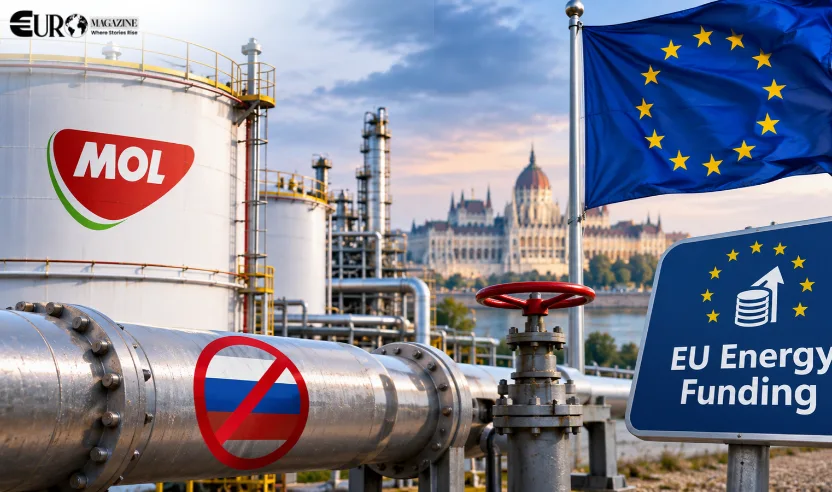
Hungarian oil and gas company MOL is seeking financial support from the European Union to reduce its dependence on Russian crude oil, warning that the transition could increase energy costs and create social and political tensions in Hungary and Slovakia.
MOL Hungary CEO György Bacsa told Euronews that the company expects to be technically ready to phase out Russian oil imports by the end of 2027. However, he stressed that additional investment in alternative supply routes and pipeline infrastructure will be necessary to complete the transition.
Higher Energy Costs Raise Concerns
Bacsa warned that replacing relatively cheaper Russian crude with alternative supplies could significantly increase energy expenses for both countries.
According to a 2025 International Monetary Fund study, a complete disruption of Russian energy supplies could increase Hungary's energy spending by approximately 15% by 2030.
He cautioned that higher costs could put pressure on households and businesses, potentially contributing to social unrest and political instability.
Hungary and Slovakia remain heavily dependent on Russian crude transported through the Soviet-era Druzhba pipeline. The European Commission has made reducing this dependence a priority under its broader energy diversification strategy.
MOL Calls for European Infrastructure Investment
MOL is asking the EU to establish a dedicated funding programme to expand and connect oil, gas, electricity and petroleum product networks across Central and Eastern Europe.
The company argues that restrictions on funding fossil fuel infrastructure projects have made it difficult to secure financial support for alternative supply routes.
One important option is the Adria pipeline, which connects Croatia with Hungary and could provide an alternative to Russian supplies. However, MOL and Croatian pipeline operator JANAF have faced disagreements over transportation capacity, testing and transit fees.
MOL is also interested in connecting Hungary to the TAL pipeline network, which runs from Trieste towards Germany.
EU Maintains Focus on Ending Russian Energy Dependence
The European Commission has indicated that discussions on fossil fuel infrastructure projects remain possible, but reducing reliance on Russian energy continues to be its central objective.
Russia's share of EU oil imports has fallen from 27% in 2021 to approximately 2%, according to the Commission.
MOL says it remains committed to complying with EU regulations while diversifying its supplies. The company's request for European funding highlights the economic and infrastructure challenges facing countries that still rely heavily on Russian energy.
Read more news:-
















Comments
Be the first to share your thoughts.
Leave a comment
Join the conversation. Your email address will not be published.