
whatsapp

Automation vs Human Judgment: Finding the Right Balance

  • 0
  • 390
/media/TEM_1_UBi09Kg.webp © Image Copyrights Title

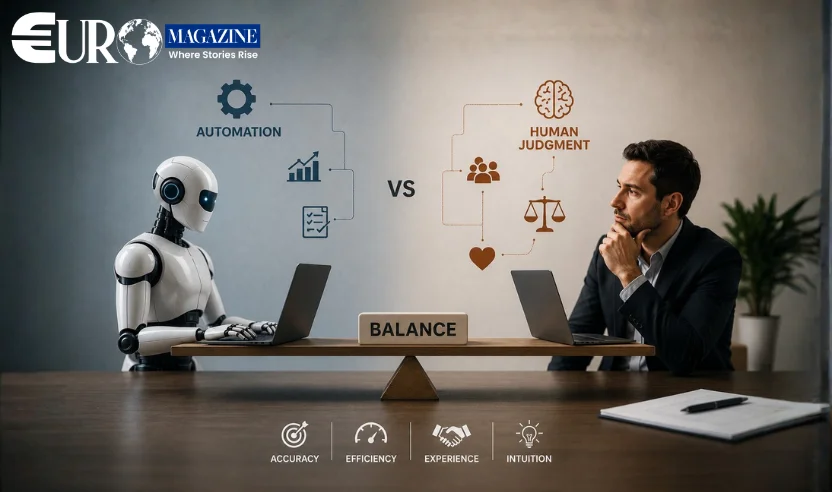
Automation has become a central part of modern business operations. From data processing and customer support to decision-making systems, organizations are increasingly relying on technology to improve efficiency, reduce costs, and scale operations. Automation promises speed, consistency, and the ability to handle large volumes of work with minimal human intervention. At the same time, human judgment remains essential. Not all decisions can be reduced to data points or predefined rules. Many situations require context, experience, and critical thinking qualities that automation cannot fully replicate. The challenge for businesses today is not choosing between automation and human involvement. It is understanding how to balance both effectively to achieve better outcomes.

The Rise of Automation in Business

Automation has expanded rapidly due to advancements in artificial intelligence, machine learning, and digital infrastructure.

Organizations are automating tasks that were previously manual, particularly those that are repetitive, time-consuming, or data-intensive. This shift has improved operational efficiency across multiple functions.

Automation is now commonly used for:

  • Processing large datasets
  • Managing routine customer interactions
  • Streamlining internal workflows
  • Supporting decision-making through analytics

These applications allow businesses to operate faster and with greater consistency.

The Strength of Human Judgment

While automation excels in structured environments, human judgment is critical in situations that involve uncertainty, complexity, and interpretation.

Human decision-making is shaped by:

  • Experience and intuition
  • Contextual understanding
  • Ethical considerations
  • Ability to adapt to unexpected scenarios

In many business contexts, especially those involving strategy, leadership, and customer relationships, human judgment remains indispensable.

Automation can support decisions, but it cannot fully replace the nuanced thinking required in complex situations.

Where Automation Adds the Most Value

Automation is most effective when applied to tasks that follow clear rules and predictable patterns.

These include:

  • Repetitive operational tasks
    Such as data entry, transaction processing, and routine reporting
  • High-volume data analysis
    Identifying trends and patterns across large datasets
  • Standardized customer interactions
    Handling basic queries through chatbots or automated systems
  • Process optimization
    Improving efficiency in supply chains and internal workflows

In these areas, automation reduces errors, saves time, and allows employees to focus on higher-value work.

Where Human Judgment Remains Critical

There are areas where automation alone is not sufficient.

Human involvement is essential in situations that require interpretation, creativity, or ethical consideration.

Key areas include:

  • Strategic decision-making
    Defining long-term direction and evaluating complex trade-offs
  • Customer relationship management
    Handling sensitive interactions and building trust
  • Crisis management
    Responding to unexpected challenges where predefined rules may not apply
  • Innovation and creativity
    Developing new ideas and approaches that require original thinking

In these contexts, human judgment ensures that decisions are aligned with broader business goals and values.

The Risks of Over-Automation

While automation offers clear benefits, excessive reliance on it can create challenges.

Organizations that automate without clear boundaries may experience:

  • Loss of human oversight
  • Reduced flexibility in decision-making
  • Overdependence on data-driven outputs
  • Difficulty handling exceptions or unique cases

Automation systems operate based on predefined logic. When situations fall outside that logic, they may produce inaccurate or incomplete results.

Maintaining human involvement helps mitigate these risks.

The Risks of Underutilizing Automation

On the other hand, failing to adopt automation can also limit business performance.

Organizations that rely too heavily on manual processes may face:

  • Slower operations
  • Higher operational costs
  • Increased risk of human error
  • Limited scalability

The absence of automation can prevent businesses from achieving efficiency and consistency at scale.

Key Factors in Achieving the Right Balance

Finding the right balance between automation and human judgment requires a structured approach.

Organizations should consider:

  • Nature of the task
    Whether it is repetitive and rule-based or complex and variable
  • Impact of errors
    High-risk decisions may require human oversight
  • Need for flexibility
    Tasks that involve changing conditions benefit from human involvement
  • Scalability requirements
    Automation is essential for handling large volumes efficiently

Evaluating these factors helps determine where automation should be applied and where human input should be retained.

Building a Hybrid Decision-Making Model

The most effective organizations are not choosing between automation and human judgment, they are combining both.

In a hybrid model:

  • Automation handles data processing and routine tasks
  • Human judgment is applied to interpretation and decision-making
  • Systems are designed to escalate complex cases to human review

This approach ensures that efficiency is achieved without compromising quality or flexibility.

The Role of Leadership in Managing the Balance

Leadership plays a critical role in defining how automation is implemented.

Leaders must:

  • Set clear boundaries for automation use
  • Ensure teams understand when human input is required
  • Align technology adoption with business objectives

Effective leadership ensures that automation enhances performance rather than replacing critical thinking.

Conclusion

The question is no longer whether businesses should adopt automation, it is how they should use it effectively.

Automation brings efficiency, speed, and consistency. Human judgment brings context, adaptability, and insight.

The most successful organizations are those that recognize the strengths of both and design systems that integrate them seamlessly.

In a rapidly evolving business environment, the advantage lies not in choosing one over the other, but in building a balanced approach that leverages the best of both worlds.


You can also read:-

Related Posts
© Profitability vs Growth: What Founders Need to Prioritize Today

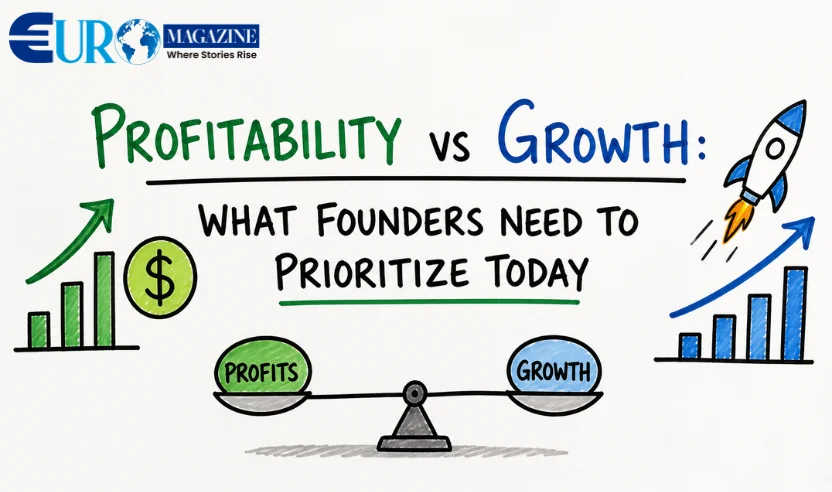
Profitability vs Growth: What Founders Need to Prioritize Today

For a long time, the startup world operated on a clear belief: growth comes first, profitability comes later. Founders were encouraged to scale quickly, capture market share, and build visibility, oft...

  • 1023
© Entering the European Market: Strategy, Structure, and Reality

Entering the European Market: Strategy, Structure, and Reality

Entering the European market is often perceived as a single strategic decision. In reality, it is a sequence of interdependent choices involving regulation, structure, localisation, and long-term comm...

  • 1157
© From Startups to Boardrooms: The Business Journey of Women Leaders

From Startups to Boardrooms: The Business Journey of Women Leaders

Not too long ago, women in business were often expected to stay behind the scenes. Today, they are starting companies, leading global organizations, and shaping the future of industries. From the earl...

  • 140
© Top 10 Most Valuable Family-Owned Businesses Still Run by Founders’ Heirs

Top 10 Most Valuable Family-Owned Businesses Still Run by Founders’ Heirs

In today’s global economy, ownership and control are often separated. Professional managers rotate through boardrooms, institutional investors dictate strategy, and short-term performance metrics domi...

  • 1285
© How to Make an Article Worthy of a Lifestyle Magazine | The Euro Magazine

How to Make an Article Worthy of a Lifestyle Magazine | The Euro Magazine

Lifestyle magazines are among the most widely read and visually engaging forms of media, covering everything from fashion, travel, wellness, and home design to personal development and culture. Gettin...

  • 845
© Cross-Border VAT in the EU: A Practical Guide for Businesses

Cross-Border VAT in the EU: A Practical Guide for Businesses

Cross-border Value Added Tax (VAT) compliance has become one of the most complex operational challenges for businesses trading within the European Union. What was once considered a technical accountin...

  • 1666
© What Makes European Business Leadership Different from the Rest of the World

What Makes European Business Leadership Different from the Rest of the World

Business leadership is never universal. It reflects the economic systems, social values, regulatory structures, and historical experiences of a region. Nowhere is this more evident than in Europe, whe...

  • 559
© ESG Requirements for European Businesses: What SMEs Need to Know

ESG Requirements for European Businesses: What SMEs Need to Know

Environmental, Social, and Governance (ESG) requirements are no longer confined to large corporations, listed entities, or multinational groups. Across Europe, regulatory frameworks and market expecta...

  • 648
© Why Many Startups Fail and What Successful Ones Do Differently

Why Many Startups Fail and What Successful Ones Do Differently

The idea of launching a startup often carries an image of innovation, speed, and disruption. Yet behind the headlines of billion-dollar valuations lies a harsher reality: most startups do not survive....

  • 1216
© How AI Is Transforming Marketing & Trust

How AI Is Transforming Marketing & Trust

Marketing has always been about influence. But in 2026, influence alone is no longer enough. In an environment saturated with content, automation, and choice, trust has become the defining currency of...

  • 556
© From Idea to Impact: The Most Promising Business Models Emerging in 2026

From Idea to Impact: The Most Promising Business Models Emerging in 2026

Every generation of entrepreneurs is shaped by its context. In 2026, business creation is no longer driven by scale alone, but by relevance. The most promising business models emerging today are not n...

  • 2250
© Business Trends Shaping 2026: What Leaders Must Prepare for Today

Business Trends Shaping 2026: What Leaders Must Prepare for Today

Every era of business is shaped by a defining transition. For leaders looking beyond quarterly results, 2026 represents more than a calendar milestone, it marks a structural shift in how organisations...

  • 702
© How Regulation Is Redefining Competitive Advantage in Europe

How Regulation Is Redefining Competitive Advantage in Europe

For much of modern business history, regulation was viewed as a constraint, something to be managed, minimized, or worked around. In Europe, however, regulation is increasingly redefining what it mean...

  • 662
© Why European Businesses Are Shifting from Growth to Stability

Why European Businesses Are Shifting from Growth to Stability

For decades, business success across global markets was largely defined by growth. Expansion, market capture, revenue acceleration, and scale were considered the ultimate indicators of performance. Co...

  • 632
© The Future of Business in Europe: What Leaders Should Know

The Future of Business in Europe: What Leaders Should Know

Europe is standing at a critical crossroads in its economic and business evolution. After years of navigating financial crises, geopolitical instability, pandemic disruptions, regulatory expansion, an...

  • 662
© Which European Economy Will Have the Highest Growth in 2026 and 2027?

Which European Economy Will Have the Highest Growth in 2026 and 2027?

Europe is entering a decisive economic phase as it moves toward 2026 and 2027. After years of navigating inflationary pressure, geopolitical uncertainty, and tightening financial conditions, the conti...

  • 1356
© How European Companies Are Building Long-Term Resilience

How European Companies Are Building Long-Term Resilience

Long-term resilience has become a defining priority for European companies operating in an era of constant disruption. Economic uncertainty, regulatory complexity, geopolitical tensions, digital trans...

  • 666
© What Foreign Investors Should Know Before Investing in Europe

What Foreign Investors Should Know Before Investing in Europe

Europe has long been one of the world’s most attractive destinations for investors. With its stable political environment, advanced infrastructure, diverse markets, skilled workforce, and strong regul...

  • 572
© E-Commerce and Changing Consumer Behaviour in Europe

E-Commerce and Changing Consumer Behaviour in Europe

E-commerce has become one of the most influential forces shaping consumer behaviour in Europe. What began as a cautious experiment in the early 2000s has transformed into a fully integrated digital ec...

  • 589
© Digital Transformation & AI in European Business: 2025 in Review

Digital Transformation & AI in European Business: 2025 in Review

As 2025 draws to a close, Europe stands at a pivotal moment in its economic and technological evolution. What began as a gradual shift toward digitalisation a decade ago has now become the backbone of...

  • 658
Commnets 0
Leave A Comment