

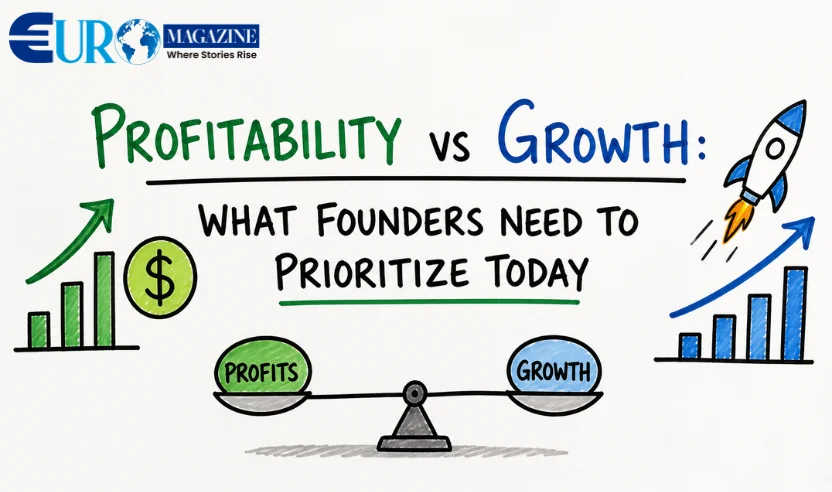
For a long time, the startup world operated on a clear belief: growth comes first, profitability comes later. Founders were encouraged to scale quickly, capture market share, and build visibility, often with the assumption that financial stability would follow once the business reached a certain size. In 2026, that assumption no longer holds the same weight. Market conditions have evolved. Capital is more selective, competition is more structured, and expectations from investors have become significantly more grounded. As a result, founders are now operating in an environment where growth alone is not enough. What matters is how that growth is achieved and whether it can sustain itself over time. This has brought the discussion around profitability and growth into sharper focus. It is no longer a theoretical debate. It is a practical decision that directly influences how businesses are built, scaled, and funded.
Understanding how modern founders are balancing expansion with financial discipline in a more demanding market environment
The Shift in Founder Priorities
The change is not about abandoning growth. It is about redefining how growth is pursued.
Founders are beginning to recognize that scaling without financial discipline introduces long-term risk. At the same time, focusing only on profitability too early can limit expansion and reduce competitive advantage.
This creates a balancing act.
On one side, growth remains essential for building market presence and relevance. On the other, profitability provides stability and independence. The challenge lies in aligning both without compromising either.
Why Growth Still Matters
Growth continues to be a critical driver of business success, particularly in competitive or emerging markets. It allows companies to establish their position, build brand recognition, and create momentum.
In certain situations, prioritizing growth is not just beneficial it is necessary.
- Entering new or underserved markets
- Building products with strong network effects
- Competing in industries where speed defines leadership
- Establishing early brand visibility
In these scenarios, delaying growth in favor of profitability can result in missed opportunities. However, growth today is expected to be more structured and intentional, rather than aggressive and unchecked.
The Rising Importance of Profitability
While growth remains important, profitability has become a central focus in the current business environment.
This shift is largely driven by external factors. Investors are more cautious, capital is more expensive, and businesses are expected to demonstrate resilience rather than rely on continuous funding.
Profitability is no longer seen as a distant milestone. It is increasingly viewed as a signal of operational strength.
Founders are now expected to show:
- Clear revenue generation
- Controlled operational costs
- Sustainable margins
A profitable business is not just financially stable it is also more adaptable in uncertain conditions.
Understanding the Balance Between the Two
The conversation is often framed as a choice between growth and profitability, but in reality, the two are interconnected.
Growth without a path to profitability creates long-term vulnerability.
Profitability without growth limits future potential.
The most effective founders approach this as a matter of timing and alignment. They focus on growth when the opportunity justifies it, while ensuring that the underlying business model remains financially viable.
This requires constant evaluation and adjustment rather than a fixed strategy.
The Role of Unit Economics
One of the most reliable ways to balance growth and profitability is through strong unit economics.
This means understanding whether each customer, product, or transaction contributes positively to the business over time.
Key factors founders need to monitor include:
- Customer Acquisition Cost (CAC)
- Customer Lifetime Value (LTV)
- Contribution margins
- Retention rates
When these fundamentals are strong, growth becomes sustainable. When they are weak, scaling can increase losses instead of creating value.
Where Founders Often Go Wrong
Despite awareness of these dynamics, many founders struggle to maintain balance. The challenges are often not strategic, but practical.
Common mistakes include:
- Scaling operations before achieving efficiency
- Relying too heavily on external funding
- Cutting growth initiatives prematurely
- Ignoring early signs of weak unit economics
These missteps usually stem from reacting to short-term pressures rather than following a structured long-term approach.
What Investors Expect in 2026
Investor expectations have evolved alongside market conditions. While growth remains important, it is now evaluated in the context of financial discipline.
Investors are increasingly looking for:
- Businesses with clear and consistent revenue models
- Evidence of cost control and operational efficiency
- A defined and realistic path to profitability
- Growth strategies supported by data, not assumptions
This shift means that founders must present not just ambition, but credibility.
Conclusion
The debate between profitability and growth is no longer about choosing one over the other. It is about understanding how they work together within the broader context of building a sustainable business.
In today’s environment, growth creates opportunity, but profitability ensures survival.
Founders who succeed are those who can scale with intention, manage resources effectively, and adapt their strategies as conditions change. They recognize that long-term success is not driven by rapid expansion alone, but by the ability to convert that expansion into consistent financial performance.





























Comments
Be the first to share your thoughts.
Leave a comment
Join the conversation. Your email address will not be published.