

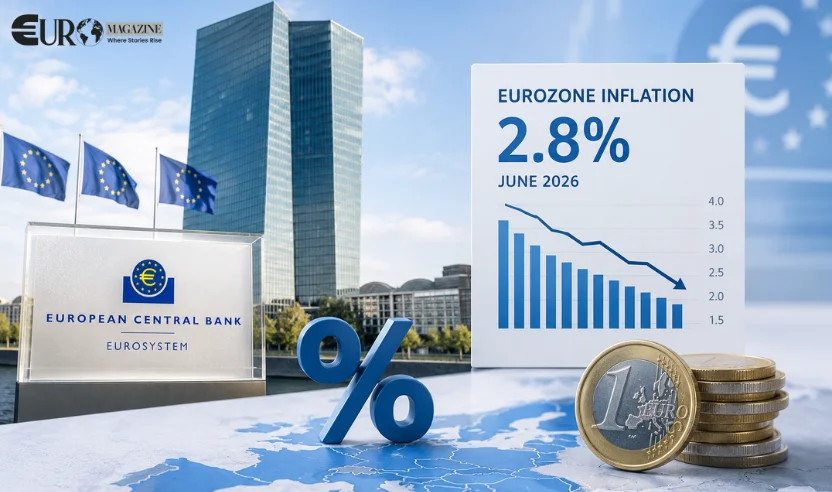
Inflation across the eurozone eased to 2.8% in June, marking the first annual decline of 2026 and reinforcing market expectations that the European Central Bank (ECB) could leave interest rates unchanged at its policy meeting later this week
Final data released by Eurostat confirmed that consumer price inflation slowed from 3.2% in May to 2.8% in June, providing policymakers with fresh evidence that price pressures have moderated after several months of acceleration.
The latest figures arrive just days before the ECB's Governing Council is scheduled to announce its monetary policy decision, with investors closely watching whether the central bank will maintain its 2.25% deposit facility rate following June's interest-rate increase.
Underlying inflation also showed signs of easing. Core inflation, which excludes volatile components such as energy and food, declined to 2.4% from 2.6% a month earlier. Energy inflation slowed to 8.5%, while services inflation eased to 3.2%, indicating broader moderation in price growth across the euro area's economy.
Among the bloc's largest economies, inflation stood at 2.4% in Germany, 2.0% in France, 3.0% in Italy, and 3.6% in Spain, reflecting varying price trends across member states.
The ECB raised interest rates in June for the first time in nearly three years after inflation accelerated sharply amid rising geopolitical tensions in the Middle East. At the time, higher energy costs linked to the conflict between Iran and the United States pushed eurozone inflation to its highest level since late 2023.
Although inflation has since moderated, policymakers continue to monitor renewed risks in global energy markets.
Brent crude prices, which retreated after a temporary easing of tensions in late June, have climbed again as geopolitical uncertainty returned to the region. Renewed military exchanges, tighter sanctions and concerns over energy supplies have increased the possibility of fresh inflationary pressure in the coming months.
Several analysts believe those developments could complicate the ECB's policy outlook.
Economists at ING said the central bank is still expected to leave interest rates unchanged this week, although persistent energy market volatility could strengthen the case for another increase at its September meeting if inflationary pressures intensify.
Attention will also focus on comments from ECB President Christine Lagarde, who has repeatedly stressed that monetary policy decisions will remain dependent on incoming economic data rather than following a predetermined path.
Speaking earlier this month, Lagarde said the June rate increase reflected genuine inflation concerns and reiterated that the ECB expects inflation to return to its 2% target only over the medium term if monetary policy remains sufficiently restrictive.
Globally, central banks have adopted different approaches to inflation. The U.S. Federal Reserve kept interest rates unchanged in June, while the Bank of England also left borrowing costs on hold despite divided policymakers. Meanwhile, the Bank of Japan continued tightening policy by raising interest rates to their highest level in more than three decades.
The ECB's policy announcement on Thursday is expected to provide further guidance on the outlook for inflation, interest rates and economic growth across the eurozone during the second half of 2026.
Read more news:-





























Comments
Be the first to share your thoughts.
Leave a comment
Join the conversation. Your email address will not be published.