

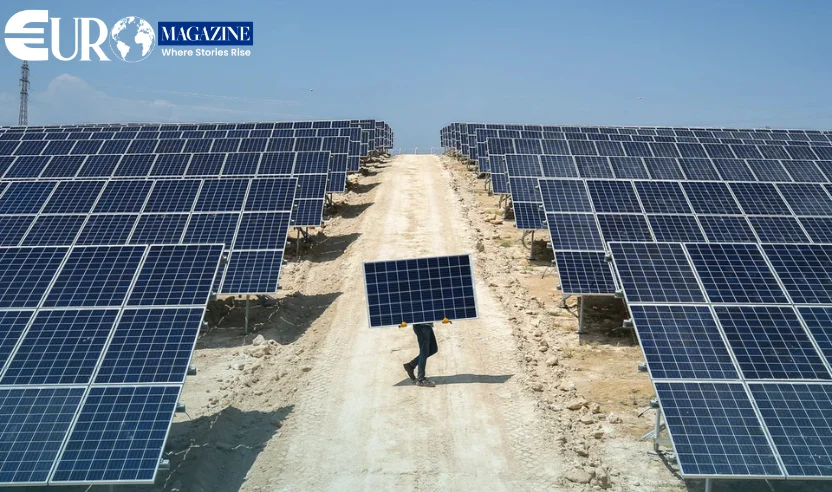
European countries are rapidly expanding battery storage capacity as governments accelerate the transition toward renewable energy and reduce dependence on fossil fuels. New industry data shows that while Germany currently leads Europe in operational battery storage, Turkey has emerged as the continent’s most ambitious market for future battery expansion.
According to Ember’s European and Türkiye Electricity Review 2026 reports, Germany currently holds the highest operational battery capacity in Europe with 2.8 gigawatts (GW), followed by Italy at 2 GW. Batteries play a critical role in modern energy systems by storing electricity generated from renewable sources such as solar and wind, helping stabilize grids and improve energy efficiency.
A second group of European countries currently maintains battery capacities between 0.5 GW and 1 GW. Ireland ranks with 0.92 GW, followed by Sweden at 0.75 GW, Bulgaria at 0.56 GW, and France at 0.52 GW. Romania, Belgium, Finland, the Netherlands, and Turkey currently remain below the 0.5 GW threshold in operational capacity.
However, the outlook changes dramatically when future project pipelines are considered. Turkey now leads Europe by a significant margin in planned battery storage expansion, with a project pipeline totaling 32.8 GW. This figure is more than three times larger than the pipelines announced by Germany at 10.5 GW, Poland at 10.4 GW, and Italy at 10.2 GW.
Industry analysts attribute Turkey’s rapid expansion plans to supportive regulatory policies that opened unlimited grid capacity for storage-integrated solar and wind projects. The move triggered substantial investor interest in large-scale battery storage developments across the country.
If all proposed projects are completed, Turkey’s total battery capacity could reach nearly 33 GW, making it Europe’s largest battery storage market. Germany, Italy, and Poland would follow significantly behind in total projected capacity.
Experts say falling battery prices are also driving rapid investment across Europe. According to Ember analysts, grid-scale battery costs fell by approximately 45 percent in 2025 compared to the previous year, continuing a decade-long trend of declining storage costs. Lower costs are increasingly making battery projects financially viable without the need for government subsidies.
Energy specialists emphasized that policy stability remains a key factor determining how quickly battery projects can move from planning to operational status. Countries including Bulgaria, Italy, and Spain have already demonstrated how supportive regulations can accelerate deployment and attract investment.
At the same time, analysts warned that policy uncertainty can slow expansion. Germany, despite its current leadership position, has faced concerns regarding proposed energy market changes and grid fee reforms that may impact investor confidence in future battery projects.
France, meanwhile, continues to lag behind many European countries in battery expansion despite plans to more than double its capacity to 1.12 GW. Analysts suggest the country’s heavy reliance on nuclear energy may partly explain its relatively lower focus on battery storage development. Nuclear power currently accounts for a major share of France’s electricity production.
While Europe’s battery expansion plans highlight growing momentum toward renewable energy infrastructure, experts note that project pipelines do not guarantee completion. In Turkey’s case, many approved projects have secured grid access but still face execution and timeline challenges before becoming operational.
The latest data underscores the increasing importance of battery technology in Europe’s long-term energy transition strategy as countries seek to improve grid reliability, integrate renewable power sources, and strengthen energy security amid changing global energy markets.



























Comments
Be the first to share your thoughts.
Leave a comment
Join the conversation. Your email address will not be published.