

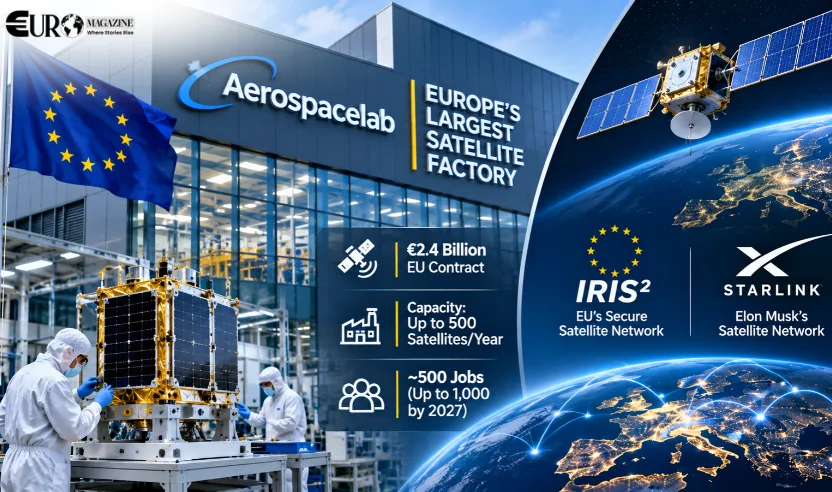
Europe has taken a major step towards strengthening its position in the global satellite industry with the opening of its largest satellite manufacturing facility in Belgium. The new factory is expected to support the European Union's efforts to build an independent satellite communications network and compete with Elon Musk's Starlink.
Belgian satellite manufacturer Aerospacelab inaugurated the facility in Charleroi on November 24, 2026, in a ceremony attended by Belgium's King Philippe.
The 20,000-square-metre factory has the capacity to produce up to 500 satellites annually, making it one of the world's largest satellite manufacturing facilities.
€2.4 Billion Contract for European Satellite Network
The factory will play an important role in producing satellites for the EU's IRIS² programme, a secure communications network designed to serve government, defence and commercial users.
Aerospacelab secured a €2.4 billion contract in September to design, manufacture and deliver 264 satellites for the project. This represents approximately three-quarters of the 348 satellites planned for the network's main constellation.
The facility represents an investment of around €100 million and is expected to initially employ approximately 500 people, with the workforce potentially increasing to 1,000 by the end of 2027.
Production Expected to Begin in 2028
Although the factory has officially opened, large-scale satellite production will not begin immediately. Employees are expected to move into the facility in January 2027, with manufacturing scheduled to start towards the end of 2028.
The European Commission is targeting the first phase of IRIS² satellite launches by the end of 2029, followed by the gradual introduction of services.
The expanded constellation is expected to include 330 satellites in low Earth orbit and 18 in medium Earth orbit.
Why Europe Wants an Alternative to Starlink
Europe's investment reflects growing concerns about dependence on foreign-controlled satellite infrastructure, particularly for government communications, defence and emergency services.
Starlink already operates a large global network, providing broadband connectivity across numerous countries. IRIS² aims to give European governments and businesses a more independent option while strengthening the region's technological and security capabilities.
However, matching Starlink's established network, launch capacity and commercial reach will take time. The new Belgian factory is an important manufacturing milestone, but Europe's broader ambition will depend on successful satellite production, launches and network deployment.
Read more news:-




























Comments
Be the first to share your thoughts.
Leave a comment
Join the conversation. Your email address will not be published.