

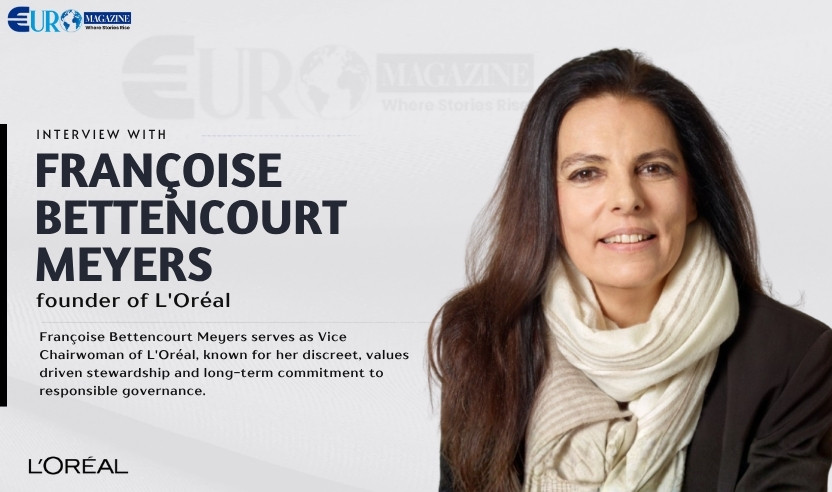
Françoise Bettencourt Meyers’ journey has never been defined by ambition in the traditional sense. It has not been shaped by the pursuit of visibility, public acclaim, or personal recognition. Instead, it has unfolded through responsibility, restraint, and a profound awareness that leadership is not about possession, but about protection. As Vice Chairwoman of L’Oréal, Françoise Bettencourt Meyers does not see herself as the face of a global enterprise, but as a guardian of its values, its independence, and its long-term purpose.
Being associated with one of the world’s most influential companies often invites assumptions, about privilege, authority, or inevitability. Yet her experience has taught her that legacy is neither automatic nor permanent. It must be preserved with intention, guided by ethics, and continuously aligned with the evolving world it serves. Leadership, when practiced responsibly, is not loud. It is deliberate, thoughtful, and deeply accountable.
This journey is not about dominance or scale. It is about continuity, trust, and the quiet decisions that ensure institutions endure beyond individuals.
Early Life and the Foundations of Reflection
Françoise Bettencourt Meyers was born in France in 1953 into a family where science, enterprise, and intellectual curiosity were deeply intertwined. Her grandfather, Eugène Schueller, founded L’Oréal with a belief that scientific innovation could improve lives. While this heritage surrounded her, her upbringing emphasized education and reflection rather than preparation for a predetermined role.
From an early age, she was encouraged to think independently. Reading, writing, philosophy, and religious studies played a formative role in shaping her worldview. These disciplines taught her patience, humility, and the importance of context, values that stand in contrast to the speed and immediacy often associated with business leadership today.
Rather than teaching her how to lead, her early years taught her how to observe. To listen. To question. These habits later became essential tools when navigating the complexities of governance, responsibility, and long-term decision-making.
Developing an Identity Beyond Inheritance
Growing up with a well-known family name carries both opportunity and constraint. Françoise Bettencourt Meyers was aware of the expectations attached to legacy, yet she was equally aware of the importance of developing her own intellectual and moral framework. Identity cannot be borrowed. It must be built.
Her academic pursuits allowed her to explore ideas beyond commerce. Writing became a space for reflection and depth, a way to engage with meaning, ethics, and history. This intellectual independence was not separate from her eventual role in business; it shaped how she would later approach leadership, not as authority, but as responsibility.
Leadership, she learned, is most effective when it is anchored in clarity of thought rather than impulse
My Gradual Entry Into L’Oréal
Her path into L’Oréal was neither sudden nor ceremonial. Françoise Bettencourt Meyers joined the Board of Directors in 1997, stepping into a role that required attention, discretion, and a willingness to learn. At that time, L’Oréal was already a global leader, operating across continents, cultures, and consumer expectations.
Serving on the board offered insight into the intricate balance required to govern a multinational organization. Decisions made at this level carry long-term consequences, not only for shareholders, but for employees, partners, and society at large. It was during these years that she developed a deep respect for governance as a discipline.
Governance is not about control. It is about structure, foresight, and accountability. It ensures that growth does not outpace values, and that ambition remains aligned with responsibility.
Understanding the Complexity of Global Leadership
L’Oréal operates in an industry that touches identity, confidence, and self-expression. Beauty is deeply personal and culturally nuanced. Leading a global beauty company therefore requires sensitivity, adaptability, and scientific rigor.
From her position on the board, Françoise Bettencourt Meyers observed how innovation, research, and cultural awareness intersect. L’Oréal’s success has always depended on its ability to listen, to consumers, to scientists, to local markets, while maintaining a unified vision.
Her role was not to direct creative or operational choices, but to help ensure that the structures supporting those choices remained strong, ethical, and resilient.
What Makes L’Oréal’s Legacy Enduring
The strength of L’Oréal lies in its capacity to evolve without losing coherence. Its commitment to research, sustainability, and inclusion has allowed it to remain relevant across generations.
From her perspective, preserving this strength requires restraint. Growth must be thoughtful. Innovation must be ethical. And leadership must prioritize trust above speed.
Legacy is not preserved by resisting change, but by guiding it responsibly. The credibility of a global brand is built over decades and sustained through consistency, transparency, and respect for the communities it serves.
A Defining Chapter of Responsibility
One of the most defining periods of her journey came during a time of personal and institutional transition. This chapter reinforced a fundamental truth: strong institutions must be designed to withstand change.
The responsibility was not symbolic. It required clarity, stability, and collaboration with executive leadership to ensure continuity without disruption. Governance became not an abstract concept, but a living practice, one that protects people, values, and long-term vision.
Leadership during transition is not about asserting presence. It is about creating certainty.
Embracing a Leadership Style Rooted in Discretion
Françoise Bettencourt Meyers has often chosen discretion over visibility. This choice is intentional. Leadership does not require constant expression. It requires consistent judgment.
As Vice Chairwoman, her focus remains on oversight, governance, and long-term direction. This allows management teams the autonomy they need to innovate and execute, while ensuring that decisions align with the company’s foundational principles.
Trust is the cornerstone of this model, trust in people, systems, and shared responsibility.
Life Beyond the Boardroom
Her life has always extended beyond business. Writing and scholarship remain central to her identity. They offer space for reflection, balance, and intellectual independence.
Philanthropy also plays a meaningful role in her journey. Supporting education, culture, and social initiatives reflects a belief that economic success carries moral responsibility. Businesses do not exist in isolation; they are part of a broader social fabric.
These pursuits inform how she approaches leadership, with perspective, humility, and awareness of impact.
Navigating the Future of Beauty and Business
The future of the beauty industry will be shaped by science, personalization, digital transformation, and sustainability. Consumers are increasingly informed, values-driven, and attentive to ethics.
Her role is to help ensure that L’Oréal adapts responsibly, investing in innovation while preserving trust. Sustainability is not a trend. It is a necessity. Scientific progress must serve both people and the planet.
The most enduring companies will be those that evolve with integrity.
Guidance for the Next Generation of Leaders
To those preparing for leadership roles, especially within legacy institutions, Françoise Bettencourt Meyers’ advice is this: cultivate depth. Leadership is not performance. It is preparation.
Patience, clarity, and ethical grounding matter more than speed or visibility. Decisions endure long after recognition fades.
True leadership is measured not by influence, but by stability.
Conclusion
Her journey has been defined by stewardship rather than spotlight. As Vice Chairwoman of L’Oréal, Françoise Bettencourt Meyers’ responsibility is to safeguard continuity, guide long-term strategy, and protect values that have endured for over a century.
In a world that often celebrates immediacy and noise, she believes lasting success is built quietly, through thoughtful governance, disciplined leadership, and unwavering respect for responsibility.
Legacy, when honored with care, becomes not a burden, but a purpose.









Comments
Be the first to share your thoughts.
Leave a comment
Join the conversation. Your email address will not be published.