

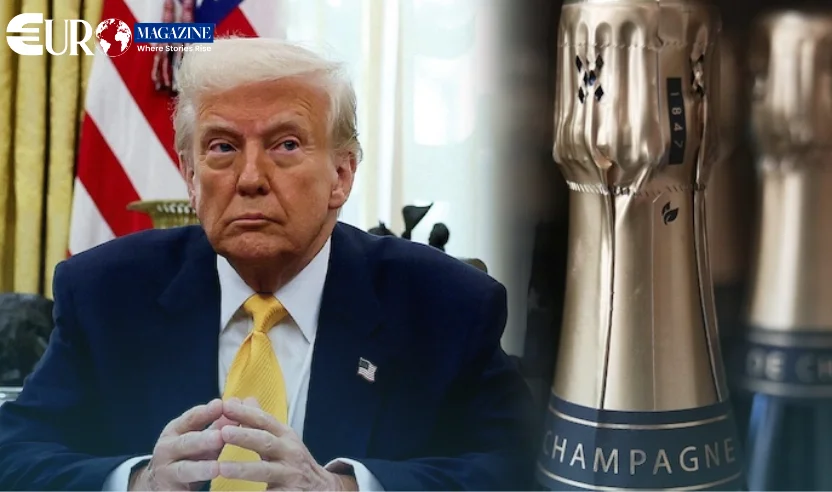
US President Donald Trump has threatened to impose a 100% tariff on French wine and champagne imports unless France abolishes its digital services tax on major American technology companies, reigniting a long-standing trade dispute between Washington and Paris.
The warning comes ahead of Trump's meeting with French President Emmanuel Macron on the sidelines of the G7 Summit in Evian, where trade relations and global economic cooperation are expected to feature prominently on the agenda.
According to reports, Trump criticized France's digital services tax, arguing that it unfairly targets American technology firms operating in the country. Introduced in 2019, the levy imposes a 3% tax on revenues generated in France by large multinational digital companies, including Meta, Amazon, Apple, and Alphabet.
Speaking about the measure, Trump reportedly stated that the United States would have little choice but to respond if France continues to maintain the tax.
"If they do, I have no choice but to charge a 100% tariff on all champagnes and all wines coming out of France," Trump was quoted as saying.
The latest threat marks another chapter in the ongoing disagreement between the two allies over the taxation of digital businesses. During his first term in office, Trump similarly threatened tariffs on French products, including wine, champagne, and cheese, following France's introduction of the digital tax.
French Wine Industry Faces Growing Uncertainty
The United States remains the largest export destination for French wines and spirits, accounting for approximately 21% of the industry's total exports last year. Industry data shows that exports to the American market declined by 21% over the same period, reflecting the impact of existing trade barriers and economic uncertainty.
French and broader European wine exports are already subject to a 15% tariff in the United States, up from the previous rate of 10%. Industry representatives have repeatedly warned that additional duties could significantly affect producers, exporters, and distributors on both sides of the Atlantic.
Digital Tax Remains a Point of Contention
Supporters of digital services taxes argue that multinational technology companies should contribute taxes in countries where they generate substantial revenues, regardless of where they are headquartered. Advocates contend that such measures help address perceived gaps in international tax frameworks and reduce aggressive tax-optimization practices.
However, successive US administrations have opposed unilateral digital taxes, arguing that they disproportionately target American technology firms and create barriers to international trade.
The issue has become a recurring source of tension between Washington and several European governments seeking to increase taxation of global technology companies.
G7 Discussions Under Close Watch
The renewed tariff threat comes at a sensitive moment for transatlantic relations, with global leaders gathering for the G7 Summit amid ongoing economic and geopolitical challenges.
Market observers and industry stakeholders will be closely monitoring discussions between Trump and Macron for any signs of compromise that could prevent a further escalation of trade tensions.
While no formal tariff measures have been announced, the prospect of a 100% duty on French wine and champagne has raised concerns within the European beverage sector and renewed uncertainty for exporters dependent on access to the US market.
For now, the dispute highlights the continuing challenges governments face in balancing digital taxation policies with broader international trade relationships.























Comments
Be the first to share your thoughts.
Leave a comment
Join the conversation. Your email address will not be published.