

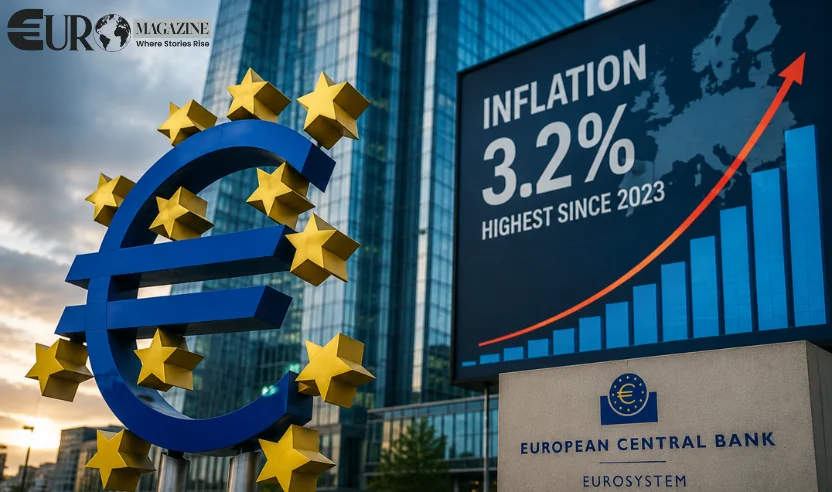
Inflation across the eurozone accelerated to its highest level in nearly three years in May, reinforcing market expectations that the European Central Bank (ECB) will raise interest rates at its upcoming policy meeting.
According to Eurostat's flash estimate released on Tuesday, annual inflation in the euro area rose to 3.2% in May from 3.0% in April. The reading matched analyst forecasts and marked the highest inflation level recorded since September 2023.
The increase was largely driven by elevated energy costs, as disruptions linked to the Strait of Hormuz blockade continued to affect global fuel markets. Energy prices were 10.9% higher than a year earlier, remaining broadly unchanged from April's 10.8% increase.
While energy remained the primary contributor to inflation, policymakers are paying closer attention to rising price pressures in the services sector. Services inflation accelerated sharply to 3.5% in May from 3.0% in April, suggesting that higher costs are beginning to spread beyond energy and into the broader economy.
Core inflation, which excludes volatile energy prices, also increased to 2.4% from 2.2%, adding to concerns that underlying inflationary pressures are becoming more persistent.
Inflation trends varied across major eurozone economies. Spain recorded the highest inflation rate among the bloc's largest members at 3.6%, followed by Italy at 3.3%, up significantly from 2.8% a month earlier. France reported inflation of 2.8%, while Germany, the eurozone's largest economy, registered 2.7%. Portugal was one of the few countries to see inflation ease, slipping to 3.1% from 3.3%.
Meanwhile, a separate ECB Consumer Expectations Survey showed households are increasingly preparing for prolonged inflation. Consumers expect inflation to average 4.0% over the next 12 months, double the ECB's official 2% target. Perceived inflation over the previous year also rose to 4.0%, compared with 3.5% in the prior survey.
Although longer-term expectations remained relatively stable, uncertainty surrounding future price developments continued to weigh on consumer sentiment. The survey also indicated growing pessimism about economic growth prospects and rising concerns over household spending pressures.
Financial markets now see an ECB interest rate increase as virtually certain. Prediction platform Polymarket currently assigns a 97% probability to a 25-basis-point rate hike at next week's Governing Council meeting.
Several economists have echoed those expectations. Analysts at ABN AMRO anticipate consecutive rate increases over the next two policy meetings, while ING described the likely June move as an "insurance hike" aimed at preventing inflation expectations from becoming entrenched.
ECB President Christine Lagarde has recently signaled growing concern over inflation risks, leading many market participants to believe policymakers are preparing for tighter monetary conditions.
However, economists warn that higher borrowing costs could place additional strain on businesses, consumers and governments already facing economic headwinds. Rising interest rates typically increase financing costs, potentially slowing investment and consumer spending.
Despite those risks, many analysts believe the ECB has little choice but to act as inflation remains well above its target. Some forecasts suggest the central bank could deliver two consecutive quarter-point rate increases, potentially lifting its deposit rate to 2.5% by mid-summer.
Attention is now turning to whether the current inflation surge proves temporary or develops into a more persistent challenge. While falling energy prices and improving geopolitical conditions could ease pressure later in the year, policymakers remain concerned that broader price increases may continue to spread throughout the eurozone economy.
For now, investors and economists alike appear convinced that the ECB's next move is all but decided. The bigger question is whether the central bank's tightening cycle will extend beyond the summer if inflation remains stubbornly elevated.






























Comments
Be the first to share your thoughts.
Leave a comment
Join the conversation. Your email address will not be published.