

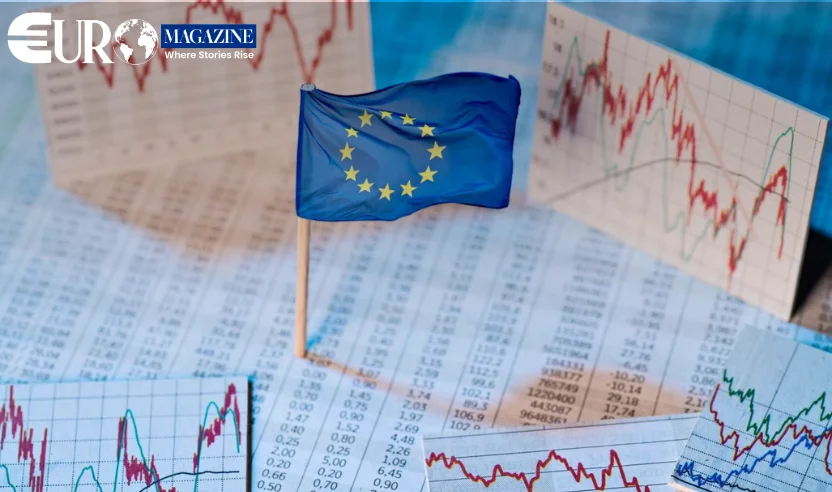
The eurozone economy slipped into contraction during the first quarter of 2026, highlighting growing economic challenges across the region amid persistent geopolitical tensions, weakening trade activity, and rising energy costs.
According to the latest data released by Eurostat, the economy of the 21-member euro area shrank by 0.2 percent between January and March 2026. The figure represents a significant downgrade from earlier estimates that had indicated modest growth and marks the first quarterly contraction recorded by the bloc in more than a year.
On an annual basis, economic growth slowed to just 0.3 percent, compared with 1.2 percent recorded during the same period last year, reflecting a sharp loss of momentum across several key sectors.
A major factor influencing the overall result was Ireland's unusually steep economic decline. The country reported a 12.1 percent quarterly contraction and a 16.8 percent decline compared with the previous year. However, economists caution that Ireland's GDP figures are often heavily influenced by multinational corporations and pharmaceutical exports, making them less reflective of domestic economic conditions.
Excluding Ireland, the eurozone's performance appears more resilient. Germany, Europe's largest economy, recorded 0.3 percent growth after an extended period of economic stagnation. Italy also expanded by 0.3 percent, while Spain remained one of the strongest performers with growth of 0.6 percent during the quarter.
France, however, continued to face challenges, posting a 0.1 percent contraction and extending a trend of economic weakness that predates recent geopolitical developments.
Eurostat's data showed that weaker trade activity was the largest contributor to the downturn, reducing overall economic output by 0.3 percentage points. Lower investment spending further weighed on growth, subtracting an additional 0.1 percentage points.
The ongoing conflict involving Iran has emerged as a significant economic headwind for Europe. Rising energy prices and disruptions to global supply routes have increased costs for businesses and consumers alike, placing additional pressure on economic activity across the region.
Energy markets remain particularly sensitive due to disruptions affecting the Strait of Hormuz, one of the world's most important oil transit routes. Elevated oil and gas prices have contributed to higher inflation levels throughout the eurozone, complicating the policy outlook for the European Central Bank (ECB).
Inflation in the euro area accelerated during the first months of 2026, driven largely by energy costs. As a result, investors increasingly expect the ECB to consider further interest rate increases at upcoming policy meetings despite signs of slowing economic growth.
The labor market has so far remained relatively stable. Employment increased slightly during the first quarter, although total hours worked declined. Meanwhile, the unemployment rate edged higher to 6.3 percent in April, indicating that labor market conditions may be beginning to soften.
Economists warn that the eurozone now faces a delicate balancing act. Policymakers must navigate slowing growth, persistent inflationary pressures, and ongoing geopolitical uncertainty while attempting to preserve economic stability across the bloc.
With energy markets remaining volatile and global trade conditions uncertain, the outlook for the remainder of 2026 continues to present significant challenges for European economies.
























Comments
Be the first to share your thoughts.
Leave a comment
Join the conversation. Your email address will not be published.