
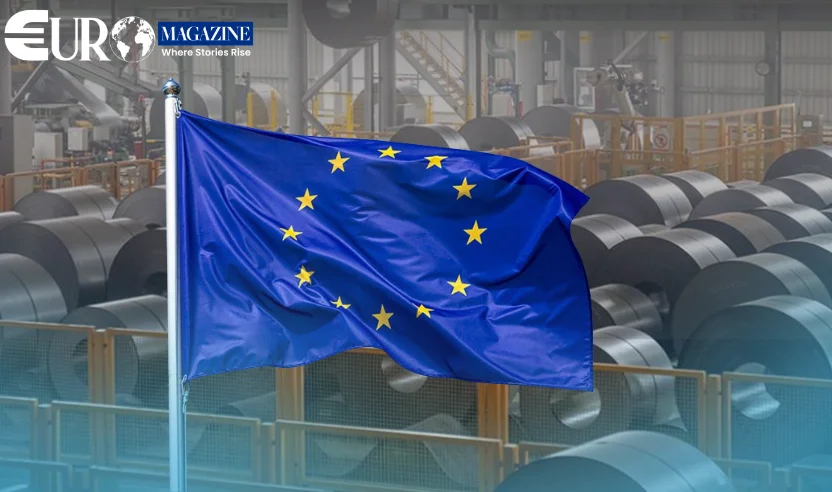
Brussels - The European Parliament is intensifying efforts to impose a full ban on Russian steel imports, setting the stage for high-level negotiations with EU member states next week as the bloc marks nearly four years since Russia’s invasion of Ukraine.
Although finished Russian steel products were banned in 2022, semi-finished steel, a critical input for further processing, remains exempt under a phase-out arrangement running until 2028. Several EU governments argue that an immediate ban could disrupt infrastructure and industrial projects dependent on these supplies.
The debate has evolved from a technical sanctions issue into a broader political confrontation over the European Union’s economic ties to Moscow.
Parliament Seeks Stronger Measures
Swedish Member of the European Parliament Karin Karlsbro is among those leading the push for a comprehensive prohibition. She has criticised the continued imports, arguing they undermine efforts to curb Russian revenues.
“It is a big provocation that we haven't done everything possible to limit Putin's war chest,” Karlsbro said, describing Russia’s steel sector as integral to the country’s broader industrial capacity.
According to figures cited during the debate, the EU imports close to three million tonnes of Russian steel annually, roughly equivalent to Sweden’s total yearly output, with an estimated value of €1.7 billion.
Karlsbro maintains that there is no technical justification for maintaining the exemption, saying the steel in question is not uniquely specialised.
Member States Cite Industrial Needs
Several member states, including Belgium, Italy, the Czech Republic and Denmark, have defended the current exemption, citing reliance on semi-finished steel for major infrastructure and construction projects.
One European diplomat said unfinished steel “cannot be produced anywhere in the EU” in sufficient quantities and remains necessary for large-scale industrial applications.
The exemption was originally negotiated to cushion domestic industries from supply shocks and price volatility, with the 2028 deadline intended to allow time for diversification.
Procedural Strategy
To overcome the unanimity requirement typically needed for EU sanctions, supporters of the ban have taken a procedural approach. The proposed restriction was inserted into a separate European Commission initiative designed to protect the EU market from global steel overcapacity, particularly as redirected exports increase due to U.S. tariffs.
Unlike sanctions policy, trade measures can be adopted through qualified majority voting, meaning a smaller group of opposing governments may not be able to block the move.
The European Parliament’s trade committee approved the amendment on January 27, clearing the way for negotiations with the Council of the European Union.
An industry source familiar with the discussions described the maneuver as politically driven, while another diplomat acknowledged that despite reservations, there may not be enough member states to prevent the ban from advancing.
Broader Context
The negotiations come as the EU faces dual pressures: sustaining economic measures against Russia while shielding its own industries from global steel oversupply.
By June, the bloc must finalise its strategy to address steel market imbalances. Officials insist that tackling Russian imports and managing global overcapacity are separate policy objectives, though the timing has intertwined the debates.
As discussions begin, the outcome could signal how far the European Union is prepared to go in aligning its trade policy with its geopolitical stance, nearly four years after the start of the war in Ukraine.