

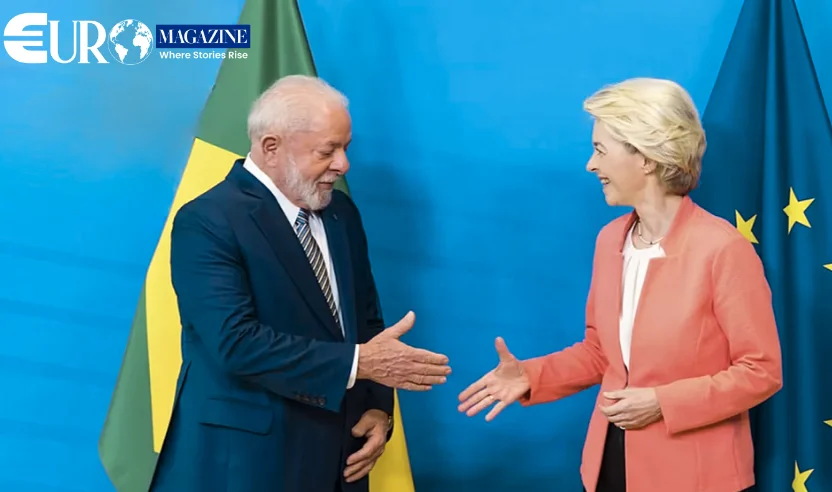
The European Commission has intensified pressure on France to lift its opposition to the EU–Mercosur trade agreement, saying the pact must be signed by the end of the year as global economic and geopolitical conditions shift.
The Commission said on Monday it still expects to finalise the agreement before year-end, despite resistance from Paris, which is seeking to delay a vote by EU member states amid mounting anger from French farmers.
The deal, negotiated over more than 25 years with Mercosur countries, Argentina, Brazil, Paraguay and Uruguay, is viewed by Brussels as strategically urgent. Commission deputy chief spokesperson Olof Gill said signing the agreement now was critical for the EU’s economic, diplomatic and geopolitical standing.
“In the view of the Commission, signing the deal now is a matter of crucial importance economically, diplomatically and geopolitically, but also in terms of our credibility on the global stage,” Gill told reporters.
France reiterated its opposition over the weekend. In a statement issued by the office of Prime Minister Sébastien Lecornu, Paris called for a delay to December deadlines, arguing that conditions were not in place for an EU Council vote authorising the signing of the agreement, even though a Mercosur summit is scheduled for December 20.
The agreement, concluded politically in 2024, would liberalise trade between the EU and Mercosur. French farming groups argue it would expose domestic producers to unfair competition from Latin American agricultural imports produced under lower environmental and animal welfare standards.
France is leading opposition within the EU Council, alongside Poland, Hungary and Austria, and is demanding stronger safeguards, including the ability to suspend tariff reductions if imports disrupt EU markets, so-called reciprocity clauses to align Mercosur standards with EU rules, and stricter sanitary and phytosanitary controls.
The Commission said it has responded to concerns raised by farmers and member states. Gill said Brussels had acted decisively by proposing accompanying measures following consultations with farmers, consumers, governments and EU lawmakers.
On Tuesday, Members of the European Parliament are due to vote on a safeguard clause proposed by the Commission, with some lawmakers seeking to add amendments on reciprocity. Member states have already backed the safeguard mechanism, though without explicit reciprocity guarantees.
Negotiations between the European Parliament and EU governments are expected to follow quickly. Parliamentary sources said that while reciprocity is also a concern for German farmers, Berlin supports the deal and is unlikely to risk derailing it over that issue.
Supporters of the agreement, led by Germany and Spain, argue the pact is essential as the EU faces declining access to the U.S. market and growing Chinese influence in Latin America.
The political arithmetic for approval remains uncertain. Belgium plans to abstain, while Ireland and the Netherlands have yet to declare their positions. Italy’s stance remains unclear, making the outcome of any vote unpredictable.
French President Emmanuel Macron, already weakened by domestic political instability, is facing sustained protests from farmers over the Mercosur deal as well as over the handling of livestock disease outbreaks.
“France will continue to firmly defend its agricultural interests,” Lecornu’s office said in its statement.