

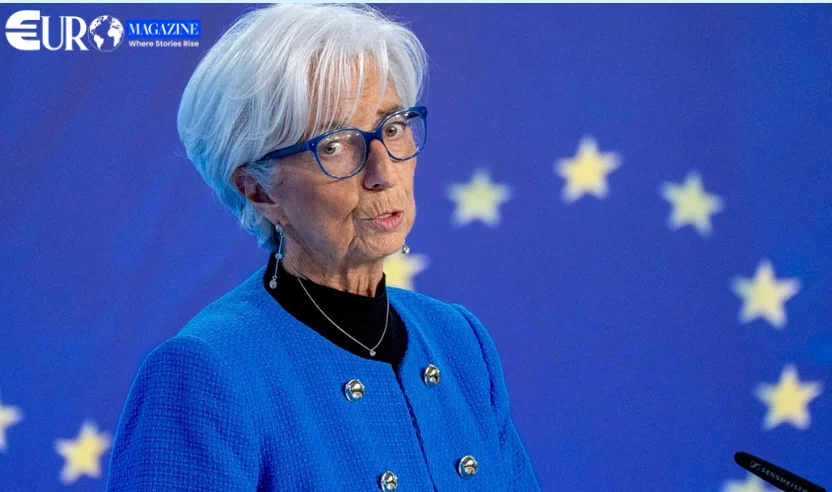
Frankfurt: European Central Bank President Christine Lagarde said the euro area economy is undergoing a structural shift driven by artificial intelligence–related investment, while stressing that there is no predetermined path for interest rates as uncertainty remains high.
Speaking after the ECB’s final Governing Council meeting of the year, Lagarde confirmed that policymakers unanimously decided to keep all three key interest rates unchanged. She said monetary policy is currently “in a good place,” but made clear that this does not imply stability or predictability in future rate decisions.
Lagarde emphasised that the ECB will continue to make decisions meeting by meeting, based strictly on incoming data, and ruled out providing forward guidance on interest rates.
Rates, Growth and Inflation Outlook
According to Lagarde, there was broad agreement among policymakers that all policy options should remain open. While current settings are seen as appropriate, she cautioned that economic conditions remain fluid.
The ECB is closely monitoring wage growth, services inflation, and global trade developments, all of which continue to pose risks to the inflation outlook. Updated staff projections now forecast euro area growth of 1.4% in 2025, slowing to 1.2% in 2026, before rebounding to 1.4% in 2027 and 2028, supported mainly by domestic demand.
Inflation projections were revised slightly higher for 2026 due to slower easing in services inflation. Headline inflation is expected to average 2.1% in 2025, fall below the ECB’s target in 2026 and 2027, and return to 2.0% in 2028.
Lagarde said wage dynamics and service prices will remain under close scrutiny, given their importance for medium-term inflation persistence.
AI Investment Reshaping the Economy
Lagarde highlighted artificial intelligence as a key driver of current investment trends across the euro area. Both large companies and small and medium-sized firms are increasing spending on computing capacity, telecommunications infrastructure, software, and data, rather than traditional physical assets.
While AI has the potential to boost productivity over time, Lagarde warned against drawing early conclusions about its impact on the so-called neutral interest rate, noting that such structural parameters remain difficult to measure and were not discussed at the meeting.
Digital Euro and Russian Assets
On the digital euro, Lagarde said the ECB has completed its technical preparations, leaving the next steps in the hands of political institutions. The initiative is now under consideration by the European Council and the European Parliament.
She described the digital euro as a tool to ensure monetary stability and sovereignty in the digital age, rather than a purely technological innovation.
Lagarde also addressed calls to use frozen Russian central bank assets to support Ukraine’s reconstruction. She said any approach that implies monetary financing would breach EU treaties, stressing that such decisions fall under the responsibility of political leaders, not the central bank.
Market Reaction
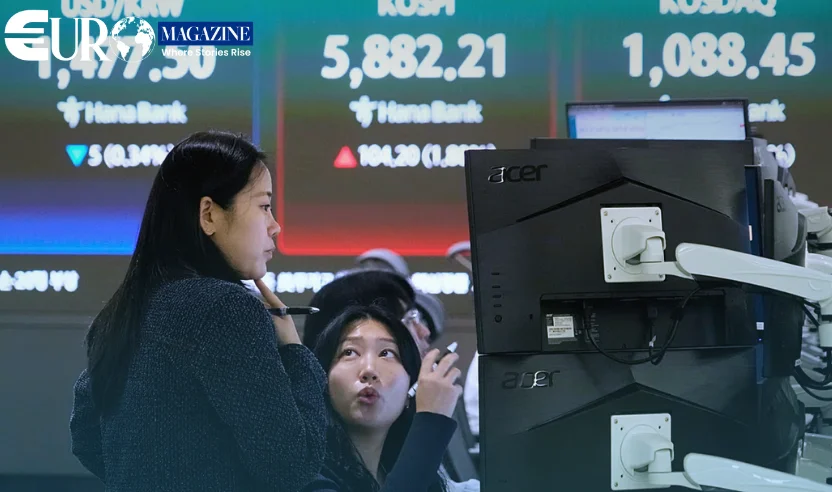
Markets reacted calmly to Lagarde’s remarks. The euro traded around $1.1730, while German 10-year bond yields remained steady near 2.85%. European equity markets rose, supported by softer-than-expected U.S. inflation data, with the Euro STOXX 50 up 0.8% and Germany’s DAX rising about 1%.