
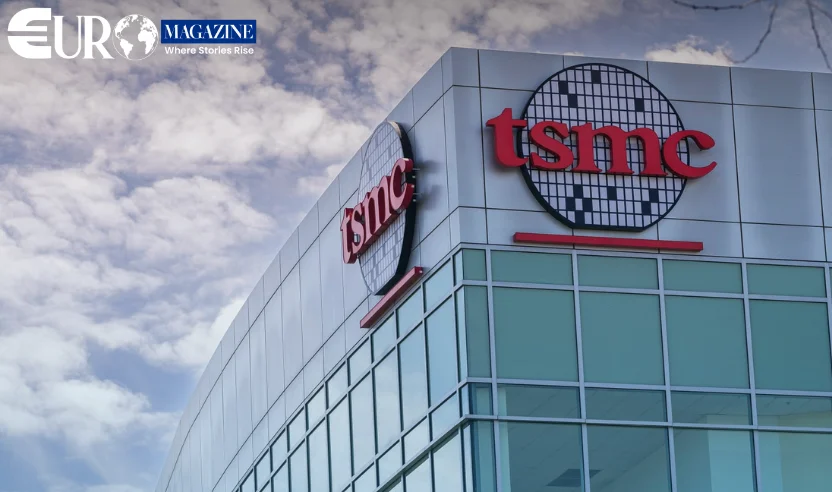
Taiwan Semiconductor Manufacturing Co. is preparing to accelerate its already massive U.S. investment programme, signaling that spending in Arizona will rise beyond the $165 billion it has committed so far as demand for artificial intelligence chips continues to surge.
The expansion comes as Taiwan Semiconductor Manufacturing Company (TSMC) posts strong earnings and benefits from a newly signed U.S.–Taiwan trade agreement that reduces tariffs on Taiwanese goods and encourages reshoring of advanced manufacturing.
Speaking to CNBC on Thursday, TSMC Chief Financial Officer Wendell Huang said the company has “strong conviction” in long-term AI demand and is increasing capital expenditure accordingly.
“We have strong conviction on the AI mega trend, and that is the reason we are stepping up capital expenditures to expand in Taiwan and in the U.S.,” Huang said, adding that the company aims to accelerate capacity where possible to meet customer demand.
TSMC, the world’s largest contract chipmaker, has already positioned itself at the centre of Washington’s push to rebuild domestic semiconductor production, a priority strongly backed by Donald Trump. The company is a key supplier to major technology firms including Nvidia and Apple.
Earlier on Thursday, Chief Executive Officer C. C. Wei told analysts that TSMC has acquired additional land in Arizona and plans to develop a large-scale “gigafab cluster” in the state. While the company has not disclosed the exact size of the next investment phase, it forecast capital spending for 2026 to rise by more than 30% at the midpoint compared with 2025.
The expansion also coincides with the signing of a U.S.–Taiwan trade deal that caps tariffs on Taiwanese goods at 15%, down from 20%. Under the agreement, Taiwanese companies are expected to commit $250 billion in direct U.S. investments across semiconductors, AI and related industries, alongside $250 billion in credit guarantees to strengthen supply chains.
Despite reports suggesting that TSMC’s Arizona expansion was linked to the trade negotiations, Huang rejected that view, saying the company was not involved in government-to-government discussions.
“The trade deal is between two governments, and we are not part of the discussions,” he said. “We are continuing to invest and accelerate our investment in Arizona because of customer demand.”
Progress at TSMC’s existing U.S. facilities appears to be reinforcing that strategy. Executives said the company’s first Arizona fabrication plant, which has already begun mass production, is achieving yields and technology levels comparable to its leading fabs in Taiwan.
“It demonstrates that our manufacturing excellence can be repeated in the U.S.,” Huang said, describing the milestone as significant for both customers and the company.
TSMC has also moved up the production timeline for its second Arizona plant to the second half of 2027, while construction on a third facility is accelerating. The company has begun applying for permits for a fourth plant, according to statements made during its latest earnings call.
Huang said TSMC’s original Arizona site, spanning 1,100 acres, was initially planned to host six wafer fabrication plants, two advanced packaging facilities and a research and development centre. Rapid expansion plans later prompted the purchase of an additional 900-acre site, providing flexibility for future growth.
TSMC shares were trading more than 2% higher in Taipei on Friday, reflecting investor confidence in the company’s expanding U.S. footprint and its central role in the global AI supply chain.