
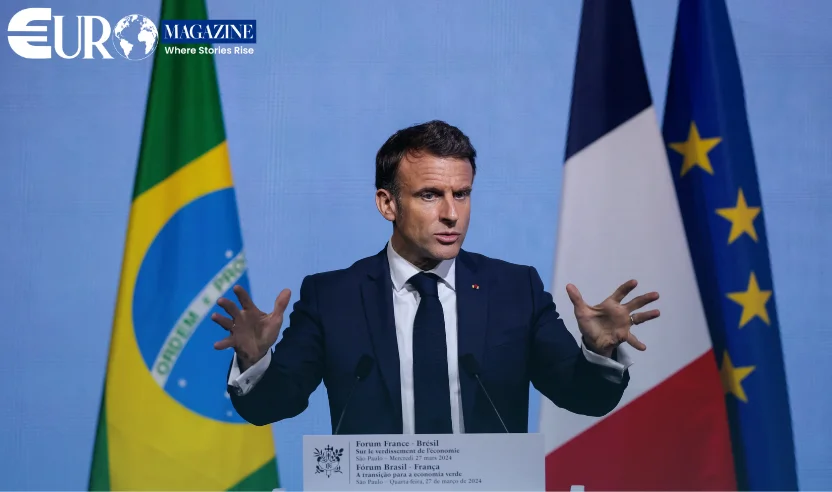
Brussels — France’s failure to block the long-negotiated Mercosur trade agreement has highlighted a deeper shift inside the European Union: President Emmanuel Macron no longer carries the political weight in Brussels that once allowed Paris to shape outcomes behind closed doors.
On Friday, the European Commission cleared the final political hurdle for the EU-Mercosur agreement, sidelining French objections despite weeks of domestic protests by farmers and mounting political pressure in Paris. The setback underscored how Macron’s weakened position at home has eroded France’s ability to mobilize allies at the European level.
The agreement, negotiated over more than two decades with Argentina, Brazil, Paraguay and Uruguay, would establish one of the world’s largest free-trade areas, covering nearly 700 million people. Supporters argue it would help Europe diversify trade ties at a moment when the United States and China are becoming more inward-focused.
France opposed the deal, citing concerns that cheaper Latin American agricultural imports would undercut European farmers. But diplomats said Paris struggled to turn those objections into a viable blocking minority, a reflection of diminished leverage following months of political instability.
Macron’s authority has been strained since he dissolved the National Assembly in June 2024, triggering prolonged parliamentary fragmentation and repeated threats of no-confidence votes. That domestic turmoil has increasingly limited his room to maneuver abroad.
Germany, Spain and the European Commission pressed ahead, framing the deal as a strategic necessity in a more volatile global economy. Italy, whose support France needed to form a blocking minority, ultimately backed the agreement after securing concessions for its agricultural sector, including early access to Common Agricultural Policy funds and protections on fertilizer costs.
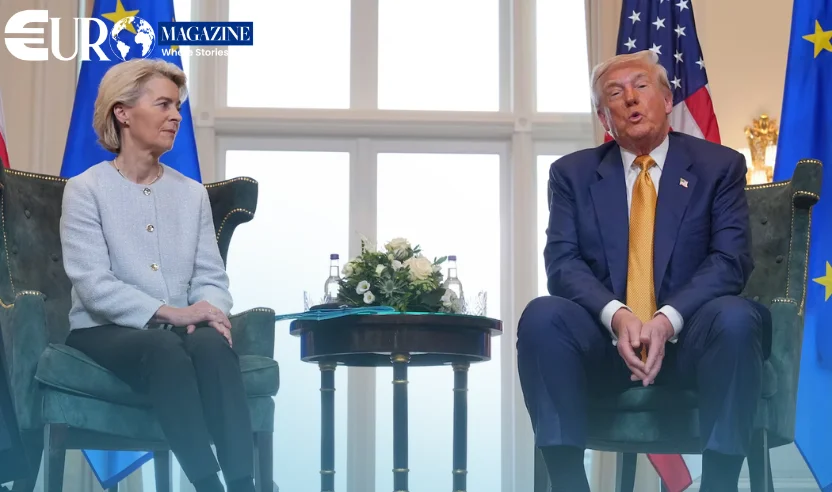
The outcome marked a clear win for Ursula von der Leyen, who has pushed forcefully to conclude the agreement despite French resistance. In previous years, opposition from Paris alone might have been enough to stall such a deal. That is no longer the case.
“France used to be able to stop a trade agreement by sheer political gravity,” one EU diplomat said. “That era appears to be over.”
Von der Leyen has steadily consolidated her authority since beginning her second term, capitalizing on France’s internal paralysis. Her decision last year to marginalize senior French commissioner Thierry Breton, once one of Paris’ most influential voices in Brussels, was widely interpreted as a sign of shifting power dynamics within the Commission.
While Macron ultimately replaced Breton with long-time ally Stéphane Séjourné, diplomats say the new commissioner holds a narrower portfolio and less clout, further limiting France’s influence inside the EU executive.
The Mercosur decision also exposed the contrast between France’s ambitions and its current constraints. Paris continues to shape debates on industrial policy, defense and European sovereignty, and Macron has remained an active voice on Ukraine, co-leading discussions on future security guarantees alongside British Prime Minister Keir Starmer.
Yet trade policy, where unity and coalition-building are essential, has become a weak spot.
The signing ceremony for the Mercosur agreement is scheduled for January 17 in Asunción, Paraguay. For Macron, the moment serves as a reminder that strong ideas and bold rhetoric carry less weight when domestic authority is fragile, especially in a European Union increasingly driven by pragmatism rather than deference.