
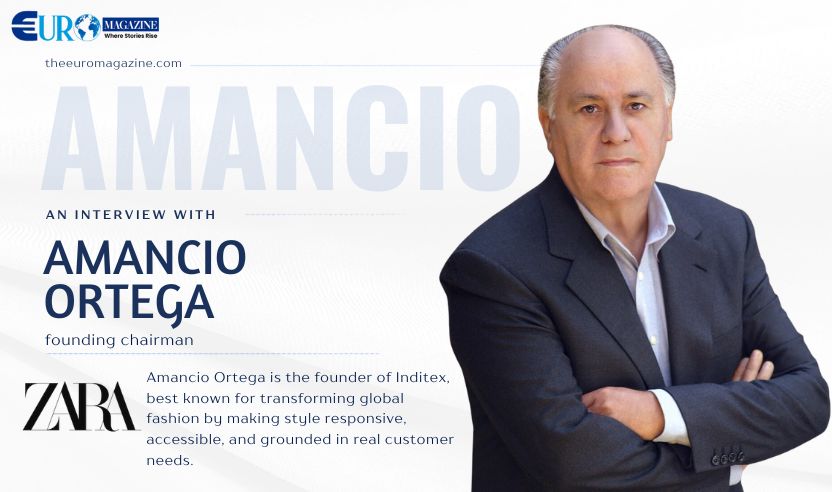
Growing up, I never envisioned global success or fashion renown. My life’s path was shaped not by grandeur or aspiration, but by work, observation, and a quiet belief that simplicity and efficiency can transform not just a business, but an industry.
I was born in 1936 in the small Spanish town of Busdongo de Arbas, in the province of León. My father was a railway worker, and my mother worked as a housemaid. We lived modestly, but my home was rich in values: dignity, humility, and respect for effort. It was not luxury that influenced me, it was necessity. From that early vantage point, I learned that clothing is more than fabric: it is confidence, identity, and dignity.
When I look back, I see a journey defined not by spectacle or sudden breakthroughs, but by countless decisions grounded in discipline, responsiveness to real human needs, and a fundamentally simple idea: fashion should be accessible, thoughtful, and rooted in practical understanding.
Early Life & Beginnings
I left school at the age of 14, not by choice, but by circumstance. My family needed support, and work became my first teacher. I found employment as a shop assistant in A Coruña, where I interacted with customers daily, learning not only about fabrics and styles, but about expectations, preferences, and the emotional connection people have with clothing.
I remember one moment clearly: a shopkeeper refused credit to my mother, a simple transaction that carried a deeper lesson. It taught me that access, affordability, and respect matter in commerce. That no matter someone’s background, they deserve products that empower rather than alienate. That moment stayed with me throughout my life.
My first jobs were about observation, watching how garments were handled, how customers spoke about quality, how production decisions affected pricing. I was not trained in design or business at the outset; I learned by watching, listening, and doing.
How It Started: From Making Bathrobes to Opening the First Store
In the early 1960s, I started working with fabric cutters and tailors, absorbing techniques and understanding how garments were constructed. Little by little, I began producing simple pieces, like bathrobes and basic shirts, in small workshops.
Then, in 1975, something changed. I opened the very first Zara store in A Coruña. It wasn’t conceived as a brand at first, merely a space where I could try ideas, test fabrics, styles, and most importantly, listen.
Zara wasn’t built on trends. It was built on reality.
Unlike other companies that planned seasons months ahead, Zara focused on the present, what customers wanted now, not what we imagined they would want later. Every collection was informed by direct feedback from the shop floor.
Interview: What Was Your Early Vision for Zara?
I never wanted to build an empire. My vision was much simpler: deliver clothes that people would enjoy wearing, garments that resonated with their tastes. I believed that fashion should not be exclusive or unattainable. Instead, it should be dynamic, responsive, and reflective of how people actually live.
I learned early that fashion is not just about design, it is about people. And to understand people, you must observe them closely, daily.
Developing a New Business Model: The Inditex Philosophy
As the Zara concept matured, I realized that success did not require one brand alone, but a system, one that could support multiple identities while maintaining responsiveness and operational excellence. This led to the creation of Inditex (Industria de Diseño Textil, S.A.), a platform designed to support brands under a common operational core.
Each brand, whether Zara, Massimo Dutti, Pull&Bear, Bershka, Stradivarius, or Oysho, has its own character, audience, and identity. Yet all share the same philosophy: listen first, then act.
We moved away from traditional fashion calendars. Instead of releasing collections seasonally, we released them in response to actual demand. The goal was not speed for its own sake, it was relevance.
What Makes the Inditex Model Unique
The uniqueness of Inditex is not just in its brands, but in its vertical integration. We designed, produced, shipped, and sold garments on a tightly coordinated timeline. Unlike competitors who outsourced or delayed key decisions, we kept control close.
Stores were not just sales points. They were data hubs. Every sale, every return, every customer interaction fed back into the system. Designers and planners used this information to adjust inventory, propose new silhouettes, and refine production.
Rather than distant management, this model created responsiveness, the ability to know what customers want while they still want it.
Interview: What Was the Biggest Turning Point?
The biggest turning point came when I understood that fashion is data, not prediction. Most fashion companies operated six to nine months in advance. I asked a simple question: Why plan that far ahead when the world changes this quickly? People’s tastes evolve faster than that. Markets shift. Cultures interact.
So I established a system that could react in weeks, not seasons. That capability became our greatest strength.
Leadership Philosophy: Presence Over Authority
I have never believed that leadership requires visibility. In fact, from the beginning, I preferred working quietly, directly with production teams, fabric cutters, and store managers. I believed, and still believe, that leadership is about creating clarity, removing obstacles, and empowering others.
Hierarchy creates distance. I preferred proximity, proximity to production, proximity to customers, proximity to reality.
Even as Inditex expanded globally, my approach did not change. I remained close to operations, focused on fundamentals, and avoided unnecessary complexity.
Expanding Worldwide Without Losing Identity
Global expansion was not about conquest. It was about listening to different cultures and adapting intelligently, without losing the core Inditex philosophy.
We never assumed that what worked in Spain would work everywhere else. In New York, Tokyo, Dubai, and Shanghai, we tailored our approach, not in design alone, but in understanding local rhythms, purchasing behaviors, and cultural preferences.
Expansion was never reckless. It was cautious, informed, and rooted in the belief that global relevance requires local sensitivity.
Life Outside Business: The Meaning of Simplicity
I have always valued simplicity. Public recognition has never been my pursuit, in fact, I avoided it. I believe that life away from work should be grounded in the same principles that guide good business: clarity, humility, and purpose.
Philanthropy has been an essential part of my journey. Supporting education, healthcare, and community development reflects a deeply held belief: success must be shared, not hoarded.
I do not measure life by awards or accolades. I measure it by impact, on people, on communities, and on systems that improve others’ lives.
Adapting to Contemporary Challenges: Sustainability & Digital Integration
The fashion industry today faces challenges that I could never have anticipated early in my career. Sustainability, digital transformation, ethical sourcing, these are not optional ventures. They are necessities.
But the principles that guided us from the beginning, efficiency, responsiveness, simplicity, and respect for consumers, remain relevant.
Sustainability is not a trend. It is an imperative. Reducing waste, improving materials, adopting circular models, these are not add-ons. They are fundamentals for the future.
Digital platforms extend our reach, but physical stores remain essential. The future lies in integration, not substitution.
Interview: What Is Your Advice to Young Entrepreneurs Today?
If I could give one piece of advice to young builders, it would be this:
Stay close to reality. Understand your customer before you pursue scale.
Success is not about shortcuts. It is about consistency, the discipline to do small things extraordinarily well, every day.
Avoid complexity that does not add value. Complexity often distracts from clarity.
Respect people, your teams, your partners, your customers. They are the real architects of progress.
Reflecting on Legacy and Impact
When I think about legacy, I do not think of numbers or market share. I think of influence, not as dominance, but as inspiration. Not as a spotlight, but as a standard of integrity.
I have never viewed fashion as superficial. To me, it is deeply human. Clothing is an expression of identity. It is how we show up in the world. When we help people feel confident, capable, and authentic, we participate in something meaningful.
Conclusion
My journey, from small-town beginnings to global impact, was never driven by ambition. Instead, it was driven by curiosity, discipline, and a relentless focus on understanding others. That focus, more than any innovation or strategy, became the heart of everything we built.
Inditex is not just a fashion group. It is a testament to what can be achieved when we listen first, act quickly, and remain grounded in purpose.
Success is not spectacle.
Success is consistency.