
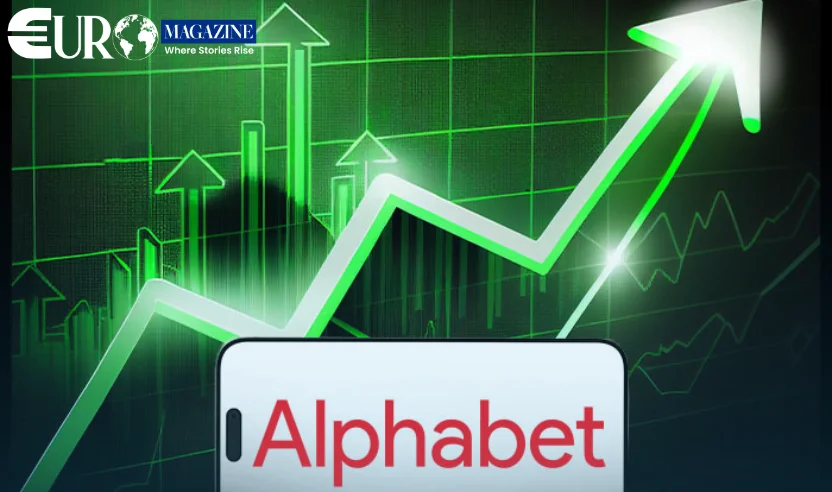
Alphabet has become the fourth company in history to reach a market valuation of $4 trillion, underscoring the continued investor enthusiasm surrounding artificial intelligence and large-scale digital platforms.
The milestone places Alphabet alongside Nvidia, Microsoft, and Apple, and makes it the world’s second-most valuable publicly listed company, behind Nvidia.
Alphabet’s share price has surged roughly 75% over the past year, with gains of nearly 7% since the start of January alone. Investors have increasingly gravitated toward companies seen as central players in the artificial intelligence boom, driving valuations to record levels despite persistent warnings about potential overpricing.
A key catalyst for Alphabet’s latest rally was Apple’s decision to integrate Google’s Gemini artificial intelligence model into an upgraded version of its digital assistant, Siri. While the financial terms of the agreement were not disclosed, analysts view the move as a strong endorsement of Google’s AI capabilities at a time of intensifying competition.
Following the rapid rise of generative AI tools such as ChatGPT, Alphabet accelerated its own development efforts, culminating in the launch of its Gemini 3 model. The system has received positive reviews for outperforming rivals across multiple benchmarks, including accuracy, coding performance, and its ability to combine text and visual outputs. Google previously said Gemini 3 achieved 72% accuracy on a widely used industry benchmark.
Alphabet’s scale and funding structure have also provided a competitive edge. Unlike AI-focused startups such as OpenAI and Anthropic, which rely heavily on continued external funding, Google benefits from substantial cash flows generated by its core businesses, allowing it to invest aggressively in AI development.
Even so, competition remains fierce. While Google has introduced an “AI mode” into its search engine, rivals have been pushing into adjacent territory. OpenAI and Perplexity have launched web browsers, while Microsoft has expanded its Copilot AI tool within its Edge browser, highlighting an escalating battle over how users access information online.
Market analysts say Alphabet has so far navigated these challenges effectively. Danni Hewson, head of financial analysis at AJ Bell, said Alphabet continues to innovate while avoiding the risk of becoming disrupted itself. She noted that the company’s ability to evolve beyond its traditional search-centric model has helped sustain investor confidence.
Regulatory developments have also played a role in shaping sentiment. Alphabet’s valuation received a boost after the conclusion of a major U.S. antitrust case in September, which ended without forcing a breakup of the company. While the court ordered Google to share certain search data with competitors, it allowed Alphabet to retain control of its Chrome browser. A separate U.S. trial examining the legality of Google’s advertising technology business is still pending.
Analysts emphasize that Alphabet’s valuation is supported by more than just search. Ben Barringer, head of technology research at Quilter Cheviot, said businesses including YouTube, cloud computing, and autonomous vehicle unit Waymo all contribute meaningfully to the company’s overall value.
Alphabet’s most recent earnings report showed stronger-than-expected results. Google Cloud revenue rose 34% to $15.2 billion in the third quarter, while YouTube advertising revenue increased 15% to $10.26 billion. Despite intense competition from Amazon Web Services and Microsoft Azure, Alphabet has expanded its cloud business by securing high-profile deals, including supplying up to one million specialized AI chips to Anthropic.
Barringer described Alphabet as a “sum-of-the-parts” company, with several businesses operating at the forefront of their respective industries. He said maintaining momentum will depend on stabilising search advertising revenues, sustaining growth at YouTube, and continuing expansion in cloud services.
However, he cautioned that Alphabet’s valuation remains demanding, and investors will be closely watching for signs that the AI-driven rally may be losing steam.