


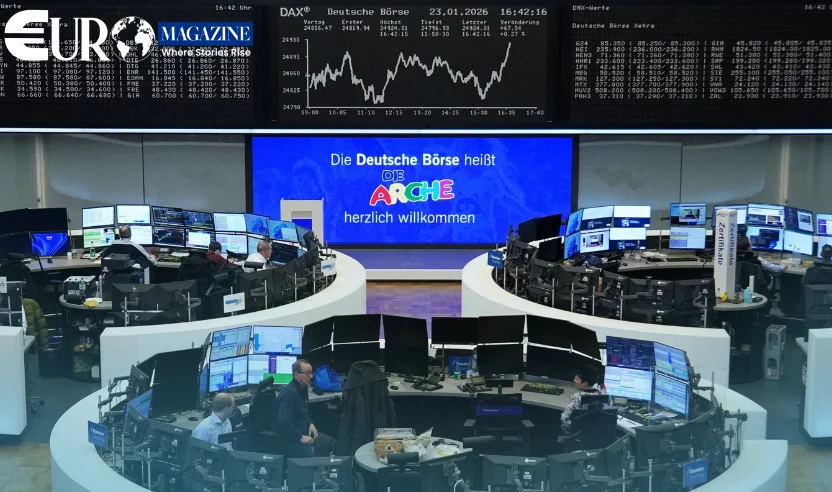
European stock markets climbed to record intraday highs on Wednesday as easing concerns over global tariffs and renewed strength in banking shares lifted investor sentiment.
The Euro Stoxx 50 rose more than 0.4% shortly after the opening bell, crossing an all-time intraday peak of 6,161 points. The broader Stoxx Europe 600 also advanced by over 0.4%, trading just below its historic high.
Across major European markets, gains were widespread. London’s FTSE 100 climbed 0.8%, Germany’s DAX moved above the 25,000-point mark, and France’s CAC 40 added 0.25%. Italy’s FTSE MIB also rose 0.8%.
Banking stocks led the rally. HSBC, Europe’s largest lender, surged more than 5% after releasing full-year earnings. Despite booking a $4.9 billion (€4.1 billion) one-off charge, the bank exceeded profit expectations and raised its net interest income target for 2026. Investors interpreted the update as a sign that the bank’s restructuring phase is largely complete, shifting focus toward revenue growth and shareholder returns.
Market anxiety linked to artificial intelligence disruption and global trade tensions also appeared to soften. Recent volatility had been driven in part by fears that rapid AI developments could pressure traditional business models, particularly in banking and industrial sectors.
Sentiment improved following news that US-based AI firm Anthropic partnered with several companies to launch new enterprise plug-ins. Investors viewed the move as evidence that established corporations are integrating AI technologies rather than being displaced by them.
Trade policy developments also remained in focus. US President Donald Trump recently proposed a 15% global tariff, with a 10% rate taking effect earlier this week. While the announcement initially unsettled markets, European equities showed resilience during Wednesday’s session.
Traders are now awaiting earnings from US chipmaker Nvidia, which are expected to provide fresh insight into global AI demand trends.
Investors are also monitoring upcoming eurozone inflation data, which could influence the European Central Bank’s next interest rate decision.