

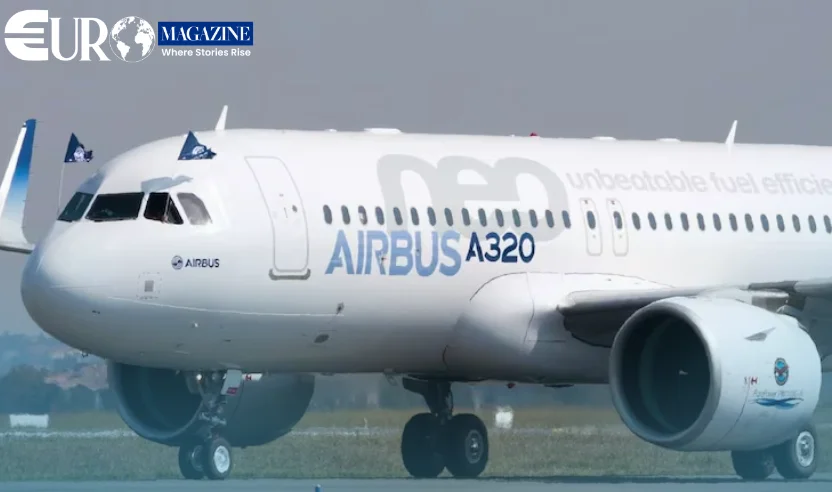
European aerospace giant Airbus reported a record financial performance in 2025, underscoring strong global demand for commercial aircraft. However, growing political support in Washington for US rival Boeing continues to shape competition in key overseas markets.
Airbus delivered 793 commercial aircraft in 2025, raising revenue by 6 per cent to €73.4 billion. The company posted an adjusted operating profit of €7.1 billion and net income of €5.2 billion. Free cash flow before customer financing reached €4.6 billion, while a dividend of €3.20 per share has been proposed.
Chief Executive Guillaume Faury described 2025 as a “landmark year,” citing strong demand across all business segments and record financial performance despite operational challenges.
Airbus shares, however, fell about 6.9 per cent to €186.9 in afternoon trading following the results announcement.
The company ended the year with gross orders for 1,000 aircraft and a record backlog of 8,754 jets, representing several years of secured production. Order intake across the group rose to €123.3 billion, bringing the total order book to €619 billion.
Despite the strong performance, Airbus continues to face supply chain constraints, particularly shortages of engines for its A320 family aircraft. The company is targeting around 870 aircraft deliveries in 2026 and an adjusted operating profit of approximately €7.5 billion, assuming no major trade or supply disruptions.
Faury acknowledged that production ramp-up plans are being affected by engine supply issues, specifically shortages linked to supplier Pratt & Whitney. He stated that global demand remains robust but operational bottlenecks continue to weigh on output.
While Airbus strengthens its commercial position, political dynamics in the United States are adding a competitive dimension to the industry’s long-standing rivalry.
Under President Donald Trump, Washington has intensified support for domestic manufacturing and defence exports. The US Commerce Department reported that government-assisted foreign contracts surged to $244 billion (€206 billion) in 2025.
Boeing’s net orders rose sharply to 1,075 aircraft in 2025, up from 377 the previous year. High-profile deals included a $96 billion (€81 billion) widebody aircraft order from Qatar Airways announced during a US Gulf visit, as well as $30 billion (€25 billion) in agreements signed by Vietnamese carriers during trade talks in Washington.
The developments highlight how aerospace competition increasingly intersects with trade diplomacy and geopolitical strategy.
Despite political headwinds, Airbus remains commercially strong, supported by sustained global demand for aircraft and a substantial production backlog. However, as transatlantic trade priorities evolve, record profits alone may not offset the strategic advantage that comes with strong political backing at home.