

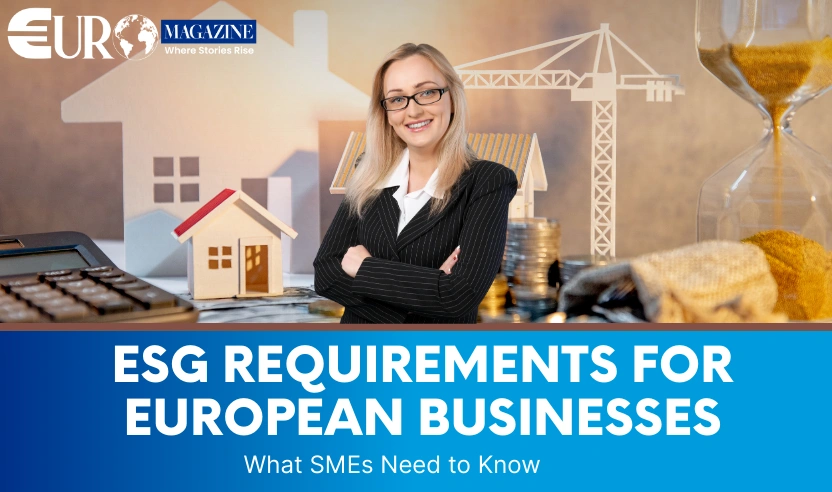
Environmental, Social, and Governance (ESG) requirements are no longer confined to large corporations, listed entities, or multinational groups. Across Europe, regulatory frameworks and market expectations are steadily extending sustainability obligations to small and medium-sized enterprises. For many SMEs, ESG has moved decisively beyond voluntary commitments or brand positioning. It is now a matter of operational readiness and commercial continuity.
This shift is driven by a convergence of forces rather than ideology. Regulatory expansion, supply-chain accountability, investor scrutiny, and financing criteria are collectively redefining what is expected from European businesses of all sizes. SMEs that recognise this transition early are better equipped to adapt without disruption. Those that delay often find themselves responding under pressure, with limited room to plan.
This article examines what ESG requirements mean in practical terms for European SMEs, how regulatory expectations are evolving, and what small businesses need to prepare for in the near and medium term.
Understanding ESG in the European Regulatory Context
ESG refers to three interconnected dimensions that assess how a business operates beyond traditional financial performance.
The environmental dimension focuses on how a company manages its impact on climate, energy consumption, emissions, waste, and natural resources.
The social dimension examines how businesses engage with people, employees, contractors, suppliers, customers, and communities, covering labour practices, workplace safety, inclusion, and human rights.
The governance dimension evaluates how organisations are directed and controlled, including leadership accountability, transparency, ethics, and risk management.
In Europe, ESG is not treated as a discretionary framework. It is increasingly embedded into binding regulation, financial supervision, and public policy. Unlike jurisdictions where ESG adoption remains largely market-led, European institutions have integrated sustainability principles directly into legislative and reporting structures.
Why ESG Expectations Are Expanding to SMEs
European policymakers recognise that sustainability objectives cannot be achieved by regulating large enterprises alone. SMEs represent the overwhelming majority of European businesses and are deeply embedded in regional economies and supply chains.
As a result, ESG obligations now reach SMEs through several channels:
-
Direct regulation, where thresholds and exemptions are gradually adjusted
-
Indirect exposure, through large customers subject to mandatory ESG reporting
-
Financial pressure, as banks and investors incorporate ESG criteria into risk assessment
Even SMEs that fall outside formal reporting requirements increasingly face ESG-related information requests from customers, lenders, insurers, and procurement partners. In many cases, compliance is no longer optional but implicit in maintaining commercial relationships.
Also Like This:- The Best U.S. States to Start a Business: A Complete Guide for Entrepreneurs
Key ESG Regulations Shaping SME Obligations
Corporate Sustainability Reporting Directive (CSRD)
The Corporate Sustainability Reporting Directive represents a significant expansion of Europe’s sustainability reporting framework. While it applies directly to large companies and listed entities, its implications for SMEs are substantial.
SMEs are affected indirectly when they:
-
Supply goods or services to CSRD-covered companies
-
Operate within regulated value chains
-
Provide operational data required for consolidated ESG reporting
In practice, this means SMEs may be asked to disclose information on emissions, workforce practices, governance structures, or environmental controls, even if they are not legally required to publish sustainability reports themselves.
EU Taxonomy Regulation
The EU Taxonomy establishes a classification system for environmentally sustainable economic activities. Although originally designed for financial institutions and large corporates, its influence now extends to SMEs seeking financing or participating in sustainability-linked supply chains.
Banks increasingly use taxonomy alignment to evaluate exposure and lending conditions. SMEs unable to demonstrate basic environmental performance may encounter higher financing costs or reduced access to capital.
Supply Chain Due Diligence and Responsibility
Emerging European regulations on supply-chain responsibility require companies to identify and mitigate environmental and social risks throughout their operations. This creates cascading obligations for SME suppliers.
In practical terms, SMEs may be required to demonstrate:
-
Ethical labour standards
-
Health and safety compliance
-
Environmental responsibility and traceability
These expectations are becoming standard elements of procurement and vendor assessment processes across Europe.
What ESG Means in Practice for SMEs
For SMEs, ESG compliance does not begin with complex sustainability reports or advanced metrics. In most cases, it starts with structure, documentation, and internal clarity.
Common ESG expectations at SME level include:
-
Basic tracking of energy and resource use
-
Documented employment and workplace policies
-
Clear governance procedures and codes of conduct
-
Reliable record-keeping and audit readiness
The emphasis is on consistency, transparency, and credibility rather than perfection or immediate sophistication.
Environmental Expectations: A Practical Starting Point
Environmental requirements often appear complex, yet they are typically the most measurable.
European SMEs are increasingly expected to:
-
Monitor energy consumption and efficiency
-
Reduce waste and improve recycling practices
-
Understand environmental impact at a basic level
For most businesses, this does not require full carbon accounting initially. It begins with utility tracking, supplier engagement, and incremental process improvements.
Social Responsibilities Within SME Operations
Social factors are often areas where SMEs already perform well, particularly in employee relations and workplace culture. However, documentation is frequently limited.
Key areas include:
-
Employment contracts and fair labour practices
-
Workplace health and safety
-
Equal opportunity and non-discrimination policies
Regulators and business partners increasingly expect written evidence of these practices rather than informal assurances.
Explore More:- How to Find and Choose the Right Small Business Idea for You?
Governance: The Foundation of ESG Credibility
Governance is frequently the least understood ESG pillar among SMEs, yet it is critical in assessments by banks, investors, and partners.
For SMEs, governance generally involves:
-
Clear decision-making authority
-
Financial transparency and controls
-
Ethical standards and risk awareness
Well-defined governance frameworks enhance credibility and support sustainable growth, particularly during expansion or ownership transitions.
Common ESG Challenges for SMEs
Despite rising awareness, SMEs face genuine obstacles in implementing ESG requirements.
-
Resource constraints, limiting dedicated sustainability roles
-
Regulatory complexity, especially across multiple EU jurisdictions
-
Data limitations, as systems were not designed with ESG in mind
These challenges explain why ESG adoption among SMEs often remains reactive rather than strategic.
How SMEs Can Prepare Without Overextending
Effective ESG preparation does not require immediate transformation. SMEs that succeed adopt a phased, proportional approach.
Practical steps include:
-
Identifying applicable ESG obligations and exposure points
-
Documenting existing practices before introducing new systems
-
Using simple digital tools for data tracking
-
Engaging specialised advisors selectively
Alignment with core business operations ensures ESG efforts remain sustainable rather than burdensome.
ESG and Access to Finance
Finance has become one of the strongest drivers of ESG adoption. European financial institutions increasingly integrate ESG criteria into lending and investment decisions.
SMEs with basic ESG structures often benefit from:
-
Improved access to credit
-
More favourable financing terms
-
Stronger institutional relationships
In this context, ESG functions as a commercial enabler rather than a regulatory cost.
Long-Term Implications for SME Competitiveness
Over time, ESG requirements will become increasingly standardised and embedded in business operations. SMEs that adapt early are better positioned to respond as expectations evolve.
ESG alignment can:
-
Strengthen supply-chain resilience
-
Improve operational efficiency
-
Enhance trust with partners and customers
The competitive advantage lies in preparedness, not compliance alone.
Conclusion
ESG requirements for European businesses are no longer limited to large corporations. SMEs are now an integral part of Europe’s sustainability framework.
For small businesses, the objective is not to master every regulation, but to build structured, credible systems that reflect responsible operations. When approached pragmatically, ESG becomes a stabilising force rather than an administrative burden.
SMEs that understand their obligations, prepare gradually, and integrate ESG into everyday decision-making will be better equipped to navigate regulation, secure financing, and remain competitive in an increasingly structured European market.
You can also read:-