
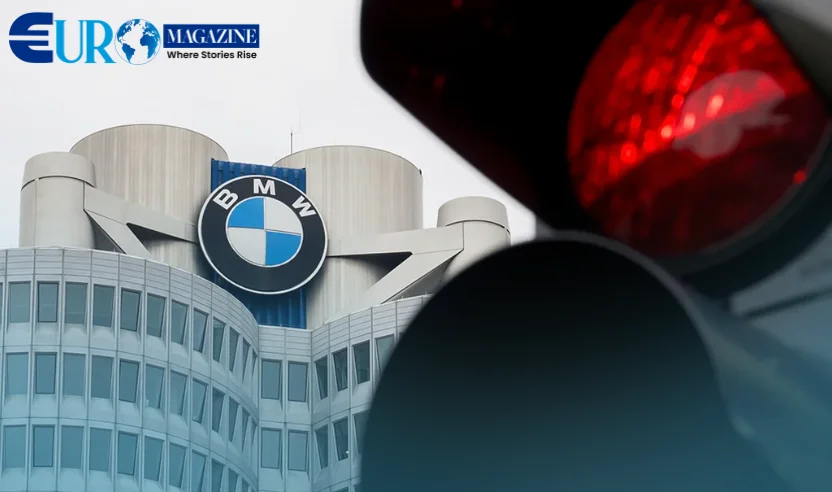
Munich — German automaker BMW reported a sharp drop in profits for 2025, as rising global tariffs and weakening demand in China weighed heavily on the company’s financial performance. BMW’s operating profit fell 11.5% to €10.2 billion, marking its lowest level since the Covid-19 pandemic. The company had reported €11.5 billion in operating profit the previous year, highlighting the growing pressure on Europe’s premium automotive sector.
The decline came as international trade tariffs and intense competition in China impacted the company’s margins and slowed growth in one of its most important markets.
Revenue and Net Profit Decline
According to the company’s financial results, net profit declined by about 3% to €7.5 billion, while total revenue dropped 6.3% to approximately €133.5 billion in 2025.
The automotive segment, which represents the core of BMW’s business, experienced the most pressure. Its earnings before interest and taxes (EBIT) margin fell to 5.3%, significantly below the company’s long-standing target range of 8–10%.
The weaker margin reflects a combination of rising costs, trade barriers, and slower demand in key markets.
Tariffs Weigh on Margins
Trade tariffs played a significant role in the company’s declining profitability.
Both US import duties and the European Union’s tariffs on Chinese-made electric vehicles, which affect BMW’s Mini brand, reduced margins by roughly 1.5 percentage points during the year.
BMW’s chief financial officer Walter Mertl said that without the tariff impact, the company would likely have reported profit growth in 2025.
Despite these pressures, the automaker managed to deliver approximately 2.46 million vehicles worldwide, representing a modest 0.5% increase compared with the previous year.
Europe and US Show Growth
While global results were mixed, BMW saw stronger demand in several regions.
Sales growth was particularly noticeable in Europe, where deliveries surpassed one million vehicles for the first time since before the pandemic.
The United States also recorded solid performance, with deliveries rising by about 5%.
However, the company’s performance in China, its largest single market, significantly dragged down overall results.
Vehicle sales in China dropped by more than 12%, largely due to fierce competition from local manufacturers offering increasingly advanced electric vehicles at competitive prices.
Electrified Vehicles Continue to Expand
Despite the broader slowdown, BMW’s electrification strategy continued to gain momentum.
The company delivered over 640,000 electrified vehicles globally in 2025, representing around 26% of total sales.
Fully electric models accounted for roughly 18% of all deliveries, indicating continued growth in the transition toward electric mobility.
BMW’s high-performance sub-brand BMW M also achieved a record year, delivering more than 213,000 vehicles worldwide.
Neue Klasse Platform Key to Future Strategy
A central element of BMW’s long-term strategy is its Neue Klasse vehicle architecture, designed to accelerate the company’s electric vehicle development while integrating advanced digital technologies.
The platform has already begun rolling out with the introduction of the BMW iX3, and the company expects the architecture to support a new generation of electric vehicles in the coming years.
Executives believe the platform will help improve efficiency, technology integration, and cost control as the company scales up its electric vehicle lineup.
Cautious Outlook for 2026
Looking ahead, BMW has issued a cautious forecast for 2026.
The company expects its automotive EBIT margin to range between 4% and 6%, with tariffs projected to reduce margins by around 1.25 percentage points.
BMW also warned that group pre-tax earnings could decline moderately in 2026, reflecting ongoing uncertainty in global markets.
Despite the challenges, BMW chief executive Oliver Zipse expressed confidence in the company’s long-term strategy.
“We have set the right course in recent years and do not need to change our strategic direction,” Zipse said.
“In this way, we can keep the company on track for long-term success.”
Daimler Truck Also Reports Profit Drop
BMW’s challenges come as other German manufacturers face similar pressures.
Daimler Truck reported a significant decline in annual earnings, with adjusted EBIT falling 19% to €3.78 billion in 2025.
Revenue in its core industrial business dropped 10% to €45.9 billion, while earnings per share fell 30% to €2.56.
The largest decline occurred in North America, where truck sales fell 26% to 141,814 units, reflecting weak freight demand and the impact of US trade policies.
Despite the decline, some divisions showed resilience.
Daimler Buses recorded its strongest profitability on record, achieving a 10% return on sales, while adjusted EBIT surged 39% to €599 million.
Meanwhile, Mercedes-Benz Trucks maintained relatively stable sales in Europe, suggesting that the region’s commercial vehicle downturn may be stabilising.
Daimler Truck chief executive Karin Rådström said operational improvements and new defence contracts—including a 7,000-unit order for Mercedes-Benz Zetros vehicles from the French Army—demonstrate progress in the company’s strategic repositioning.