
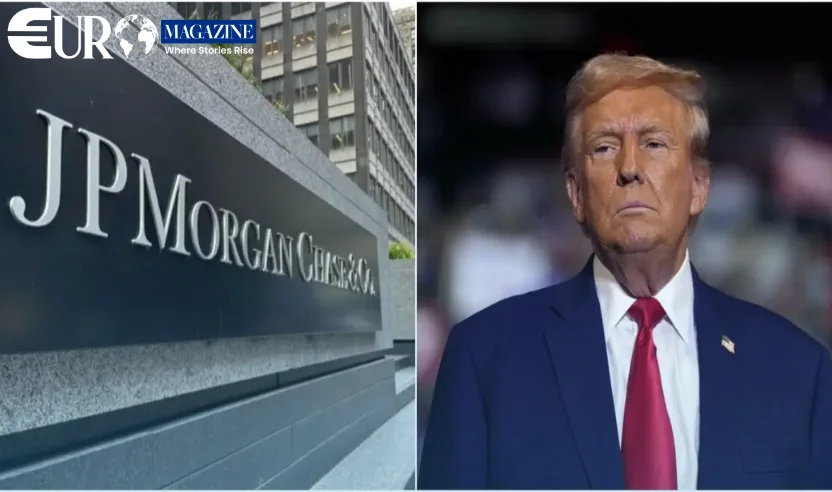
US President Donald Trump has filed a $5 billion (€4.26bn) lawsuit against JPMorgan Chase and its chief executive Jamie Dimon, alleging the bank cut him and his businesses off from financial services for political reasons following the January 6, 2021 US Capitol riots.
The lawsuit was filed on Thursday in Miami-Dade County court in Florida and claims JPMorgan abruptly closed multiple Trump-related accounts in February 2021 with just 60 days’ notice and without providing a clear explanation.
Trump alleges the closures disrupted his business operations, forced emergency banking arrangements elsewhere, and cut him off from millions of dollars in accessible funds.
Claims of Political Motivation
According to the lawsuit, JPMorgan’s actions were driven by what Trump describes as a shift in the political climate after he left office.
“JPMC debanked (Trump and his businesses) because it believed that the political tide at the moment favoured doing so,” the filing states.
Trump further claims he attempted to raise the matter directly with Dimon, who allegedly promised to look into the issue but failed to follow up.
The lawsuit also alleges that JPMorgan placed Trump and his companies on an internal reputational “blacklist”, preventing them from opening accounts at other major banks.
JPMorgan Rejects Allegations
JPMorgan has denied the claims, saying the lawsuit lacks merit.
“JPMC does not close accounts for political or religious reasons,” a bank spokesperson said. “We do close accounts because they create legal or regulatory risk for the company.”
This is not the first time Trump has pursued legal action over alleged debanking. In March 2025, the Trump Organization sued Capital One, making similar claims. That case remains ongoing.
Tensions Between Trump and the Banking Industry
The lawsuit follows renewed friction between the White House and major financial institutions. Trump recently threatened legal action against JPMorgan amid disputes over proposed credit-card interest-rate caps.
Trump has argued for limiting credit-card interest rates to 10%, a move banking executives have warned could disrupt lending markets. JPMorgan Chase is one of the largest credit-card issuers in the United States and has publicly opposed such caps.
Bank executives have also expressed concern over Trump’s criticism of the independence of the Federal Reserve.
What Is ‘Debanking’?
Debanking refers to a bank closing a customer’s account or refusing to provide services such as loans, payment processing or credit facilities.
While once a niche compliance issue, debanking has become politically charged in recent years. Conservative politicians have accused banks of discrimination under the guise of “reputational risk,” particularly following the Capitol attack.
Since returning to office, Trump’s administration has moved to limit regulators from allowing banks to cite reputational risk alone as a justification for denying services.
Others Who Have Raised Similar Claims
Trump is not the only political figure to allege politically motivated debanking.
-
Nigel Farage had his accounts closed by Coutts in 2023, sparking a national debate in the UK. While an independent review found the bank had contractual grounds to act, it criticised how the decision was communicated. The dispute was settled confidentially in 2025.
-
Marine Le Pen saw party and personal accounts closed by Société Générale and HSBC in 2017. France’s central bank later ruled the closures did not violate regulations.
-
In Germany, banks including Deutsche Kreditbank and Volksbank have closed accounts linked to politicians from the Alternative for Germany, prompting accusations of political targeting.
Banks Cite Compliance, Not Politics
Banks involved in debanking disputes consistently deny political bias, arguing that account closures stem from strict anti-money-laundering (AML), know-your-customer (KYC) and sanctions regulations.
Financial institutions are required to identify the source of funds, assess potential risks and conduct enhanced due diligence where necessary. Where risks cannot be adequately mitigated, banks may be legally obliged to terminate relationships, regardless of a customer’s political stance.
In several high-profile cases, banks have cited concerns over opaque funding, unverifiable donors or links to jurisdictions under heightened scrutiny rather than political ideology.
As Trump’s lawsuit proceeds, it is expected to intensify global debate over where compliance ends and political discrimination begins in modern banking.